
As part of a seminar series supported by the Algonquin College Office of Applied Research & Innovation and the Canada Green Building Council Ottawa Chapter, Jean Carriere, President and Building Performance Technologist at Trailloop gave a seminar on integrated energy modeling.
The seminar was intended to give an overview of how to design high performance buildings using leading edge methodologies to optimize energy usage and analyze life cycle costs.
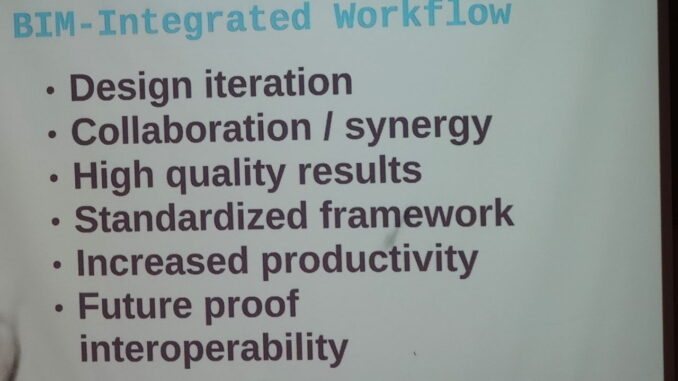
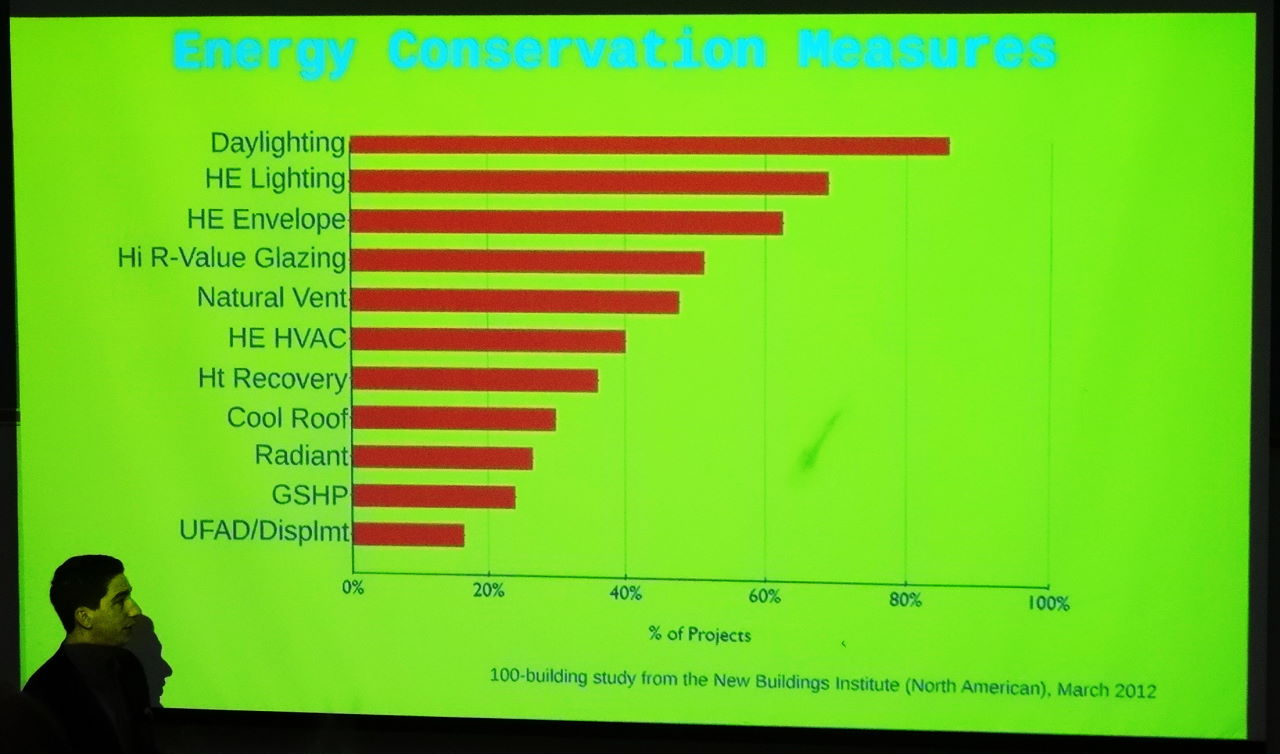 Integrative energy modeling is about optimizing energy usage over the entire lifecycle of the building for multiple objectives. An integrated project delivery process based on building information modeling (BIM) enables the energy performance designer to collaborate with others in the design team on a common platform. From a cost perspective, designing a building for efficient energy usage is more expensive in the early design and construction phases, but it reduces building costs over the entire lifecycle. LEED v4 includes a credit for using an integrated project delivery process.
The primary motivation for energy performance modeling is currently aggressive building codes that push energy efficiency, for example, customer driven certification such as LEED and other “green” certification, and financial incentives from local governments and power utilities to reduce energy consumption, peak load or both. LEED v4 incorporates up to 18 credits for demand response. The EU, US and Japanese governments have already mandated net zero energy, near zero energy and zero emissions for public and other buildings starting as soon as 2018.
BIM
While building information modeling (BIM) is not a requirement of energy performance modeling for buildings, Jean has found that it simplifies creating and maintaining a model that can be reused and it facilitates collaboration with engineers and architects who need to understand the results of the energy performance analysis. It also provides a degree of future proofing enabling the information stored with the BIM model to remain accessible throughout the lifetime of the building.
Jean not only uses BIM (Revit in his case) to create and maintain the spaces, walls, and other aspects of the building that are required for the energy performance analysis, but also as a visualization tool for presenting the results of the energy analysis to the mechanical engineers and others who need to understand heating and cooling requirements of the building at a very granular level.
The BIM model required for energy performance modeling does not require a lot of detail. Jean estimates that on the industry scale for level of development (LoD) or level of detail, an energy performance BIM model is about at level 250.
Jean tries to use industry standards wherever possible, either de facto standards like Revit for BIM design, or an industry standard like gbXML for migrating the model from the BIM design tool to the energy performance application. Jean use a commercial energy performance analysis IES-VE, but other tools can import gbXmL models such as the DoE’s open source EnergyPlus.
Jean uses a tool called BIMLink from Ideate to populate the BIM model with the results of the energy performance analysis. With Ideate BIMLink, you can pull information from a Revit file into Microsoft Excel and push BIM data from Excel into Revit. Jean uses BIMLink to push all the information that the mechanical engineers need to design lighting, heating and cooling into the BIM model, where is can be queried.
Jean relies on young graduates to develop the BIM models for his energy performance modeling projects and he finds that it is relatively easy to find recent graduates with Revit training to create and maintain BIM models.
Energy performance modeling
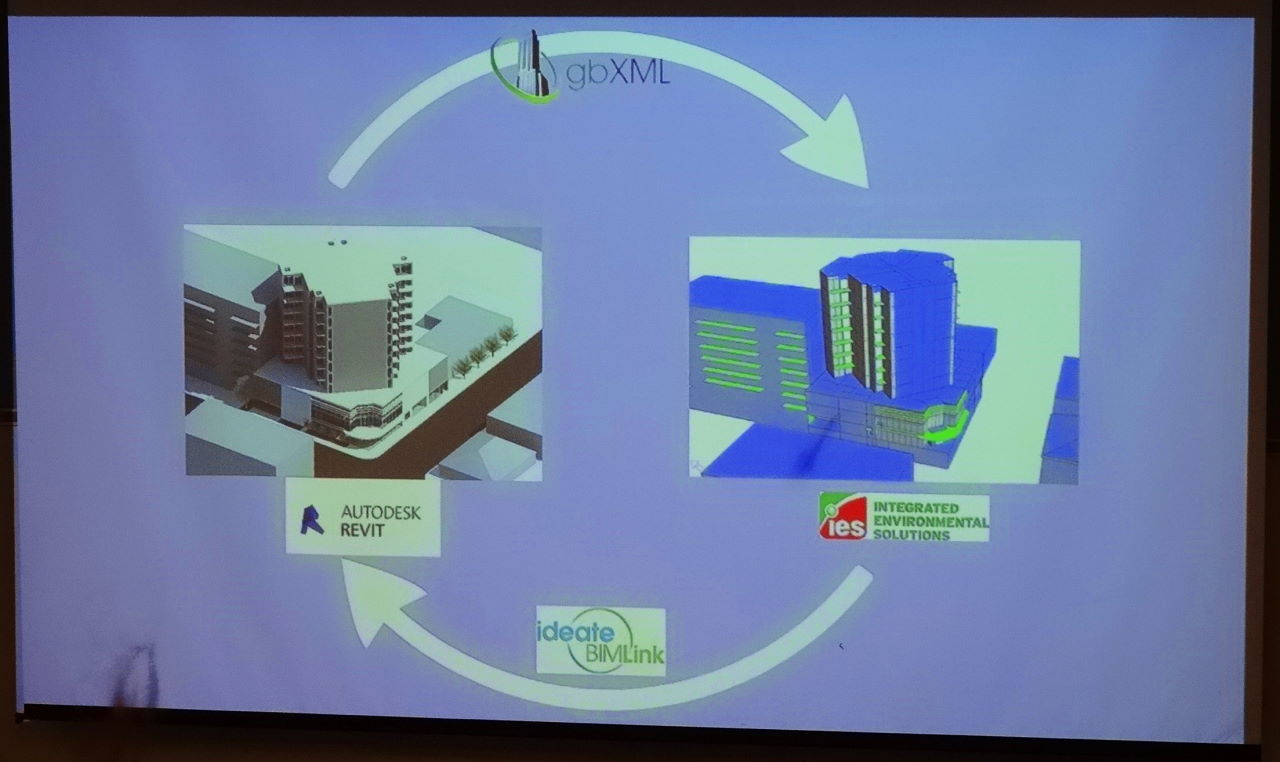 The typical process that Jean and his team typically follow to optimize energy usage for a new building is
- Use Revit to create a BIM model of the building. If there is an architect’s BIM model, an energy performance BIM can be derived from that or alternatively from CAD drawings. The model has to be very “tight” – not leave holes in walls or empty spaces. It doesn’t have to be complex, but all spaces have to be enclosed and all windows represented. This involves some tricky modeling for non-rectangular spaces, for example.
- Create custom schedules in Revit to provide an information framework for the data that is required as input for the energy performance analysis and for storing the results of the analysis.
- Generate the gbxML model from Revit.
- Import the gbXML model into IES-VE.
- Clean-up the model and add external features such as nearby buildings.
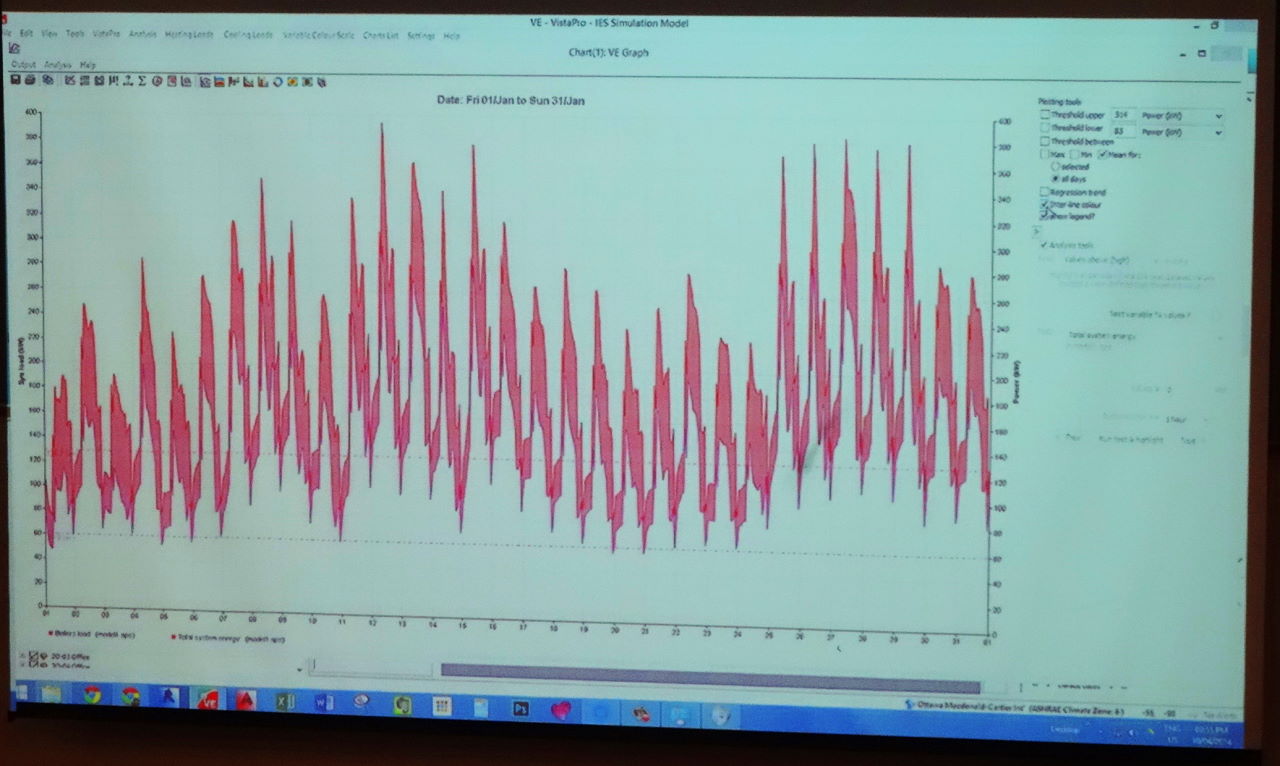
 Run the energy performance analysis.
- Export the results of the analysis from IES-VE into Excel and use BIMLink to populate the custom schedules within Revit.
- Make the BIM model with the results of the energy performance analysis available to the mechanical engineers.
- Collaborate with engineers so they understand why a room needs extra cooling or more artificial lighting, for example. This can result in changes to the building design.
- Iterative design – iterate this process to incorporate changes suggested by HVAC engineers.
Demonstration
Jean demonstrated elements of this process showing
- creating the Revit BIM model
- using Excel to create custom schedules for the BIM model
- generating and importing the gbXML model into IES-VE
- cleaning the model up in IES-VE
- exporting the geometry from IES-VE to simplify and get rid of extraneous objects
- reimporting the simplified geometry file
- using Excel to add room ids, thermal templates and other tabular information required for the simulation
- running simualtions such as thermal analysis, daylighting analysis, etc
- exporting the results back into the BIM model using BIMLink
Future
Jean foresees some important future developments
- Energy performance audit for existing structures – Jean foresees that a similar process could be used for existing structures, using scan to BIM to create a BIM model and an additional calibration step to ensure the base model reproduces the observed bldg performance.
- Operate and maintain (O&M) – Jean estimates that the BIM model incorporates 45 % of what facilities management (FM) would require to operate and maintain the building from an energy usage perspective.

Be the first to comment