
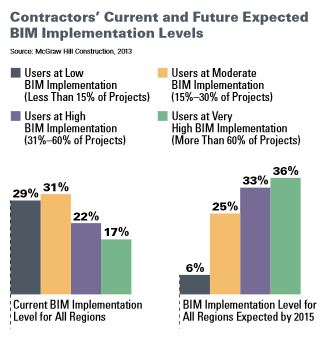
Building Information Modeling (BIM) has achieved incredible penetration in the vertical construction market in North America and in several Northern European and Asian countries. The McGraw-Hill Construction report Business Value of BIM in North America 2012 reports that overall Adoption of BIM has increased from 17% in 2007 to 71% in 2012, which represents 45% growth over the last 3 years. A McGraw-Hill SmartMarket Report suggests that BIM is also beginning to significantly impact the infrastructure or horizontal construction industry. In 2009 73% of firms reported no or low use of BIM on infrastructure projects. In 2013 only 21% of firms reported low or no use of BIM on horizontal projects.
A recent 2014 McGraw Hill Construction report analyzes survey data collected from construction companies that use BiM. The survey was conducted in nine of the world’s important construction markets. The data and analysis in this report are based on an online survey conducted with 727 contractors in ten countries: Australia, Brazil, Canada, France, Germany, Japan, New Zealand, South Korea, the United Kingdom (UK) and the United States (US).
According to the McGraw Hill analysis while BiM implementation has been underway for a long time in Canada, France, Germany, UK and the US some of the areas where BIM is just starting to penetrate markets including Australia, Brazil, Japan, Korea and New Zealand, are outperforming the more mature markets in several key categories of the research, such as ROI, commitment to investment, offering innovative new services and expanding the use of BiM to non-building projects like mining and manufacturing.
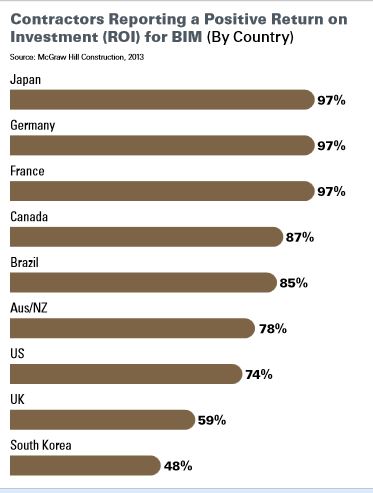 Three quarters of all respondents report a positive ROI on their investment in BIM. The largest percentage of firms estimate the ROI on their BIM investments to be between 10% and 25%. The analysis found that each region has different drivers that contribute to improving return on investment in BIM. Japanese, German and French contractors report the highest ROI on BIM investments, ahead of South Korea, the UK and the US.
The more deeply that construction companies become engaged with BIM, the greater their ability to realize benefits and to experience a very strong return on their investments in BIM. McGraw Hill Construction developed a BIM engagement index to measure the level of engagement for contractors. It is based on their experience, skill and the percentage of BiM projects they work on. The research found a clear correlation bewteen level of engagement and business benefits.
 Half of the contractors with the highest level of BIM engagement reported ROI exceeding 25% on their investment in BIM. Only 11% of the firms with the lowest level of engagement reported a similar level of ROI. The study found that BIM significantly reduced rework on projects for 40% of the highest BIM engagement contractors, compared with only 28% of respondents at a low engagement level.
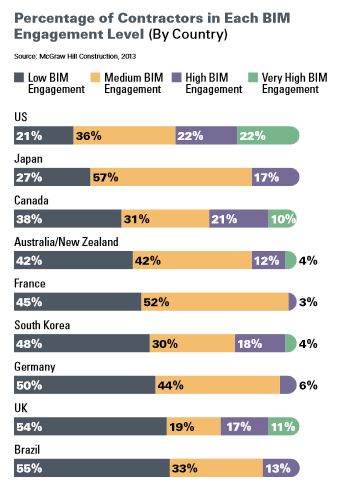
Engagement is also usefult in comparing regions in terms of their degree of adoption of BIM. The UK shows a very large percentage of low engagement users (54%) due to the recently announced government BIM mandates, but also has a relatively large population (28%) at high and very high engagement levels.
The US has both the lowest proportion of low-level users (21%) and the largest proportion of at high and very high levels (22% each). This reflects the very early adoption of BIM often encouraged by government policy.
The top two benefits that contractors reported receiving from BIM are reduced errors and omissions and reduced rework. Both of these provide immediate financial benefits and contribute to strong ROI. The next most important benefits are reduced construction cost, reduced project duration, and improved safety.
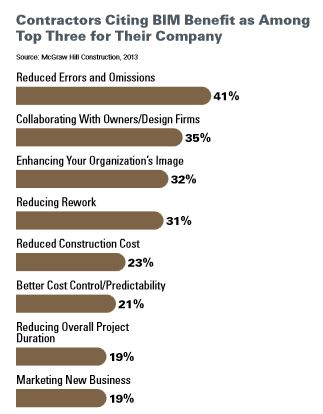 For all countries involved in this research, the top benefit of BIM was reducing errors and omissions, which also enhances other downstream benefits such as reducing rework, construction cost and overall project duration.
Leveraging BIM to improve collaboration with owners and design firms scored very highly with over a third (35%) of contractors. This reflects the trend toward greater integration among all team members on model-oriented projects.

Be the first to comment