
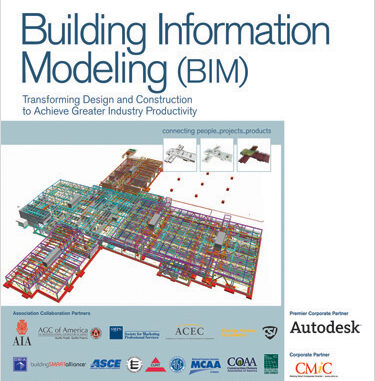
There’s a very interesting article The BIM Boom
that outlines some of the business reasons why engineers, architects, and contractors are increasingly using BIM and how the economic downturn is affecting the adoption of BIM.
that outlines some of the business reasons why engineers, architects, and contractors are increasingly using BIM and how the economic downturn is affecting the adoption of BIM.
Clash Detection
For many contractors, clash detection is the low hanging fruit and an application like Navisworks allows users to import models from different groups like HVAC, water, electrical systems into a single environment and show clashes, for example, where an elevator and a heating duct conflict. Clash detection makes collaboration easier so that these problems are identified and rectified digitally in the design, rather than during construction.
Estimation
The BIM model contains the quantities and types of materials so the data required to generate a bill-of-materials is in the model. Many contractors are using bridging technologies like Quantity Takeoff to pull the quantities from BIM models into a spreadsheet or other estimating system to compute estimates.
Sustainability Analysis
BIM also facilitates sustainability analysis for buildings helping engineers and architects to understand in the early design phase how the environment will impact building performance. Accurate predictions can be made for energy performance, carbon footprint, building code compliance, operating costs, and construction costs. For example, a sustainability analysis application can analyze the proposed building design as a BIM model and provides a baseline report on the proposed building’s net consumption of fuel, electricity, water, and other resources. It provides a summary for the building’s carbon output and, to make that figure easier to understand, provides an equivalent in the number of Hummer automobiles it would take to produce as much carbon. The types of analysis that can now be performed digitally include shadows and reflections, shading design, solar analysis, photovoltaic array sizing and load matching, lighting design, right-to-light, acoustic analysis, thermal analysis, and ventilation and airflow.
The Economy and Adoption of BIM
The economy also is having an effect on the adoption of BIM technology. Historically, economic slowdowns have had a positive impact on efficiency and contractors are increasingly seeing BIM as a way to improve their productivity. Recent surveys have shown that 40% of the ENR top 400 contractors are using BIM on more than 10% of their work. Some of the advantages of BIM in an economic downturn are described in a McGraw-Hill SmartMarket Report on BIM.
BIM Education
The Associated General Contractors of America, Associated Builders and Contractors, The American Society of Plumbing Engineers, Construction Management Association of America, and the Design-Build Institute of America all offer classes and/or Webinar informational sessions on the topic of BIM. And Autodesk has just announced the Autodesk Assistance Program for unemployed designers, engineers, and architects to upgrade their skills in BIM during the economic downturn.

Be the first to comment