
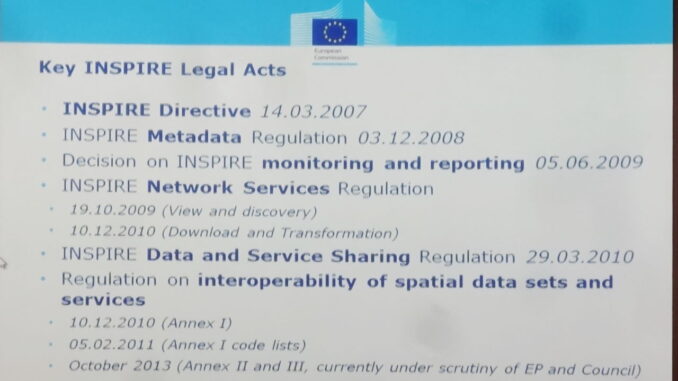
At the INSPIRE conference in Florence, Maria Betti, Director of the Institute for Environment and Sustainability gave an overview of where the INSPIRE initiative is today.
The original INSPIRE Directive was issued Mar 14, .2007, so it has been about a 5 to 6 year effort involving 30 countries and 23 languages. The major components
- Network Services Regulation
- Data and Services Sharing
were adopted in 2009/2010 and 2010/2011, respectively. The Data Specification Annexes II and III including 25 data themes (with Annex I a total of 34 themes), an incredible cross-disciplinary participatory effort by hundreds of experts and many organizations, has been accepted unanimously by the INSPIRE Committee and been adopted by the European Commission and just needs adoption by the European Parliament, which is expected by October 2013.
 So the first phase of INSPIRE has been completed and INSPIRE is now moving into the implementation and maintenance phase during which time a Commission Expert Group on Inspire Implementation and Maintenance will be responsible for it.
Business benefits
I blogged previously about some business benefits of INSPIRE reported by local governments. Maria Betti reported on a survey that was done among small to medium enterprises (SMEs) in the European information communications technology (ICT) sector.
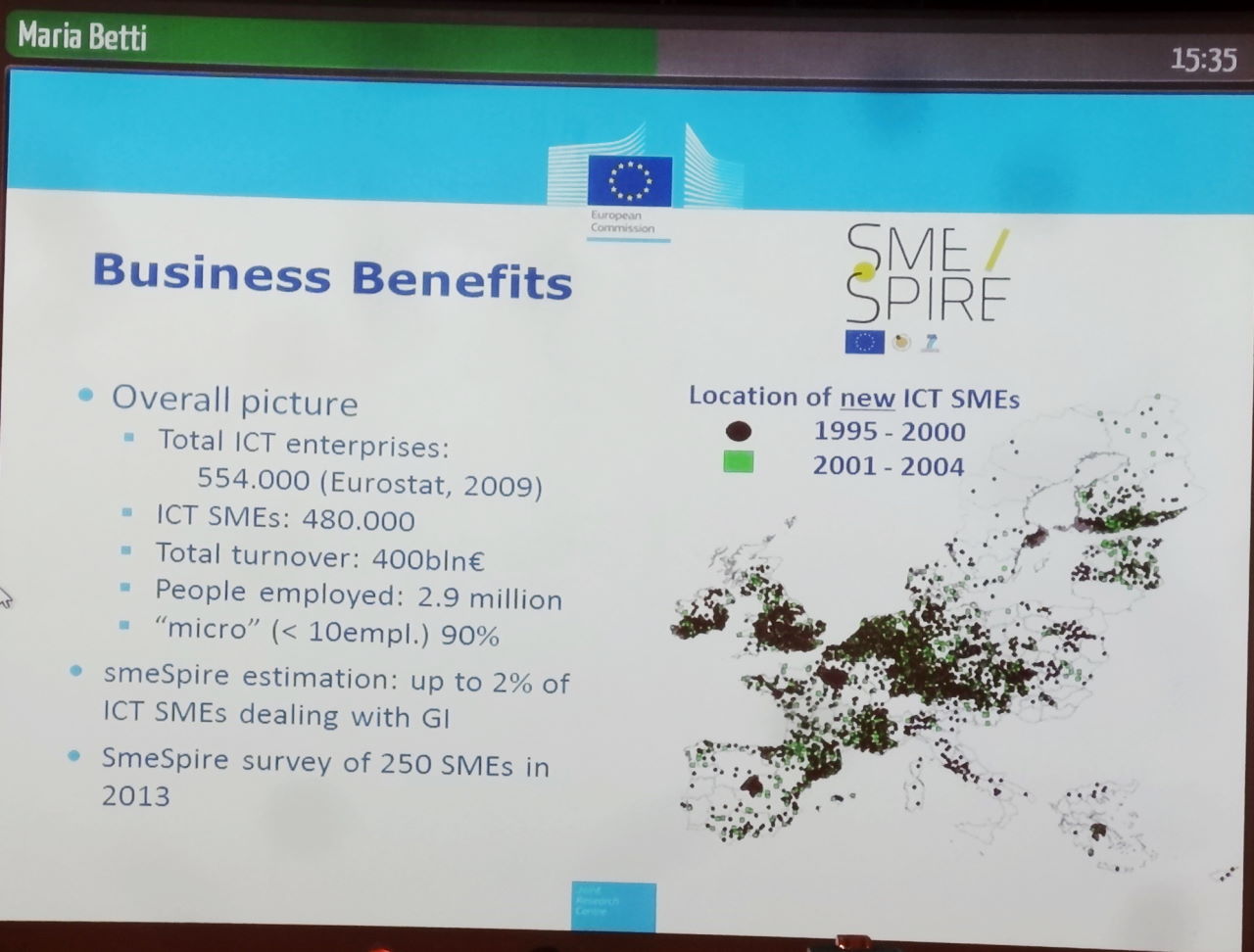
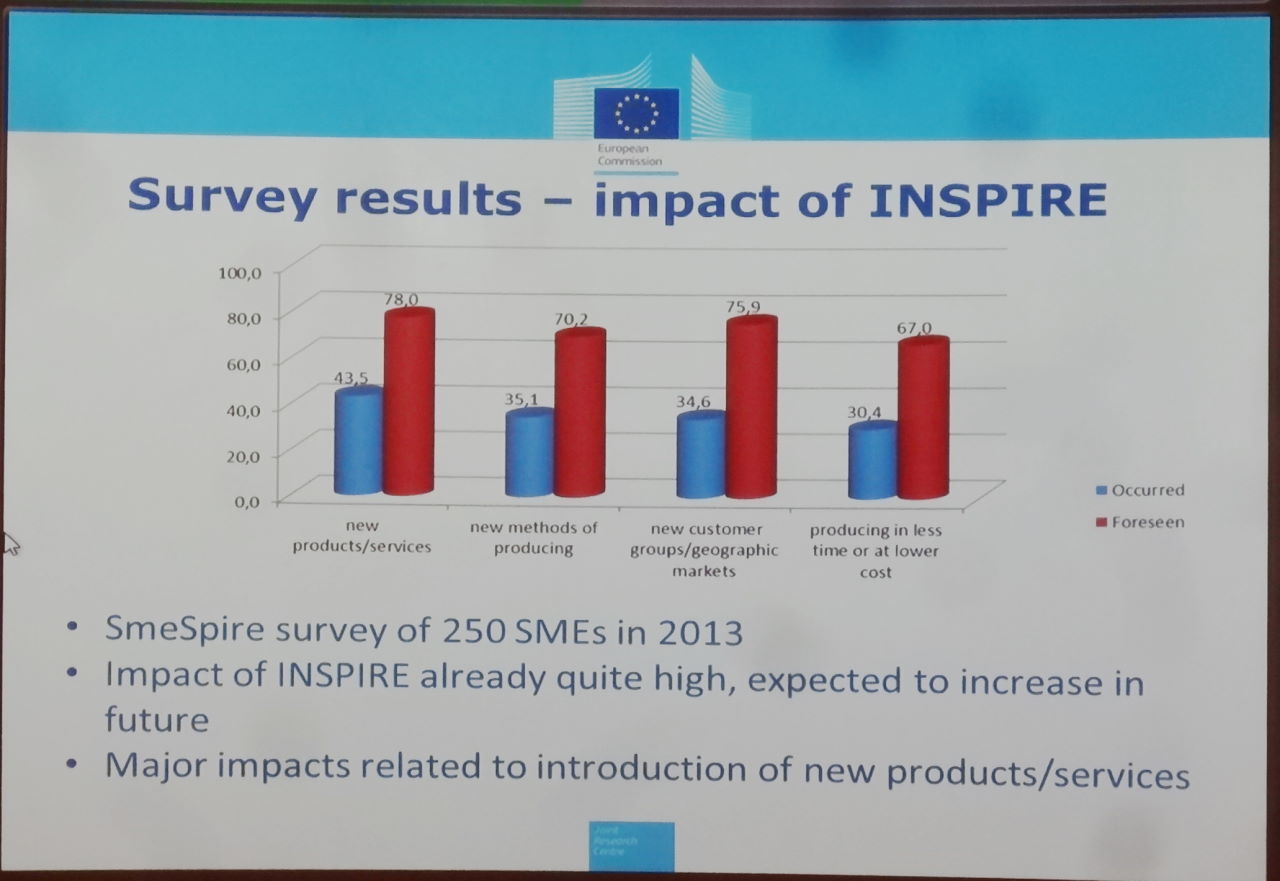 It is estimated that there are 480 000 of these small to medium enterprises in the ICT sector in Europe. 90% of these have less than 10 employees. Of these it is estimated that 2% of these are in the geospatial information (GI) segment. In 2013 SmeSpire conducted interviews with 250 of these GI SMEs. They found that the primary business benefits that have been realized by these SMEs are
- New products/services – realized 43.5% (foreseen 78.0%)
- New methods of producing procudts and services- realized 35.1% (foreseen 70.2 %)
- New customer groups/geographic markets- realized 34.6% (foreseen 75.9%)
- Producing in less time or at lower cost- realized 30.4% (foreseen 67.0%)
Maria Betti concluded that the impact of INSPIRE is already quite high among SMEs and it is expected to go much higher.

Be the first to comment