
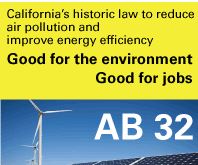
In 2006, the California Legislature passed and Governor Schwarzenegger signed AB 32, the Global Warming Solutions Act of 2006. Among other measures it
- Set California’s greenhouse gas emissions objective for 2020 to reduce GHG emissions to 1990 levels.
- Made reporting of GHG emissions mandatory for the largest industrial GHG sources.
- Establishes a system of market-based declining annual aggregate emission limits for sources that emit greenhouse gases. In 2011, the California
Air Resources Board adopted a cap-and-trade regulation. The cap-and-trade program covers major sources of GHG emissions in the State such as refineries, power plants, industrial facilities, and transportation fuels. The cap-and-trade program includes an enforceable emissions cap that will decline over time.
California’s cap-and-trade system
On Nov. 14 next week, California will launch its market-based “cap-and-trade” program of selling pollution
credits at auction. The objective is to reduce California’s greenhouse gas emissions by 2020 by about 17% compared to current levels.
Initially big polluters will be required
to buy pollution credits if they plan to emit greenhouse gases above
their allotted levels. In the first year about 350 industrial
businesses including cement plants, steel mills, food processors, electric
utilities and refineries have been issued free credits worth 90% of their current emissions. To make up the difference they must either cut emissions or buy credits. Companies that have more credits
than they need can sell them at an auction, and the state will also sell credits. Beginning in 2015, the program will be extended to
distributors of natural gas and other fuels.
Each credit permits the release of one metric tonne of greenhouse gases. The California Air Resources Board is responsible for the
quarterly auctions and has set a minimum bid of $10 per credit. It is
predicted that the price could rise to as much as $50 over the next eight
years.
Other carbon reductions schemes
The European Union already implemented a cap-and-trade system starting in 2005. There is also a Regional
Greenhouse Gas Initiative (RGGI) which includes electric power plants in the Northeast. The RGGI was the first market-based
regulatory program in the United States to reduce greenhouse gas
emissions. The states of Connecticut,
Delaware, Maine, Maryland, Massachusetts, New Hampshire, New York,
Rhode Island, and Vermont have capped and will
reduce CO2 emissions from the power sector 10 percent by 2018. This year Australia introduced a carbon tax, and is moving toward a cap-and-trade system. British Columbia introduced a carbon tax in 2008.

Be the first to comment