
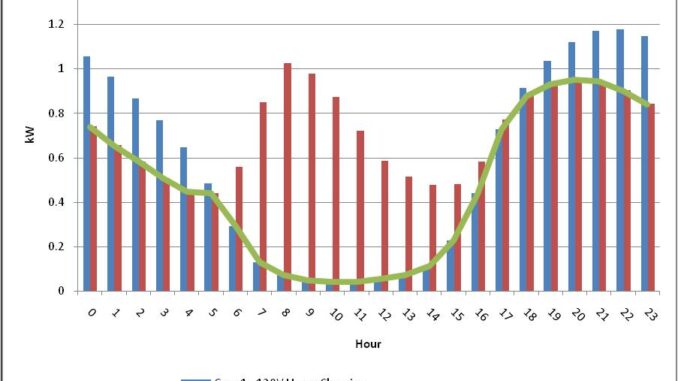
Many states have mandatory or voluntary renewable energy portfolios standards (RPS). Wind is the most widely deployed source of renewable energy in most of the US. Wind energy is variable and the intermittent nature of this source of energy creates imbalances on the power system that can be mitigated by electric storage capacity which currently is not available except in a few locations such as Niagara, where excess power capacity is used to pump water to reservoirs. A fascinating recent study by the Pacific Northwest National Laboratory (PNNL) looks at the possibility of using battery capacity in plug-in electric vehicles to mitigate imbalances from wind generation in the power grid.
Electric vehicles could be used for both charging and discharging pruposes, but apparently automobile manufacturers qare concerned about battery warranty issues if electric vehicles are used for discharging power back into the grid. Therefore, PNNL looked at two different charging scenarios. In the first electric vehicles are charged from the grid, but never feed power back into it. In the second electric vehicles are used for both charging and discharging.
The wind power scenario that PNNL has adopted is 2019 expected wind scenario where an additional 10 GW of wind capacity is added to the Northwest Power Pool (NWPP). Vehicle travel patterns are based on data from the 2001 National Household Travel Survey data.
The study concludes that under certain market scenarios and penetration levels, electric vehicles can provide a feasible resource for meeting the imbalance imposed by significant wind generation, but it will require a viable and compelling business model, either for the in dividual electric vehicle owner, or a third-party service provider.
PNNL finds that if about 13% of the existing light-duty vehicle stock (about 2.1 million vehicles) were electirc vehicles with a 33-mile electric range and could be charged both at home and at work, all of the additional balancing requirements of 3.7 GW could be provided by the electric vehicles.
If electric vehicles could be used for both charging and discharging, about 30 to 35% fewer vehicles would be required.
PNNL considered and interesting limiting case in which all the electric vehicles are available for charging and dischargign 24 hours per day, 7 days a week, basically a distributed stationary energy storage system. In this scenario only about 560,000 vehicles would be necessary to balance the intermittent wind energy.

Be the first to comment