
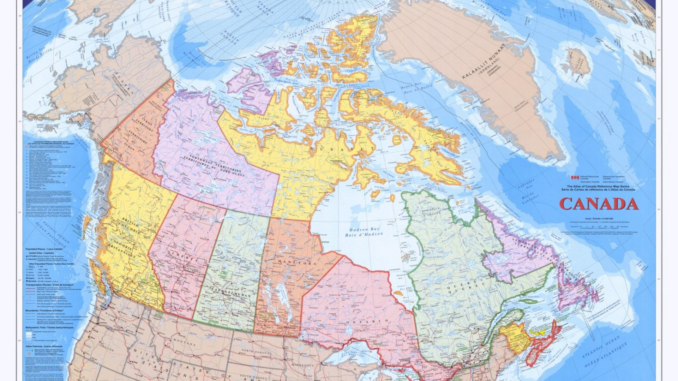
At the Geospatial World Forum in Geneva, as part of a ministerial panel discussion on government’s role in evolving geospatial policy for national and regional development, Prashant Shukle, Director General of the Canada Centre for Mapping and Earth Observation gave an overview of the Canadian Government’s plan for open access to federal government geospatial data.
Open data
In July, 2012 Tony Clement, Treasury Board President said that “Data is Canada’s new natural resource…” It is well-known that spatial information contributes significantly to the Canadian economy, in the range of billions of dollars. The Canadian Economic Value Study and Sector Scan, which is currently underway and will be completed this Fall, will put a more precise dollar figure on the value of spatial data and technology to the Canadian economy.
But the government recognizes that the true value of geospatial data to the Canadian economy will only be recognized by its liberation and use. Canada has taken a number of steps as part of the Open Government Action Plan 2.0. It has developed an open government license which removes restrictions on the reuse of all types of data published by the Government of Canada and aligns Canadian policy with international best practices to promote the re-use of Federal data as widely as possible. It has created an open data portal (data.gc.ca) which houses 191,608 datasets of which 96.5% are geospatial datasets. In addition it is working toward a pan-Canadian Open Data Strategy.
In June 2013 Prime Minister Steven Harper signed the G8 Open Data Charter, a set of norms and standards for the proactive release of high-quality data that is usable by all and is unrestricted in its use and re-use. All of this reflects a data policy where government data is published openly by default, not as the exception.
Sharing data within government
The new open data policy is helping the Canadian Government to transform itself. The Government’s Blueprint 2020 aims at encouraging open and networked, engaged citizens through policies and standards including standards for geospatial data, a standard for metadata, and shared services.
Within the federal govenment there is a growing need for geospatial data. In a FCGEO survey of federal departments in May 2012 94% of respondents reported increasing demand for and use of geospatially-related data to meet business requirements. 21 federal departments rely on geospatial data related to weather, resource development, endangered species, national parks, national defense, census data, public health and oceans management, and other topics. The challenge is to enable easy discovery and access to all federal government data holdings.
In 2012 the Government of Canada created the Federal Committee on Geomatics and Earth Observation (FCGEO) to work toward a whole of government, enterprise solution for geospatial and Earth observation data.
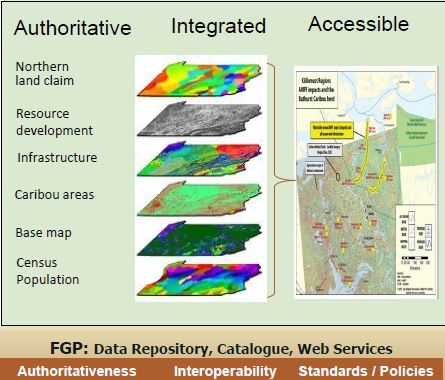 One of the FCGEO’s important initiatives is the Federal Geospatial Platform (FGP), which is intended to be a common “platform” of technical infrastructure, policies, standards and governance that will open up the government’s massive storehouse of geodata and imagery for new and innovative uses. This integrated national system is intended to reduce unnecessary duplication, fragmentation and overlap of geospatial services. Currently it can take weeks to months to find the data owner, acquire and manipulate the data, conduct the analysis and generate reports. The FGP is intended to enable users to “search once and find everything” within the federal government’s geospatial data and information holdings and reduce the time required to collect data and generate reports to hours. In addition the FGP’s visualization tools and analytics are intended to enable the public, private and academic sectors and individual Canadians to create new value from government data sources.

Be the first to comment