
Prashant Shukle, Director General of the Mapping Information Branch (MIB), Natural Resources Canada, gave an overview of the Canadian experience in developing a national spatial data infrastructure (SDI). He echoed the Minister of Natural Resource’s presentation the previous day in saying that mapping has been inextricably linked to Canada’s nation building, which is perhaps not surprising given that Canada is the second largest country in the world in terms of surface area. I hadn’t known that the Geological Survey of Canada was founded in 1842 (at that time in Upper Canada), that a legal survey was implemented in Canada in 1871, just a few years after Confederation, that the first atlas of Canada was produced in 1906, or that it was almost a hundred years after that that the atlas was put online. According to Prashant Canada was the first country in the world with an online national atlas. Together these initiatives provided the basis for the resource extraction industry, the parcel fabric (cadastre) and taxation, and the transportation network, pretty fundamental infrastructure for any country in the modern age. As I have mentioned seevral times, Canada developed the first geographic information system for the Canada Land Inventory.
GeoConnections, the formation of which as a Federal responsibility according to Prashant was suggested by the provinces and territories, was founded in 1999 with the objective of developing a standards-based Canadian geospatial data infrastructure (CGDI).
It is interesting that over the past few years, the Mapping Information Branch’s budget has shrunk by 43%, reflecting an increasing role for the provinces, territories, and the private sector in mapping and geospatial as well as the impact of technology in dramatically increasing the productivity of MIB geomatics practitioners.
Future
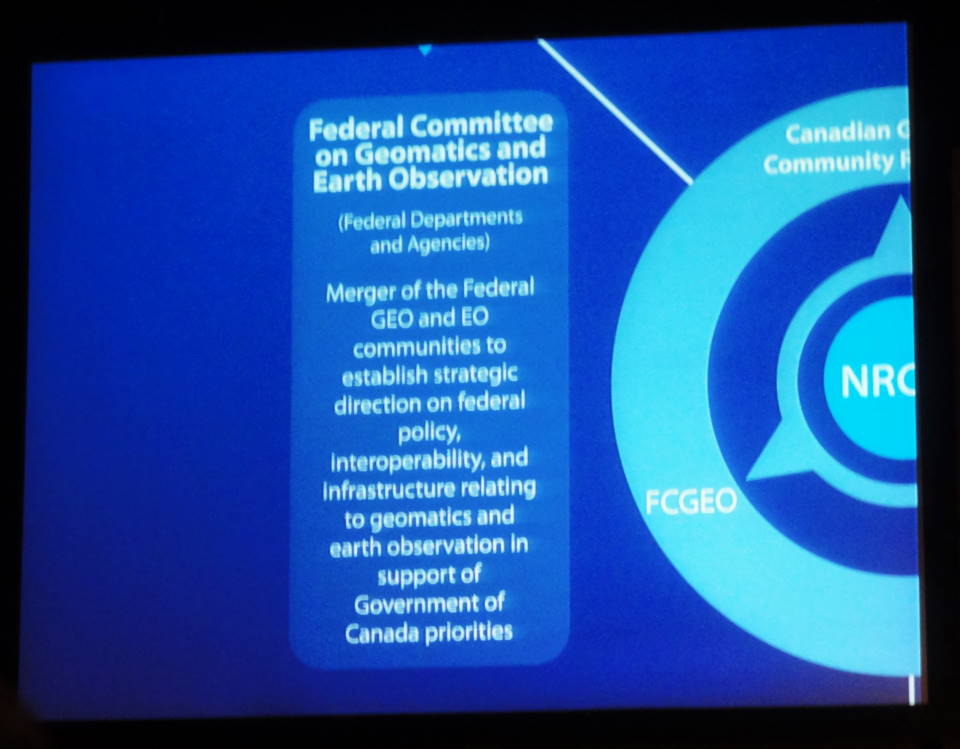 There are even greater changes coming in the the next few years. In the area of governance, there is a new combined Federal Committee on Geomatics and Earth Observation, that combines the responsibilities of existing committees including the Canadian Geomatics Community Roundtable and the Canadian Council on Geomatics.
The government’s focus on the citizen means that the open data initiative will continue to get attention. Prashant said that the government was even embracing volunteered geospatial data, also known as crowd-sourced, albeit in a cautious way that will ensure that it is trusted, verified and accurate.
The government will continue to encourage technology evolution through standards and interoperability. It plans to merge MIB and the Canadian Centre for Remote Sensing by 2014. A member of the audience in a comment/question after Prashant’s presentation who was familiar with the U.S. experience in attempting to do this, suggested that the very different cultures mapping and earth observation are makes integrating the two organizations a challenge.
There will be a continued focus on technical and scientific excellence. Prashant mentioned radar imagery in particular, which I assumed referred to MacDonald, Dettwiler and Associates Ltd. (MDA) existing Radarsat-2 and the proposed Radarsat Constellation programs.
In the future, the areas that will get increasing focus are the North including the national and international Arctic, water, the development of a Federal geospatial platform, modelled on the U.S. Geospatial One-Stop site, and participating in international organizations, including the UN’s GGIM initiative.

Be the first to comment