
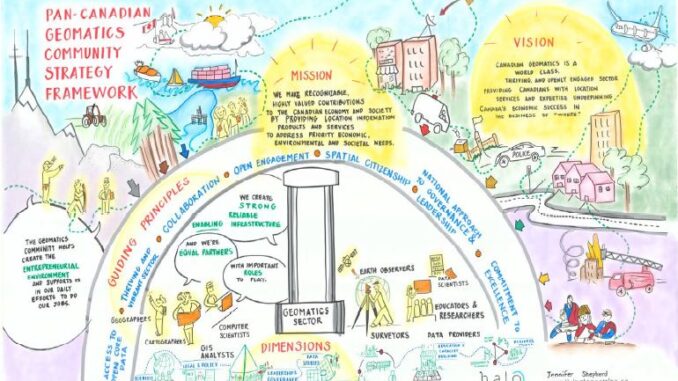
The Canadian Geomatics Sector employs 27,000 people. It provides geospatial information products and services to the user community for geospatially enabling decision‐making and policy planning. The Geomatics Sector is also responsible for the development and delivery of Canada’s network of spatial data infrastructure (SDIs) providing users with necessary “core” data services. Canada’s SDIs provide a set of geographic information, such as address, postal codes, roads, cadastre, and census data, including related metadata that is necessary for enabling geographic applications and service delivery. Canada’s SDIs includes government, private and community data services.
In Canada, the Geomatics Sector is defined as organizations and individuals providing technologies, products, data and services involving geospatial information capture and processing (including surveying); geospatial information analysis and presentation; integrated information products and services; and location‐based solutions.
In this context the Geospatial Community is defined as the broader community encompassing the Geomatics Sector plus the organizations and individuals that use the technologies, products, data and services provided by the Geomatics Sector.
To help bring this group of people together as part of a community focussed on geospatial data, technology and services, the Canadian Geomatics Community Round Table (CGCRT) was formed in 2010 as a collaboration between governments (federal, provincial, territorial, municipal and First Nations), industry, educators and students, and not-for‐profit organizations.
In November 2013, Natural Resources Canada (NRCan) sponsored a workshop on behalf of the CGCRT to initiate the development of a geomatics strategy document. Yesterday at an exceptionally well-attended meeting in Ottawa, the Canadian Geomatics Community Round Table (CGCRT) met to review a draft of the Pan‐Canadian Geomatics Strategy which was tabled at this meeting.
The Strategy has three parts.
- Vision, mission and guiding principles for the Geomatics Sector.
- Strategic objectives and recommendations
- An implementation approach to completing the Strategy
Yesterday the entire day was devoted to reviewing the strategic objectives and recommendations for the seven dimensions of the geomatics strategy.
Identity – A more cohesive and compelling geomatics story needs to be communicated to public, business leaders and politicians.
Market – Canada’s Geomatics Sector needs to respond to current and future geomatics market trends to position Canada as a leader in the rapidy expanding geospatial market. Traditionally the Canadian Geomatics industry has focused on meeting the demands of a narrowly focused geomatics marketplace. Solution providers in the Canadian Geomatics Sector are now faced with opportunities to address demands from a much broader Geospatial Community that is exploding well beyond the traditional sphere of activities serviced by the Sector.
Business Model – An appropriate business model is required to enable a healthy, viable Geomatics Sector supporting Canada’s diverse and expanding Geospatial Community.
Leadership and Governance – Governance provides structure to leadership, which is responsible for advice and direction, and finding resources and moving the strategic process forward through consultation.
Education and Capacity Building – Ensuring that we have the Canadian Geomatics workforce and geospatially‐enabled society of tomorrow
Data Sources – Canadians are using more geospatial data for decision making than ever before – and that use is growing. Core data holdings in the network of Canadian SDIs needs to be improved, enabling the effective use of all geospatial data sources. Assigning custodial responsibilities for maintaining and distributing core data helps to ensure confidence that the data being used is Accurate, Authoritative and Accessible (AAA).
Legal and Policy Interoperability – A harmonized, interoperable legal and policy framework is required that enables the creation, access and use of geospatial data in Canada.

Be the first to comment