
The Conference Board of Canada estimates that the global market for water and wastewater is in excess of $450 billion (2008), with annual growth of 8% to 15%.
Water consumption in Canada is excessive because of the lack of widespread water conservation practices and because of water pricing that
does not promote efficiency.
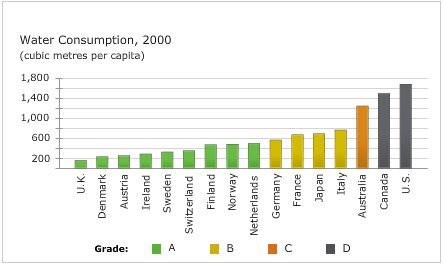
- In 2000 Canada ranked 15th out of 16 peer OECD countries
- Canada’s water consumption is more than double that of the 16-country average
Over a decade ago, Environment Canada warned that without increasing the price of water consumption, delivery infrastructure was at risk of deteriorating beyond usability. Water revenues are not sufficient to cover operational, repair, upgrading, or expansion costs. The cost of maintaining municipal water supply and sewage systems is estimated at $23 billion over the next 10 years.
In 2000 Canadians used over 300 litres of water per person per day. Canada’s water consumption per capita was over nine times greater than the U.K.. Only the U.S. consumed more water per person.
Industry is Canada’s largest water user, using 68 per cent of the total water used in Canada in 2000. Of the industrial water users, thermal-electric power producers withdraw almost 80 per cent. Manufacturing industries use just over 19 per cent. Domestic water use accounted for 20 per cent of total water use in Canada. Agricultural water use accounted for 12 per cent of total water consumption in Canada. While many countries in the OECD have decreased water consumption, Canada’s water usage has increased considerably. Between 1980 and 1997, overall water use in Canada increased by 26 per cent, five times more than the overall OECD increase of 5 per cent.
Only 57 per cent of Canada’s urban population was metered in 1999. Furthermore, municipal water rates in Canada are a fraction of those in other countries and among the lowest in the OECD. Consequently, a significant proportion of Canadians have little economic incentive to use water efficiently.

Be the first to comment