
Beginning in 2007 the European Union made CCS an integral
part of EU energy policy. The European Commission’s energy strategy
published in 2007 recommended developing low-CO2 power generation from
fossil fuels by 2020. In 2008 the European Commission adopted this
proposal. Since then the ETS 2009 Directive amends the original Trading
Scheme to include additional allowances to finance renewable
technologies and CCS installations. The CCS Directive 2009 defines a
carbon capture readiness policy requiring that new combustion power
plants generating over 300 MW need to be built to be CCS-ready. By the
end of 2009, six CCS demonstration projects
were selected to receive European Energy Recovery Program funds. But the development of CCS has not progressed at the pace initially foreseen.
The German decision to shutdown its nuclear power plants and replace
them with renewable sources and coal-fired power plants has created
additional impetus for CCS in the EU. German electricity generation has been about one half coal and one
fifth nuclear. In September 2010
the German Government released a 40 year masterplan
for revolutionizing the German energy supply, but continues the use of coal-fired power generation.
- increase offshore wind power generation to 25 gigawatts by 2030 costing about €75 billion
- expand biomass production including importing bio fuels
- increase solar power capacity to 51 gigawatts by 2020
- continue to use coal for power generation
- test carbon capture and storage (CCS) technology by building two test plants with long-term CO2 storage in Germany by 2020
But cost remains an important barrier to the uptake of CCS. Capture in particular is an expensive component. Flue gas from coal- or gas-fired power plants contains relatively low concentrations of CO2 (10-12% for coal, and around 3-6% for gas), and the energy needed to capture at such low concentrations imposes a significant efficiency penalty and thus additional cost.
In March 2013 the European Commission published a Consultative Communication on the future of CCS in Europe to stimulate discussion on how best to promote its development. The Communication identifies the barriers that have prevented CCS from progressing in Europe at the pace initially foreseen and discusses options for promoting its timely demonstration and early deployment and for strengthening the long-term business case for CCS. It invites stakeholders’ views on the best policy framework for achieving this.
In the U.S. there appears to be a consensus that the cost of retrofitting carbon capture and storage (CCS) to coal-fired electric power plants is simply not attractive at the present time because of the low cost of other power generating options especially combined cycle gas turbines (CCGT). A major factor is the continuing low price of natural gas in the U.S.
CCS for non-electric power industries
The third Clean Energy Ministerial meeting (CEM3) in London in 2012
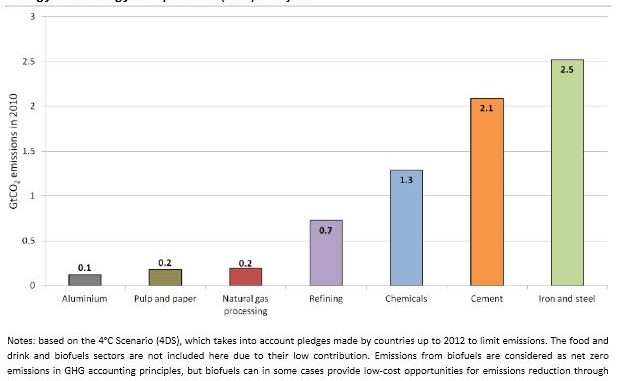
identified CCS in industrial applications as a crucial area for action. According to the International Energy Agency (IEA) energy‐intensive industries account for one-fifth of total global CO2 emissions. Cement, iron and steel, chemicals and refining are expected to increase their CO2 emissions over the coming decades. Carbon capture and storage (CCS) is currently the only large-scale mitigation option available to cut the emissions intensity of these sectors. CCS is already proven in some industrial sectors such as natural gas processing. But for key sectors such as cement, iron and steel, and refining, CCS has not reached the commercial-scale demonstration stage. Analysis by the IEA suggests that CCS in industrial applications could represent around half of the emission reductions achieved through CCS by 2050.
The IEA is recommending funding ten pilot and demonstration‐scale projects to show the technical and
economic feasibility of large‐scale CO2 capture in sectors such as iron and steel and cement The IEA also makes policy recommendations that aim to provide governments with tools to prepare the ground for CCS to make a significant contribution to agreed climate targets, starting in the next decade.

Be the first to comment