
Chattanooga’s power company Electric Power Board (EPB) is one of the most advanced with respect to adopting smart grid technology in North America. At HXGNLive in Las Vegas, Ken Jones reported quantified benefits that EPB has found from its investment in smart grid technology. These include 65% reduction in customer outages and 52% reduction in outage minutes and savings of $23 million in restoring outages after a recent severe storm.
About five years ago I first heard about the remarkable transformation of the power grid in the Chattanooga, Tennessee, a city with a population of about 180,000. With the help of the Department of Energy and other partners the local power company Electric Power Board (EPB) saw the smart grid as not only benefiting the utility and improving the quality of life of its cusomers, but also as a driver of economic development. Early on EPB decided to deploy one of the country’s highest capacity fiber-optic networks to improve power quality, reliability, customer service and energy efficiency. Chattanooga is one of the few municipalities anywhere with 10 Gbit/sec internet speeds for both urban and rural customers. Currently over 50% of EPB customers subscribe to the fiber service. EPB has estimated that the incremental economic and social benefits of the high capacity backbone for Chattanooga lie between $865.3 million to $1.3 billion. Furthermore, somewhere between 2,832 and 5,228 jobs have been created linked to EPB’s infrastructure investment.
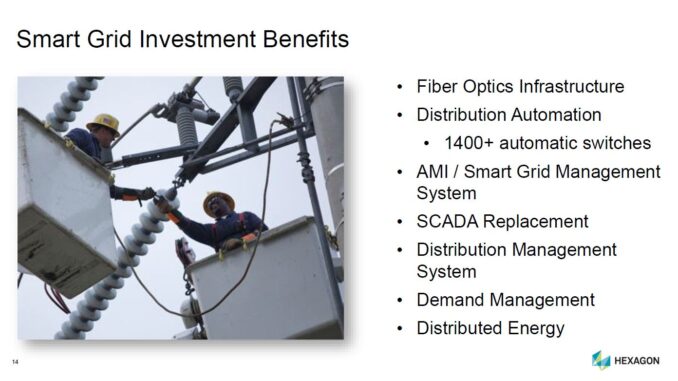
In addition to the fiber backbone, EPB has installed 1400 automatic switches, an AMI management system, a distribution management system (DMS), and support for demand management (DM) and distributed energy (DRE).
At HxGNLive in Las Vegas Ken Jones of EPB presented some of the very impressive quantified benefits that EPB has realized as a result of these investments in fiber and smart grid technology.
Reliability
| Reduction in customer outages | 65% |
| Reduction in outage minutes | 52% |
Annual operating savings
| Meter reading | $2.0 million |
| Field services | $0.7 million |
| Demand charges | $3.0 million |
Environmental benefits (CO2 emissions reduction)
| Reduced truck mileage | 400 tons/year |
| Demand management kWh reduction | 1000 tons/year |
| Power factor improvement | 2000 tons/year |
In addition EPB has developed a solar farm of 4,400 panels generating about 2 million kWh/year. Anyone can buy into this starting at just $5/month. Ken gave examples of local firms that completely offset their power usage with solar power.
One of the interesting steps that EPB has introduced to help customers monitor their power usage is a mobile app MyEPB. The app provides real-time energy usage and usage comparison by day, week, and month, real-time outage reporting for the EPB service territory, support for customers to report outages, and billing alerts, for example, notify me when my monthly bill reaches $50. To date there have been 30,000 downloads of MyEPB.
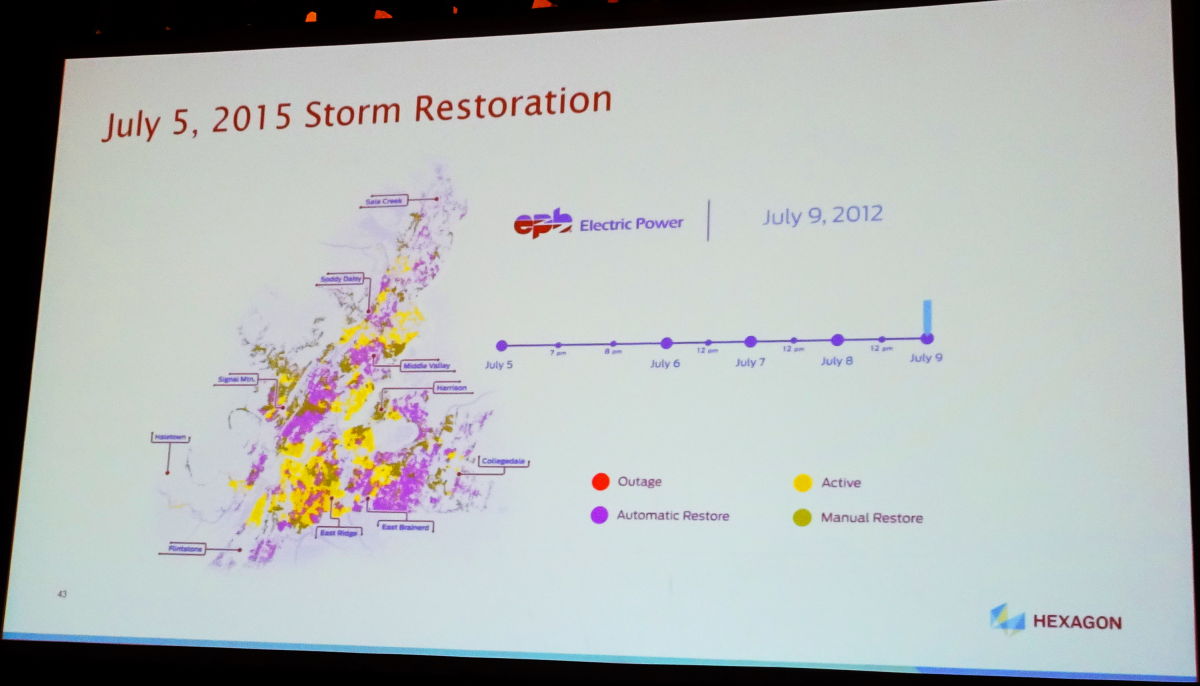
An area where the investment in smart grid technology has realized a major savings is resilience. Ken presented a map showing the areas in the EPB service territory where power was automatically restored by the automated distribution switches after a recent severe summer storm. The outage and restoration statistics were equally impressive and showed that automation resulted in an estimated savings of $23 million for this storm.
| W/o automation | W/ automation | Difference | Improvement(%) | |
| Customers with an outage | 72,622 | 32,043 | 40,579 | 55.88% |
| Cost of all outages | $69.3 million | $46.1 million | $23.2 million | 33.48 % |
| Outage minutes | 16,986,240 | 12,059,524 | 4,926,716 | 29.00 % |
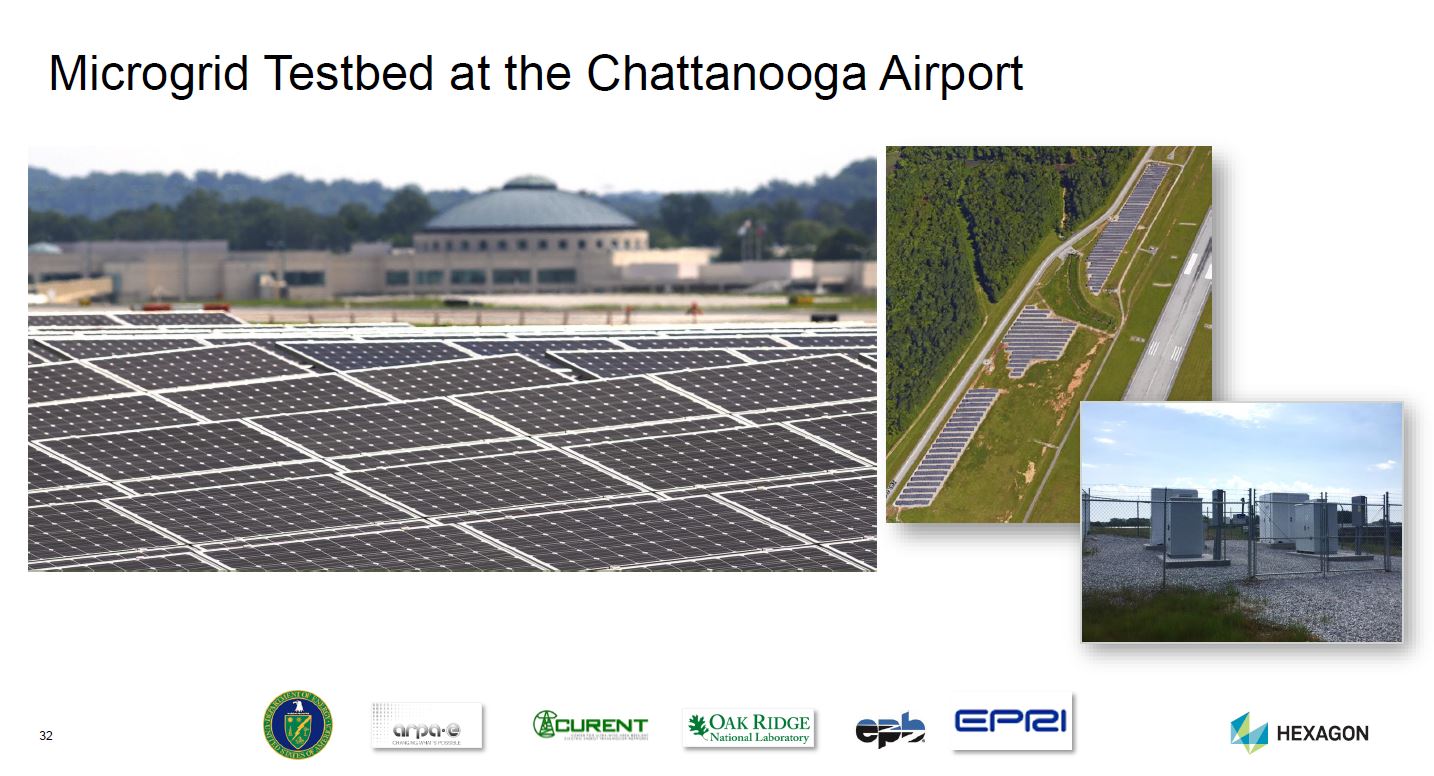 One of the important steps that the EPB has taken with its partners is to implement a microgrid testbed at the Chattanooga airport comprising a solar farm, batteries and supporting infrastructure. This is one of the few airports anywhere that is able function completely off the grid.
These quantified benefits provide tangible evidence of the benefits of smart grid technology deployment. I would recommend that any power utility operating in a small to medium-sized city seriously consider the Chattanooga experience.

Be the first to comment