
The Chinese National People’s Congress begins meeting tomorrow to pass the 12th five year plan. One of the policy items that is a priority for the five year plan is new energy efficiency and pollution reduction targets intended to put China on a less carbon-intensive economic development track. How seriously this will taken by Chinese industry will depend on China’s Environmental Protection Law, first passed in 1979 and revised in 1989, which is notoriously weak in enforcement measures.
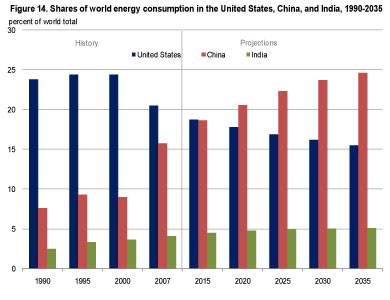
Since 1990, energy consumption as a share of total world energy use has increased significantly in both China and India, and together they accounted for about 10 percent of the world’s total energy consumption in 1990 and 20 percent in 2007. According to the US Energy Information Administration (EIA) reference case projection, which assumes no new legislation, it is projected that strong economic growth in both countries will continue and their combined energy use will more than double and will account for 30 percent of total world energy consumption in 2035, with China responsible for just under 25 percent. The U.S. share of world energy consumption is projected to fall from 21 percent in 2007 to 16 percent in 2035.
China exceeded the US in energy related carbon emssions in 2006, though per capita emissions in China is far below the US. One of the expected measures to be included in the 12th five year plan is reducing carbon intensity. According to the 11th five year plan (2006-2010), China’s per unit GDP energy consumption should have been reduced by 20 percent by the end of 2010 compared with 2005 levels. However, from 2006 to 2009, energy consumption per unit of GDP fell only 14.38 percent. It is expected that the five year plan will target reducing carbon intensity by 40 to 45 percent by 2020 compared to 2005 levels.
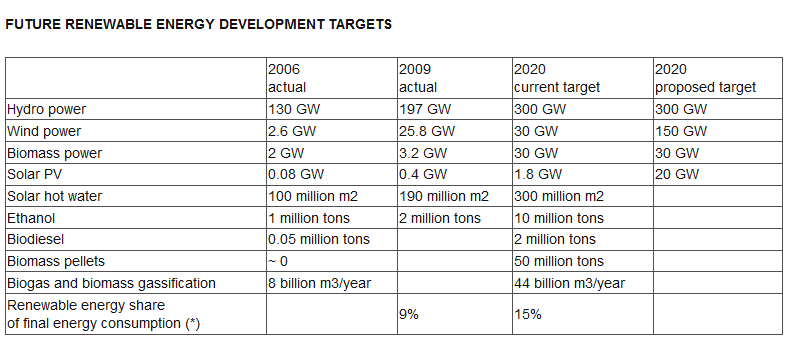 In 2005, China passed a law to promote renewable energy that aims to get a total of 500 gigawatts of renewable energy on the grid by 2020, including massive increases in wind power, biofuels, solar, and hydro power. In 2009 China and the EU led the world in clean energy investment. The total EU investment was $41.1 billion, China $34.6 billion, and the U.S. $18.6 billion. Over the past five years, China’s clean energy investment has increased 148 percent, the U.S. significantly less, 103 percent.

Be the first to comment