
Last week GITA Ontario Chapter held a Spring Educational Session with a focus on asset management. One of the presentations was given by John Murray, who is responsible for asset management in the public works department of the City of Hamilton, Ontario. The City of Hamilton has focussed on asset management as a priority. One of the unique things Hamilton has done is create a single multi-disciplinary group responsible for asset management for all assets including sanitary and storm sewers, water, roads and traffic, trees,cemeteries, and a few other things. In Hamilton the asset management group is focussed on tracking the condition of and value of city assets. They do not own or maintain city infrastructure.
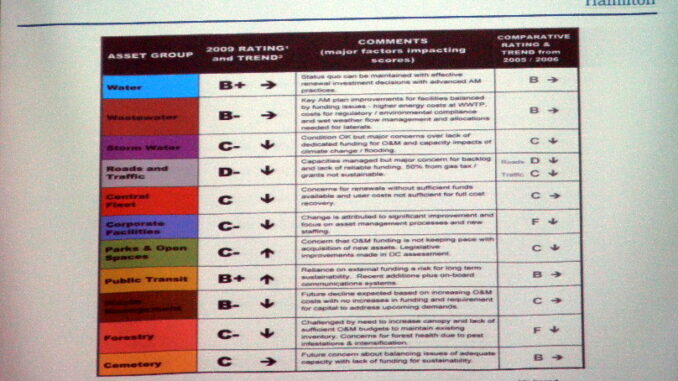
 One of the really unique things the asset management group has done is put together an infrastructure report card similar to the well-known ASCE Report Card which assigns a grade of A through F to each category of infrastructure. The city has also assigned a trend (improving, flat, or downward) to each type of infrastructure.
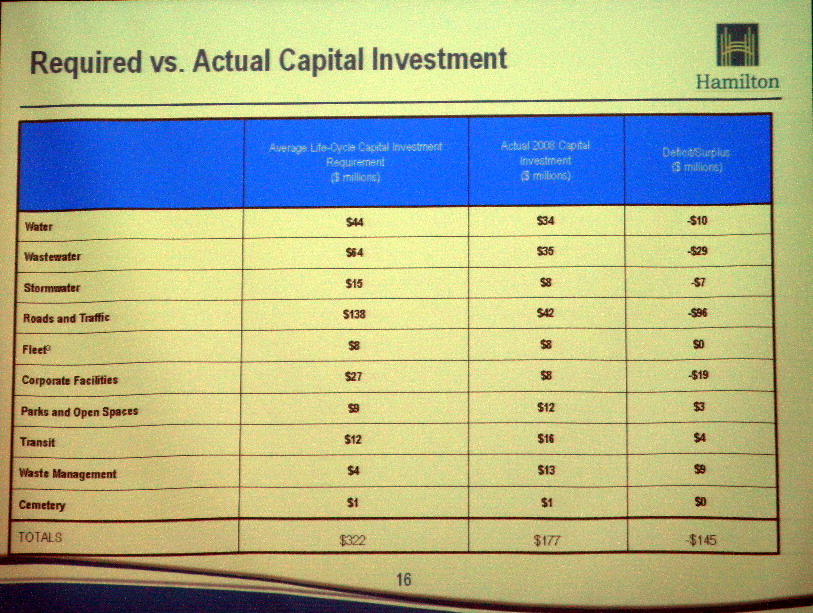
The asset management team has conducted an investment gap analysis where they have estimated the annual investment required to maintain each type of infrastructure at an acceptable level (average lifecycle capital investment), compared it to the actual level of investment for a particular year and then computed the surplus or deficit. Of the total $145 million deficit, the class of infrastructure with the largest deficit is roads and traffic, followed by wastewater.
 The asset management team has also estimated the total replacement value of all city-owned assets, about $14 billion, and the value per property or parcel, about $92,000.
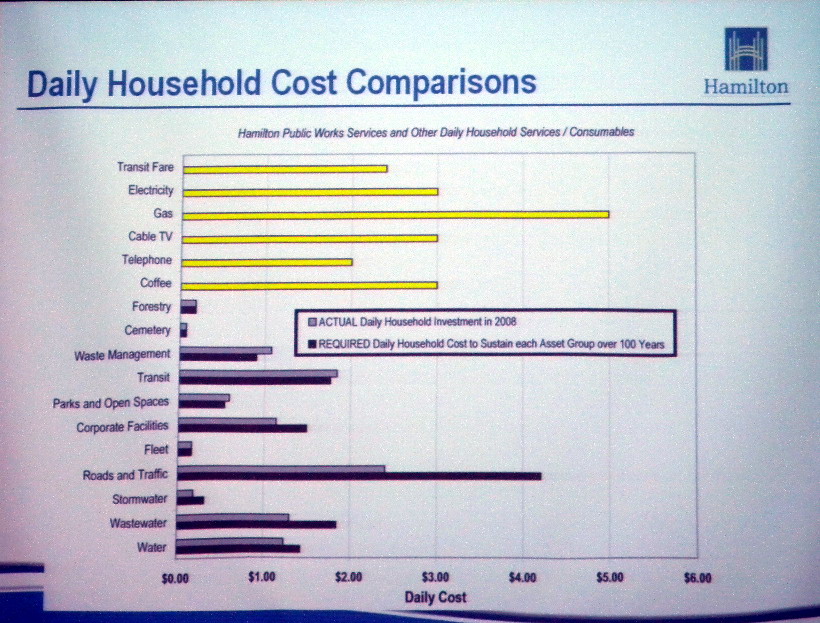
One of the most interesting things the asset management group has done is to estimate the current daily household investment in city infrastructure and the investment that would be required to maintain infrastructure at an acceptable level and to compared it to daily household costs for things like transit, electricity, telephone, cable TV, gas and coffee. It’s a very enlightening comparison. According to this analysis, in 2008 the average household paid less per day for maintaining roads and traffic ($2.50) than for coffee ($3.00).

Be the first to comment