
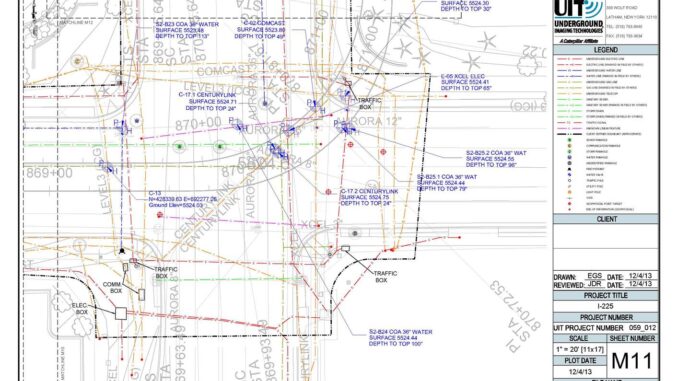
I’ve blogged several times about the expanding effort in Europe and the United States to map accurately underground infrastructure. I blogged about the high ROI for investment in improving the geolocation and other information about underground utilities, the 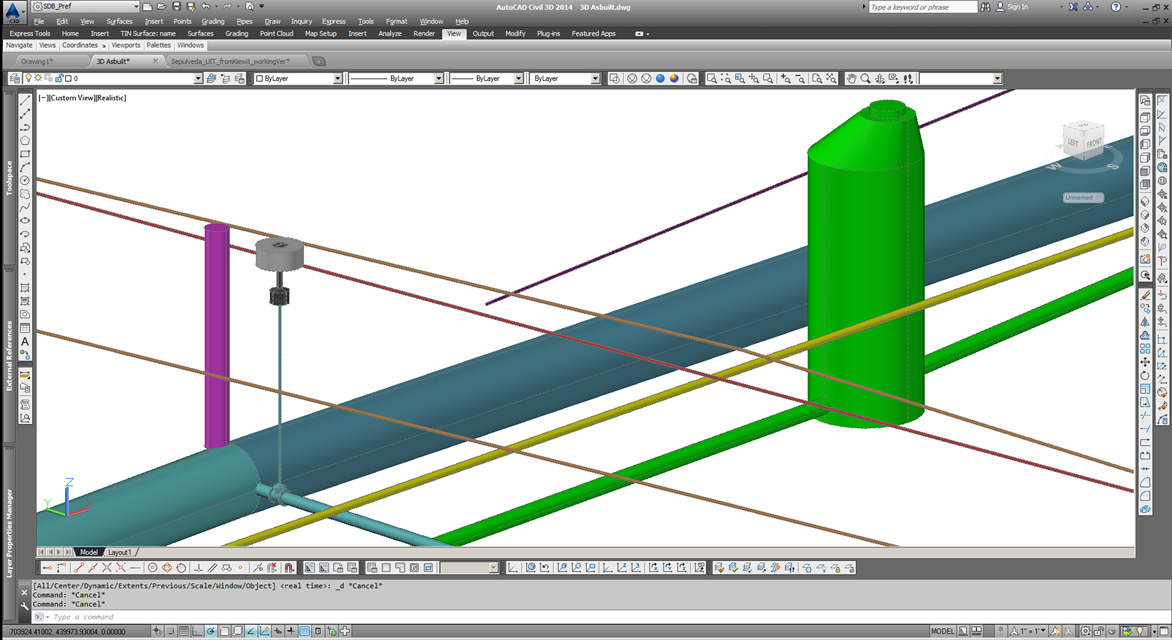 project of the City of Las Vegas to create a 3D model of its underground utilities and a ten year effort in Lombardy, which includes Milan, to map all underground infrastructure using ground penetrating radar (GPR).
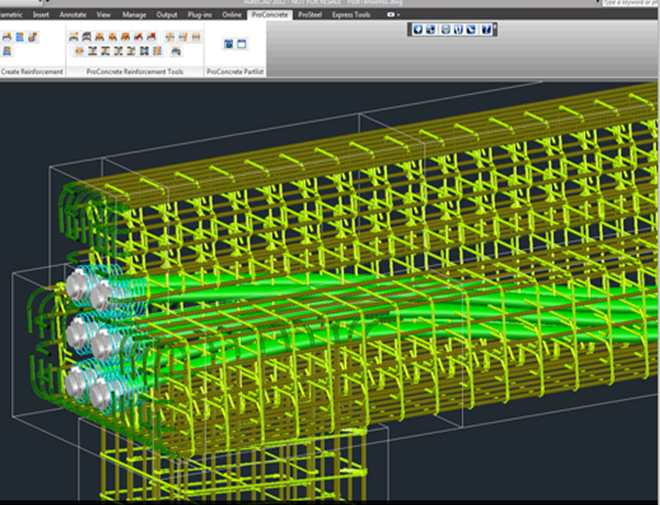
At the SPAR International conference Steven DiBenedetto, Senior Geoscientist & Technology Manager at Underground Imaging Technologies, whose field is geophysics and how it relates to subsurface utility engineering (SUE), compared using GPR for detecting underground and other hidden infrastructure with laser scanning of above ground structures. 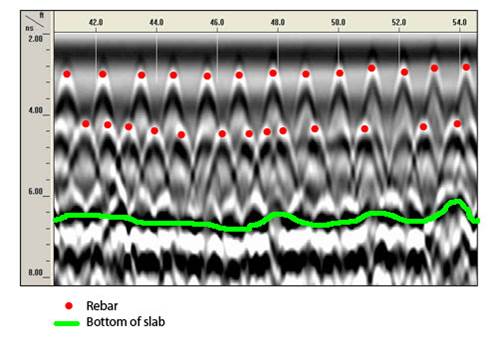 In addition to underground utilities, GPR can be used to detect rebar. BIM models makes it possible for rebar detailing to be a fully realized component of a structural design.
  GPR can be used to detect existing rebar embedded in concrete.
I’ve blogged previously about level of development (LoD) in the context of BIM modeling for buildings and horizontal infrastructure.
- 100 – generic representation
- 200 – generic representation; approximate quantities, size, shape, location, & orientation
- 300 – specific system object or assembly
- 350 – Include interfaces to other building systems
- 400 – include detailing, fabrication, assembly, & installation information
- 500 – field verified
LOD relates to the degree of detail included in a model element and is (mostly) based on objects that are visible, at least during construction. Steven sees a parallel between LoD and the ASCE Standard 38-02 “Standard Guideline for the Collection and Depiction of Existing Subsurface Utility Data“
- Quality Level D (QL D) Review of Existing Records & Information
- Quality Level C (QL C) Surveying & plotting above ground (surficial) features and connecting points
- Quality Level B (QL B) Surface geophysical methods to map subsurface utilities
- Quality Level A (QL A) Non-destructive excavation to expose & survey subsurface utilities, typically by potholing
The SUE classification is based on classifying the reliability of the location about subsurface facilities depending on the means by which the subsurface infoormation was obtained. For example, a pipe can be represented as
- line
- line with dimension and colour representing type of pipe
- cylinder with accurate diameter
- pipe assembly with accurate dimension, location and other metadata
Perhaps the most important thing that LoD and ASCE quality level for SUE have in common is they measure reliability, the degree to which you can rely on the information.
There are significant differences between the technologies that are used for above ground laser scanning and subsurface scanning with GPR and the interpretation of the results. 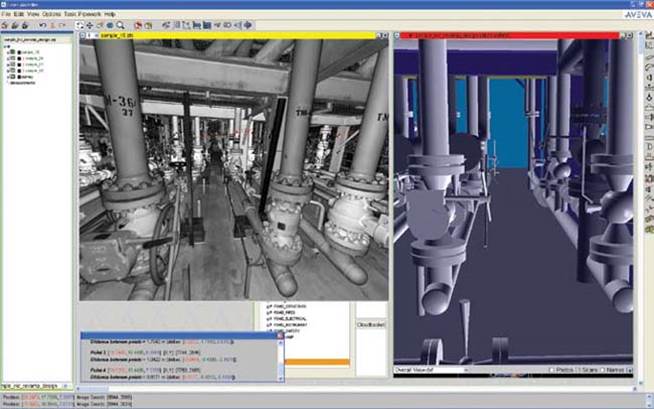 Laser scanning typically involves very short wavelengths which makes possible high resolution, on the order of millimeters. The media in which it operates is air, which is relatively homogeneous and non-absorbing at the wavelengths that are used. This means that laser scanning can record accurately at distances of up to hundreds of meters from the target. Lase scanning requires optical line-of-sight visibility. Measurements can be easily ground truthed by tape measure or total station. The result is a point cloud that can be visualized and measured and compared directly with the scanned object. In some cases feature extraction techniques can be used to extract individual objects to form a 3D model of the scanned object.
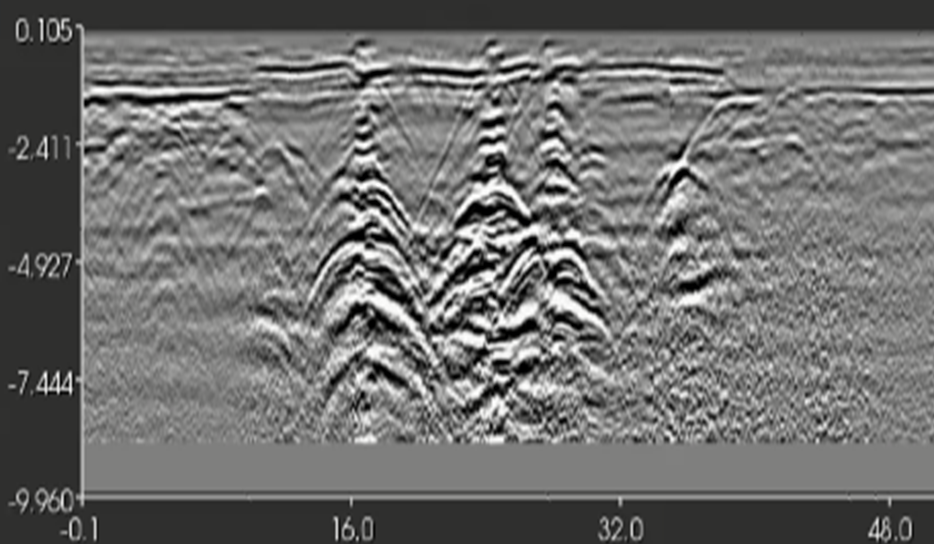 The wavelengths used in GPR are longer, sub-meter wavelengths, to enable them to pass through soil and rock which limits the spatial resolution that is achievable. The medium is heterogeneous – it may be comprised of different soil and rock types together with manmade materials. The sensor must be relatively close to the object, typically within meters or even feet depending on the medium and the strength of the transmitter. Transmitters in Europe are permitted to be stronger than in the U.S. where the FCC severely limits transmitter power. As with any type of radar, GPR signals must be interpreted. It is difficult to ground truth what has been detected without potholing – actually digging a hole. In Steven’s experience with GPR you use all other available information including existing engineering drawings, above ground visible structures such as manholes and storm drains, and historical records.

Be the first to comment