
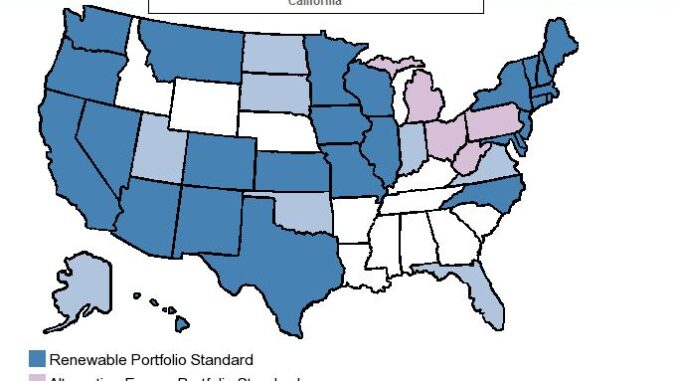
Most US states have some form of renewable energy objective. There have been several unsuccessful attempts to enact a national renewable energy or energy-related emissions objective. One of the problems arising from the lack of such a national objective is the difficulty of building the transmission network to bring renewable energy to market.
The US Environmental Protection Agency (EPA) is mandating a new rule this year that will enforce toxic gas emissions standards on coal and oil fired power plants under the Clean Air Act. The 1990 Clean Air Act Amendments mandated the EPA to control toxic air pollutants.  Since then, the EPA has taken action to reduce mercury emissions from the highest-emitting sources, but not power plants. The Mercury and Air Toxics Standards (MATS) rule is intended to limit mercury, acid gases and other toxic pollution from power plants. The objective of the rule is to prevent “hundreds of thousands of illnesses and up to 17,000 premature deaths each year.” The EPA estimates that for every dollar spent to reduce pollution from power plants, there are $5 to $13 in health benefits. Estimates of the impact on
 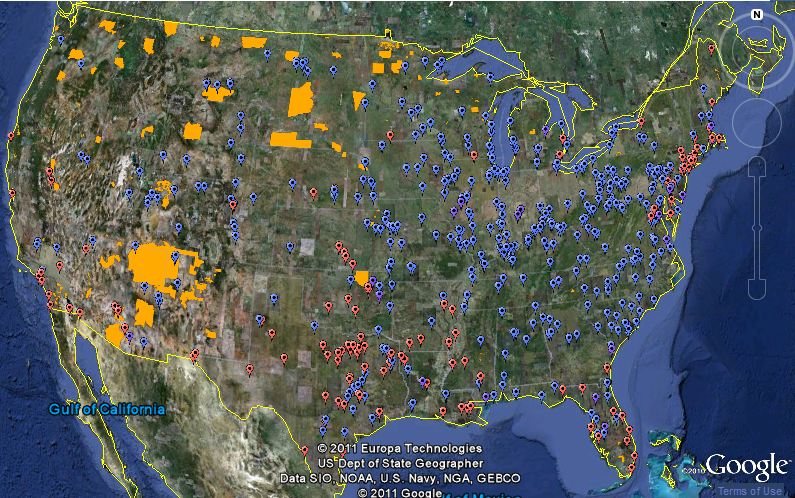 coal-fired power plants range from 10 GW to 35 or even 60 GW of the US’s 340 GW of coal-fired power capacity that could be forced to shut down and replaced with more expensive alternatives.
Recently the Congressional Budget Office (CBO) has looked at several alternative schemes for reducing emissions.
- Carbon cap-and-trade
Sets pollution limits and allows utilities that meet those thresholds to bank or sell credits to those that are not able.
- Renewable energy standard (RES or RPS)
RES includes green energy sources such as wind, solar, biomass, and geothermal.
- Clean energy standard (CES)
CES includes not only green fuels, but also natural gas, nuclear and coal plants with carbon capture and sequestration (CCS).
The CBO report concluded that either an RES or CES would reduce carbon emissions in the US, but that both would raise the average cost of generating electricity. Interestingly, the CBO also felt that neither a national RES nor a CES would do as much to reduce carbon emissions as a cap-and-trade program, which the CBO also said would help offset the expected higher cost of electricity. Politically a carbon cap-and-trade is not a feasible option at the present time. Reportedly the President has asked Congress to require that 80% of the US generation capacity be invested in clean energy by 2035, but it is unlikely that this will be adopted. However, in the context of the potential impact of the EPA’s new MATS rule on electric power prices, there appears to be a greater willingness in Congress to look at a CES as a less threatening alternative.

Be the first to comment