
India has announced plans to build an Advanced Heavy Water Reactor (AHWR) designed to use thorium as fuel. India has very little uranium which was the initial motivation to develop a thorium reactor. The reactor will operate with a power of 300 MW using a mix of thorium and uranium-233. About 75% of the power will come from the thorium. Construction of a pilot AHWR could start in 18 months.
There are significant benefits to using thorium rather than uranium-235. Thorium is three times more abundant in nature than uranium. It is only slightly radioactive. It is fertile rather than fissile which means that it can be used as a nuclear fuel only in conjunction with a fissile material such as U-233. Thorium fuels can breed uranium-233. Very importantly, the thorium cycle does not produce weapons grade plutonium, unlike U-235. This is why thorium reactors are sometimes referred to as clean nuclear power. There are other advantages. Thorium reactors generate lower levels of waste and the use of thorium in most reactor types leads to extra safety margins.
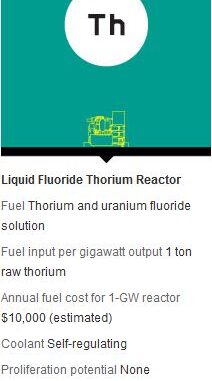
There are a number of reactor designs that use thorium, probably the best known of which is molten salt reactors (MSR), originally designed and built at Oak Ridge National Laboratory in the 1960’s. One of the most interesting MSR designs is the Liquid Fluoride Thorium Reactor (LFTR). For fissile material the LFTR uses U-233 which has been bred in a liquid thorium salt blanket. The LFTR is safer than many other reactors because the design includes a freeze plug which if external electrical power is lost, as at Fukushima Daiichi, causes the fuel to be drained into a catch basin which ensures that the fuel remains subcritical. The design also has a negative temperature coefficient of reactivity due to expansion of the fuel, which means that as the fuel gets hotter, it becomes less reactive. China has announced its intention to develop thorium-based MSRs.
In the US a company called Lightbridge is commercializing the Radkowsky Thorium Reactor, which is a ‘seed & blanket’ reactor in which enriched U-235 is used at the centre surrounded by a thorium blanket.
Of the total estimated 2,610,000 tonnes of thorium in the world, Australia has the largest reserves.
Australia 19%
USA 15%
Turkey 13%
India 12%
Venezuela 12%
Brazil 12%

Be the first to comment