
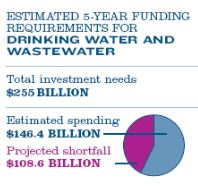
I blogged recently about the Water Protection and Reinvestment Act (HR 3202) which proposes a trust fund for water and wastewater infrastructure similar to the Highway Trust Fund. In June there was a Congressional hearing on the bill before the Subcommittee on Water Resources and the Environment of the House Transportation and Infrastructure Committee. At that hearing the American Society of Civil Engineers, the National Association of Clean Water Agencies and the Associated General Contractors of America spoke in favour of the bill.
But Chips Barry, representing the American Water Works Association (AWWA), said AWWA was “not prepared…at this time” to support HR 3202. Mr Barry said that the AWWA would prefer that “funds raised locally be retained and spent locally, rather than being sent to Washington, D.C., first, and that communities that have adopted adequate rates not be asked to subsidize those that have not.” AWWA believes that a federal water infrastructure bank would provide a better way of achieving funding for water and wastewater infrastructure. Late last year, the American Water Works Association (AWWA) and the Water Environment Federation (WEF) proposed the creation of a Water Infrastructure Finance Innovations Authority (WIFIA), whose purpose would be to lower the cost of infrastructure investments by increasing access to low-cost capital. WIFIA would be modeled on the Transportation Infrastructure Finance and Innovations Authority (TIFIA). AWWA/WEF argue that WIFIA could lower the cost of capital for water utilities while having negligible effect on the federal budget. WIFIA would offer low interest loans and guarantees for large water infrastructure projects and those with national or regional importance. Since water utilities providers are among the most fiscally responsible borrowers in the United States, with a tiny default rate of 0.04 percent, AWWA/WEF argue that WIFIA involves minimal risks and minimal long-term costs to the federal government.
Mr Barry also said that another problem with trust funds is that “federal trust funds routinely collect more in revenue than they are allowed to spend by congressional appropriation”. Excess revenue is often redirected by Congress to other spending.

Be the first to comment