
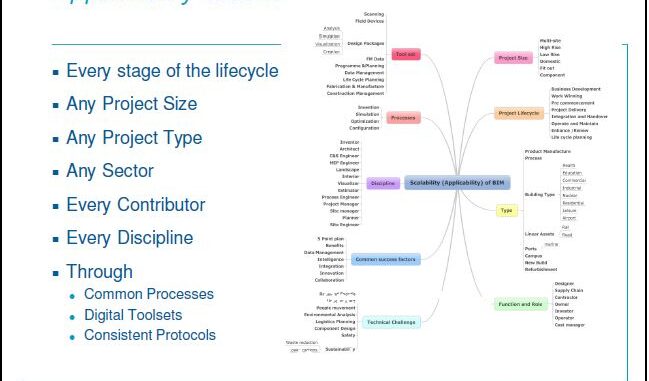
At this year’s Royal Institution of Chartered Surveyors (RICS) BIM National Conference 2014, Peter Trebilcock of Balfour Beatty gave an overview of Balfour Beatty’s extensive BIM experience. Balfour Beatty has 56 live BIM projects across the UK. In 2013 it completed 12 BIM projects. It estimates that it won £589 million of work as a result of its BIM capability. The total value of outstanding bids on BIM-related projects amounts to £5,945 million and this Includes 14 COBie projects. Balfour Beatty’s BIM projects have run the gamut in size, ranging from a small £100 thousand project to a £600 million project. Their BIM projects also cover a broad range of sectors
- Education 30%
- Healthcare 12%
- Commercial 15%
- Defense 4%
- Transportation 24%
- Power 7%
- Leisure 4%
- Residential 4%
Balfour Beatty’s conclusion based on their extensive experience is that BIM is scalable, applicable to small and large projects in any sector.
Role of client
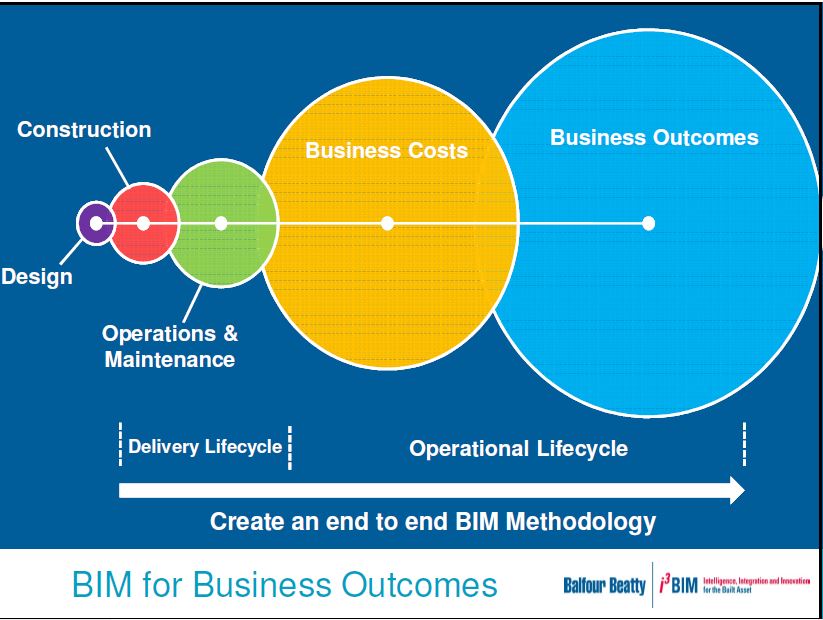 A client, who can be a patron, developer, owner, occupier, user, FM manager, or funder/investor, has a critical role to play in the transformation of the construction industry and that is to change the traditional construction process.
BIM enables the client and the contractor to collaborate more fully than is possible with a traditional approach. Balfour Beatty’s vision of BIM benefits extends across the lifecycle of the building or facility. For example, Balfour Beatty sees the potential of significant benefit in providing the BIM model and associated information to the client to contribute to facilities management.
Balfour Beatty has considered a number of potential BIM requirements that a client could demand including validation, engagement during design, clash avoidance, cost impact evaluation, asset data (COBie), user aspects, safety case, safe construction, package interfaces, accurate area (sq-m), FFE/equipment scheduling, and integration into existing FM packages/databases. Based on their experience Balfour Beatty estmates that currently clients are not demanding 47% of these potential BIM requirements.
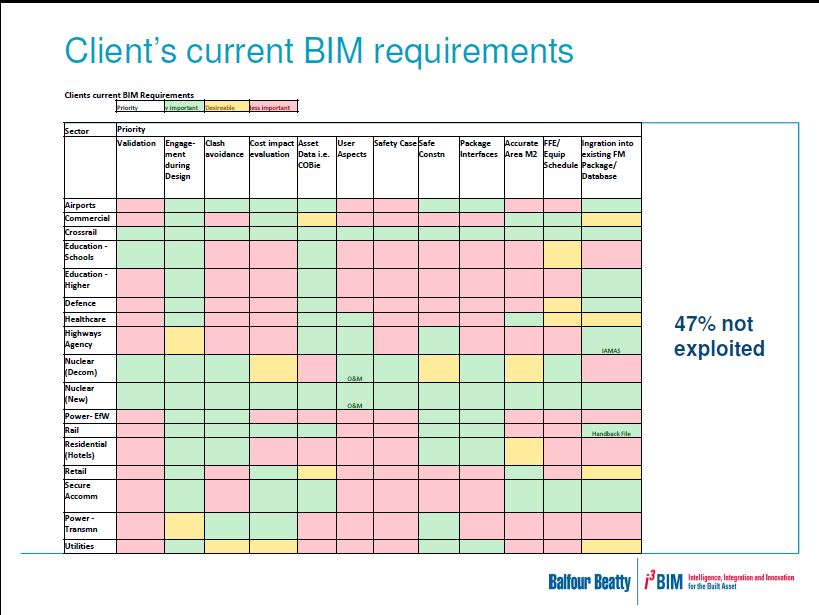 Balfour Beatty has looked at the extent to which clients in individual industries (airports, commercial buildings, crossrail, education/schools. defence, healthcare, highways agency, decommissioning aging nuclear plants, building new nuclear plants, power – distribution, rail, residential (hotels), retail, secure accommodation, power – transmission, utilities) are demanding BIM requirements. They found that clients in new nuclear power plant sector and the Crossrail project are demanding most of the capabilities of BIM. On the other hand schools and residential projects are only taking advantage of a few of BIM’s capabilities. They found that just about client in every industry sector sees a benefit from BIM’s ability to “engage the client during design”.
Benefits of BIM for clients
Peter Trebilcock listed over 60 benefits that Balfour Beatty clients have realized related to BIM, the most important of which are
- More effective engagement
- Transparency of proposals
- Aids confidence
- Helps decision making
- Receive more competitive bids
- Reduced programmes
- Fewer project risks
- More efficient team performance
- Greater predictability of outcomes
- Easier life cycle planning
- Better asset management
- Adds long-term value to their business
For example, Crossrail, a major BIM client, has reported that the significant benefits they have realized from BIM are design optimisation, clash avoidance, package Integration, better cost and risk management, improved construction safety, and the ability to reuse asset data from design/construction in their asset management information system.

Be the first to comment