
Accepted values of the climate sensitivity to atmospheric CO2 doubling suggest 3 °C as the best estimate and finite probabilities for much higher values implying a small but significant chance of high-impact climate changes. By combining sea and land surface temperature reconstructions from the Last Glacial Maximum with climate model simulations, Schmittner et al have estimate a lower median of 2.3 °C and a lower probability of imminent extreme climatic change than previously thought.
Climate sensitivity for a doubling of atmospheric carbon dioxide (CO2) concentrations from preindustrial times has been established as a well-defined standard measure of climate sensitivity. Current best estimates are 3 ± 1.5 °C and 2 to 4.5 °C at the 66% probability range. Recent studies suggest a small but significant possibility of very high (up to 10 °C and higher) values implying the possibility of extreme climate changes in the near future.
Data from the Last Glacial Maximum (LGM), 19-23,000 years ago, can be useful to estimate climate sensitivity to CO2 because of large differences from pre-industrial climate and much lower atmospheric CO2 concentrations (185 ppm versus 280 ppm pre-industrial), both radiative forcings and surface temperatures are well constrained from extensive paleoclimate reconstructions and modeling, and climate during the LGM was close to equilibrium, avoiding uncertainties associated with transient effects.
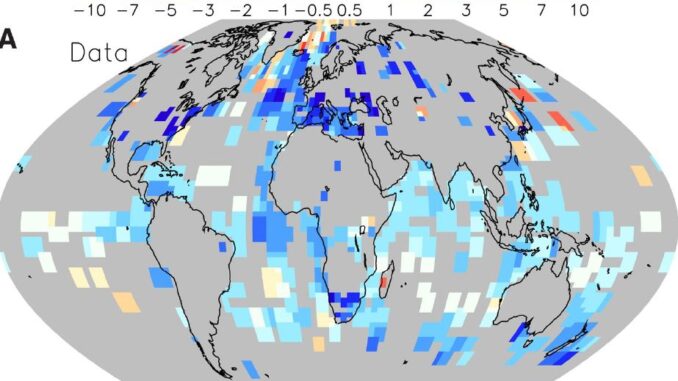
This research combines a climate model of intermediate complexity with syntheses of temperature reconstructions from the LGM to estimate climate sensitivity to CO2. The LGM simulations include larger continental ice sheets, lower greenhouse gas concentrations, higher atmospheric dust levels and changes in the seasonal distribution of solar radiation. It combines recent syntheses of global sea surface temperatures from the Multiproxy Approach for the Reconstruction of the Glacial Ocean (MARGO) project and surface air temperatures over land based on pollen evidence, with additional data from ice sheets, land and ocean temperatures. The combined dataset covers over 26% of the Earth’s surface.
Combining extensive sea and land surface temperature reconstructions from the Last Glacial Maximum with climate model simulations, it is estimated that climate sensitivity to doubling of atmospheric CO2 concentration is lower 2.3 °C with reduced uncertainty of 1.7 to 2.6 °C at the 66% probability level. Assuming paleoclimatic constraints apply to the future as predicted by this model, these results imply that climate sensitivities larger than 6 °C are implausible.

Be the first to comment