
In New Hampshire in 2006 the Public Service of New Hampshire (PSNH) converted a coal-fired plant at Schiller Station to wood pellets. The Northern Wood Power at Schiller Station is capable of 50 MW and gets its wood pellets come from the leftovers of forestry operations.
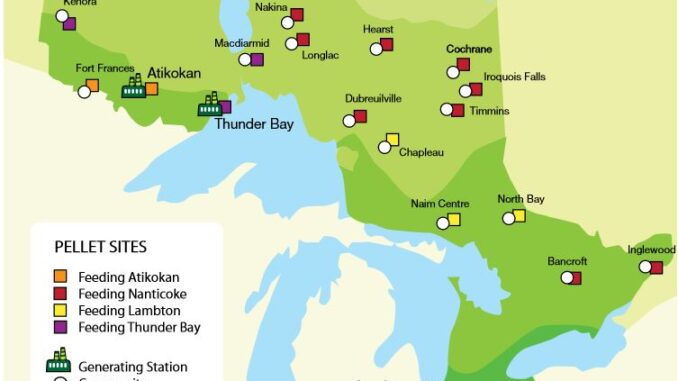
Ontario is scheduled to terminate all coal-fired generation by 2014. As part of that goal Ontario Power Generation’s (OPG) Atikokan Generating Station in northwestern Ontario stopped using coal as fuel in September 2012.
The plant is in the process of being converted to use wood pellets as fuel. When the plant comes back on line in 2014, it will be the largest 100 % biomass-fueled power plant in North America and will generate 211 MW of renewable, dispatchable power. Ontario Power Generation (OPG) has awarded contracts to two local companies to supply 90,000 tonnes of biomass wood pellets annually for the Atikokan Generating Station.
 Emissions
In a 2010 article in Environment Science and Technology researchers at the University of Toronto found that greenhouse gas emissions could be reduced by 91% by substituting wood pellets for coal.
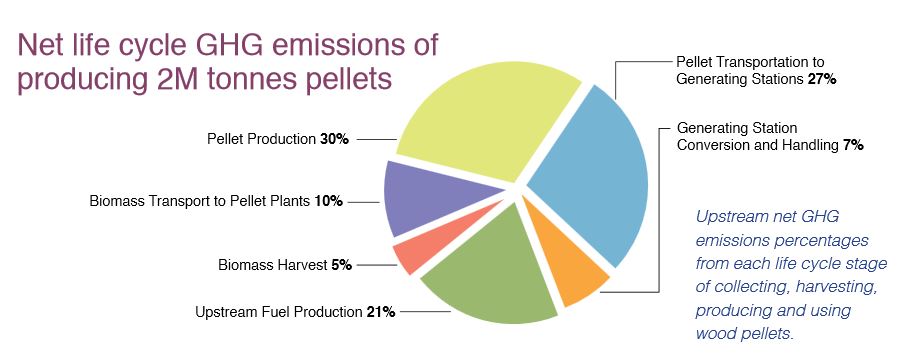
According to a Pembina Biomass Sustainability Analyis there are significant decreases in greenhouse gas emissions (GHG), as well as both social and economic benefits from burning biomass. The majority of upstream wood pellet greenhouse gas emissions come from wood pellet transportation and wood pellet production. The net life cycle emissions are calculated by adding the total upstream life cycle greenhouse gas emissions to the greenhouse gas emissions from the change in the forest carbon.
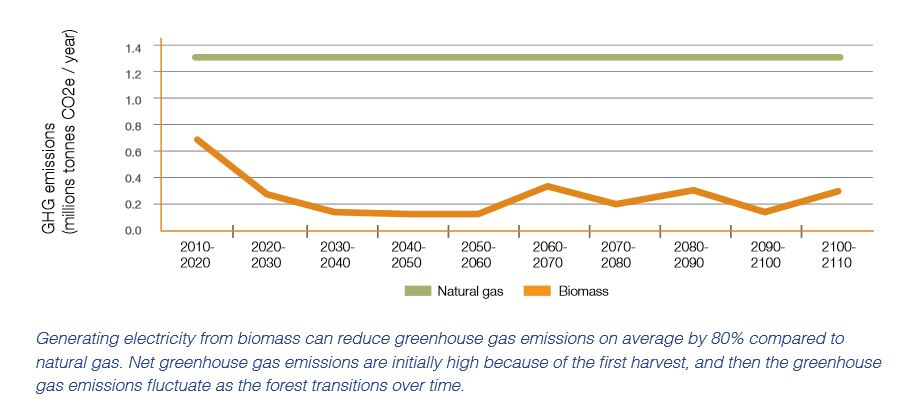 The Pembina analysis compared the difference in net greenhouse gas emissions between wood pellet fired electricity and natural gas-fired electricity over a hundred year period. With wood pellets greenhouse gas emissions are initially high because of the initial removal of biomass from the forest carbon stock. Averaged over 100 years it is estimated that there is an 80% reduction in greenhouse gas emissions from biomass compared to the base case of natural gas electricity.

Be the first to comment