
Coal-fired power generation in the U.S.
In 2011 42% of US electric power production was from coal. But according to the EPA from April 2011 to April 2012 the amount of power generated from coal declined by 22%. This is primarily due to the switch from coal to natural gas motivated by the low price of natural gas and by new EPA rules for emissions including mercury and other toxics and CO2. But the Department of Energy continues to fund research projects that are designed to help coal meet the new EPA guidelines by eliminating or reducing CO2 and other emissions.
Coal-fired power generation in the E.U.
Beginning in 2007 the European Union made carbon capture and sequestration (CCS) an integral part of EU energy policy. The German decision to shutdown its nuclear power plants and replace them with renewable sources and coal-fired power plants has created additional impetus for CCS in the EU. German electricity generation has historically been about one half coal and one fifth nuclear. In September 2010 the German Government released a 40 year masterplan for revolutionizing the German energy supply that calls for continued investment in CCS technology. In March 2013 the European Commission published a Consultative Communication on the future of CCS in Europe to stimulate discussion on how best to promote its development. The Communication identifies the barriers that have prevented CCS from progressing in Europe at the pace initially foreseen and discusses options for promoting its timely demonstration and early deployment and for strengthening the long-term business case for CCS.
Kemper County Project
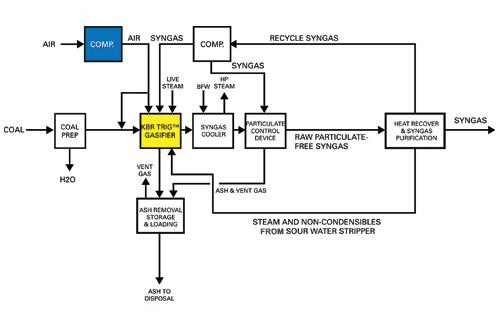
The Kemper County Project is a lignite-fueled integrated gasification combined-cycle (IGCC) facility being constructed in Kemper County, Mississippi, the largest CCS plant in the U.S. It is based on the KBR Transport Gasifier, also known as TRIG, an advanced coal gasification technology that provides clean, particulate-free syngas for a wide variety of coal-based chemicals and fuels applications. Synthesis gas (syngas) is a fuel gas mixture consisting primarily of hydrogen (70%), carbon monoxide (22%), methane (5-9%), and some carbon dioxide (0.5%). the TRIG technology was jointly developed by Southern Company, KBR, and the Department of Energy (DOE).
The major advantage of the TRIG technology is that it is cost-effective when using both low grade coals and coals with high moisture or ash content. These coals make up half of the proven reserves in the U.S. and the rest of the world.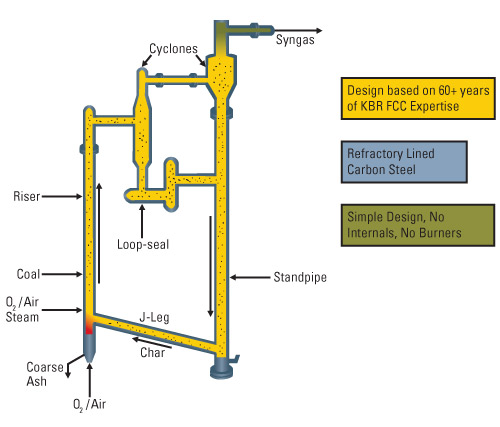 The primary objective of this project is to demonstrate the operation of a commercial-scale transport gasifier plant integrated with a combined-cycle gas turbine generator. Objectives include demonstrating high availability and high thermal efficiency. The project also supports an advanced syngas cleanup system that includes sulfur removal and recovery; ammonia recovery and mercury removal. 3 million tonnes of CO2 per year will be captured by the Kemper Facility. It is planned to transport the CO2 via pipeline for use in oil recovery operations at depleted oil production fields in Mississippi.
There are Lignite reserves near the plant site which have been developed and mined by Liberty Fuels, a subsidiary of North American Coal Corporation.
The plant can burn natural gas as well as syngas. When burning syngas only, the plant is expected to have a capacity of 524 MW. Over 65 percent of the CO2 will be captured, making the Kemper County Energy Facility’s carbon emissions comparable to a natural gas-fired combined cycle power plant and capable of meeting the EPA’s emissions rules. The Kemper County IGCC plant is scheduled to begin operating commercially in May 2014.
Be the first to comment