
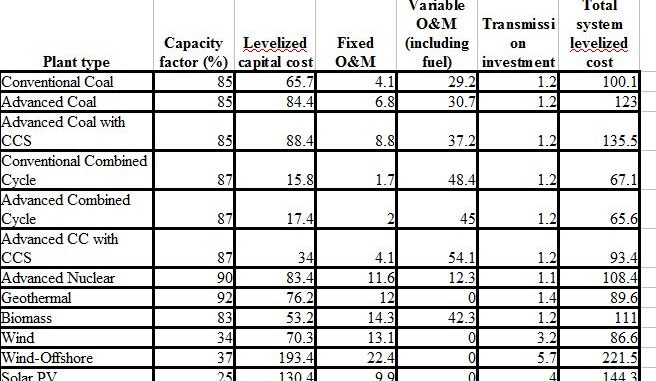
The “levelized cost”, which is the present value of the total cost of building and operating a generating plant over its financial life, aims at making the costs of different generation technologies comparable. The US Energy Information Administration (EIA) has developed a standard way of estimating levelized costs. The most recent estimates of the comparative costs of different ways of generating electricity have been developed by the EIA for the Annual Energy Outlook 2013 (AEO2013) Early Release Reference case.
The levelized cost represents the per-kWh cost (in real dollars) of building and operating a generating plant over an assumed financial life and duty cycle. Key inputs to calculating levelized costs include overnight capital costs, fuel costs, fixed and variable operations and maintenance (O&M) costs, financing costs, transmission costs, and an assumed utilization rate (capacity factor) for each plant type. Plants typically built for peaking have a much lower capacity factor or utilization rate than a baseload plant. Renewable energy generation also typically has a a lower capacity factor because wind and sun are intermittent.
The levelized cost shown for each utility-scale generation technology is based on a 30-year cost recovery period starting in 2018, using a real after tax weighted average cost of capital (WACC) of 6.6 percent.
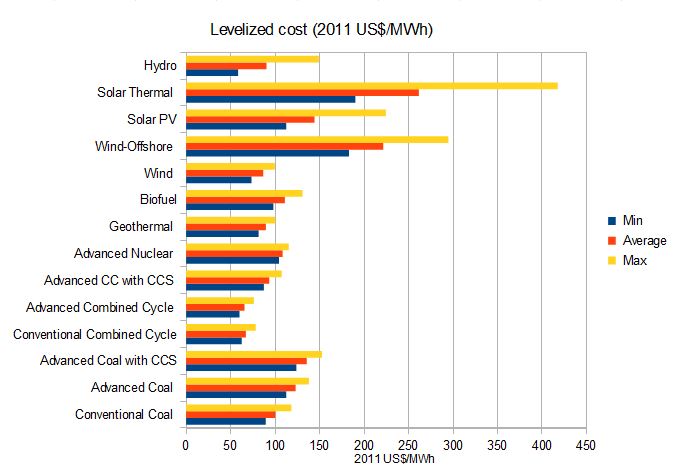 The levelized costs are the true economic cost and do not include state or federal incentives such as tax credits. In the AEO2013 reference case a 3 % increase in the cost of capital is added when evaluating investments in greenhouse gas (GHG) intensive technologies like coal-fired power and coal-to-liquids (CTL) plants without carbon control and sequestration (CCS). The impact of the 3% increase is similar to that of an emissions fee of $15 per metric tonne of carbon dioxide (CO2) when investing in a new coal plant without CCS, similar to the costs used by utilities and regulators in their resource planning. It represents an estimate of the carbon allowances these plants may have to purchase to offset their emissions. The impact is that the levelized capital costs of coal-fired plants without CCS are higher than would otherwise be expected.
Costs vary regionally. Levelized costs have been calculated for 22 regions across the U.S. The graph shows minimum, average and maximum regional costs for the U.S.
Comparing the levelized costs for dfferent generation technologies and different regions shows that natural gas-fired combined cycle is the cheapest way to generate power in many parts of the country, recognizing that the levelized cost of coal includes the potential future cost of carbon emissions.
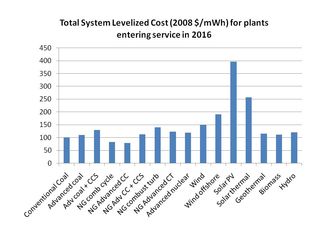 The other interesting conclusion is that in some parts of the country solar PV has already achieved grid parity (within the assumptions of levelized costs). This repesents a signfiicant drop in the cost of solar PV. When I blogged about levelized costs was at the beginning of 2011. At that time the cost of solar PV per MWh was significantly more than any other generation technology.

Be the first to comment