
Locating underground infrastructure in Bahrain
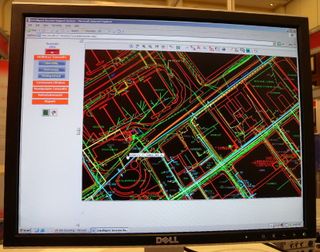
Bahrain is one of the few places in the world which attempts to maintain the location of all underground infrastructure in a single database. As I blogged in 2009, the location of all underground infrastructure in Bahrain is stored in a single Oracle Spatial RDBMS. This database Intelligent Decision Support System (iDSS), which is supported by the Ministry of Works, includes all utility networks
- electricity including transmission, distribution, and street lighting
- water including transmission and distribution
- wastewater including storm, road, sanitary, and combined
- telecommunications
The source databases are maintained by the respective owners, water and electricity by the Water and Electricity Authority, telecommunications by Batelco, and wastewater by the Ministry of Works. iDSS has several layers of security that determine who can see what, and who can update what.
Anyone proposing to add to or make a change to underground infrastructure is required to complete a Proposal Request, essentially a building permit. The request is forwarded electronically to all of the participating utilities, who are required to review and respond to the request within three days.
Developing a national 3D data model
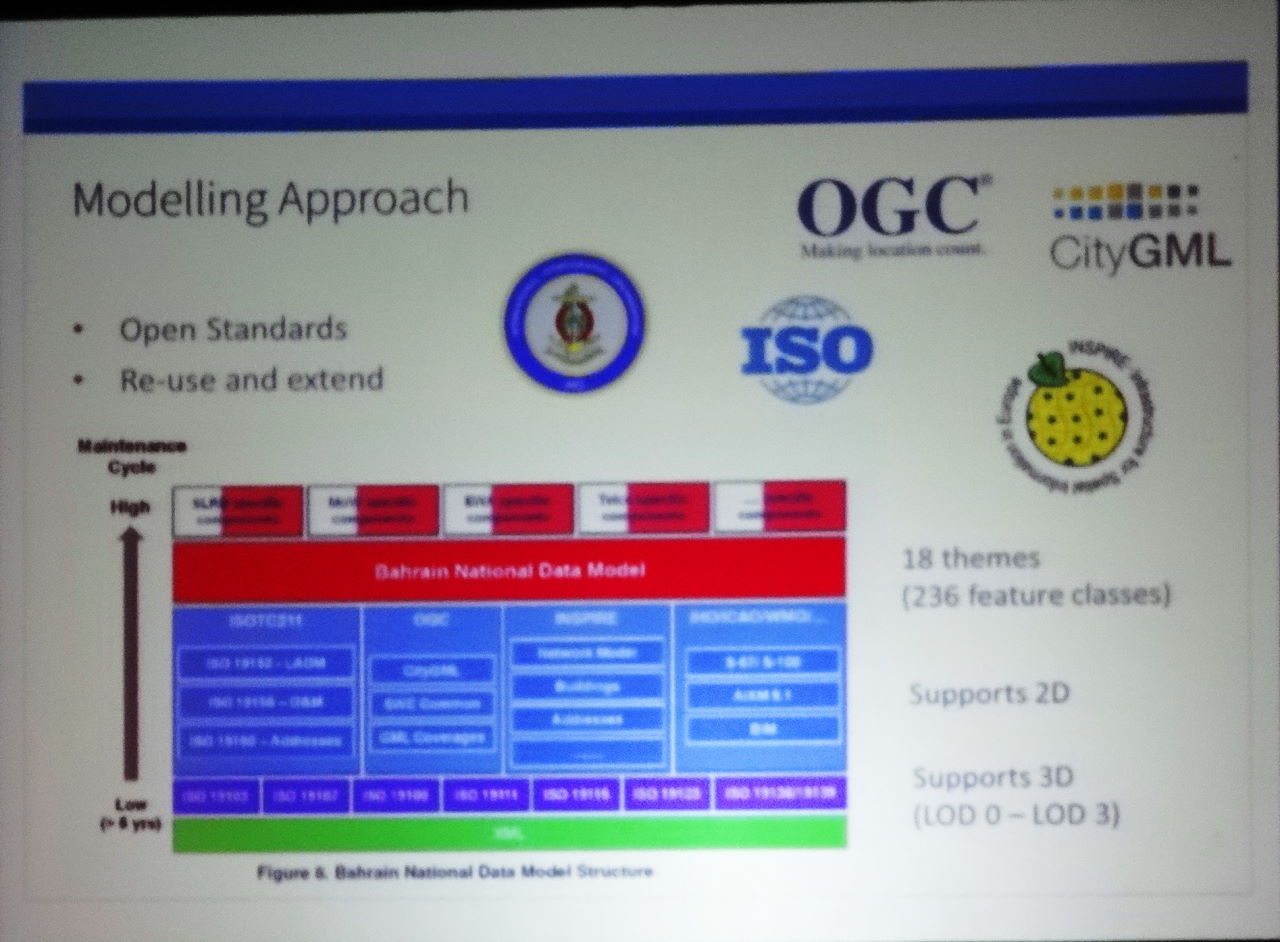 At the GEO Business 2014 conference in London, Debbie Wilson, Senior Information Architect at the Ordnance Survey in the UK, presented an overview of the development of a comprehensive national 3D city model for Bahrain that she designed in less than six months under the sponsorship of the Survey and Land Registration Bureau of the Kingdom of Bahrain (SLRB). The goal is to develop a national 3D data model that supports a broad range of objectives including topographic mapping, land administration, hydrographic survey, utilities, infrastructure, local governance and spatial planning, agriculture, aquaculture, and environment. Currently it does not include the inside of buildings or other structures.
Specifically the national 3D data model is intended to support SLRB strategic initiatives
- 3D data capture
- As-built survey
- Underground utilities
- Sand search
It is intended to promote better government data sharing as a key underpinning for economic development. This is a public-private partner (PPP) initiative involving municipalities, the Ministry of Works, and utilities.
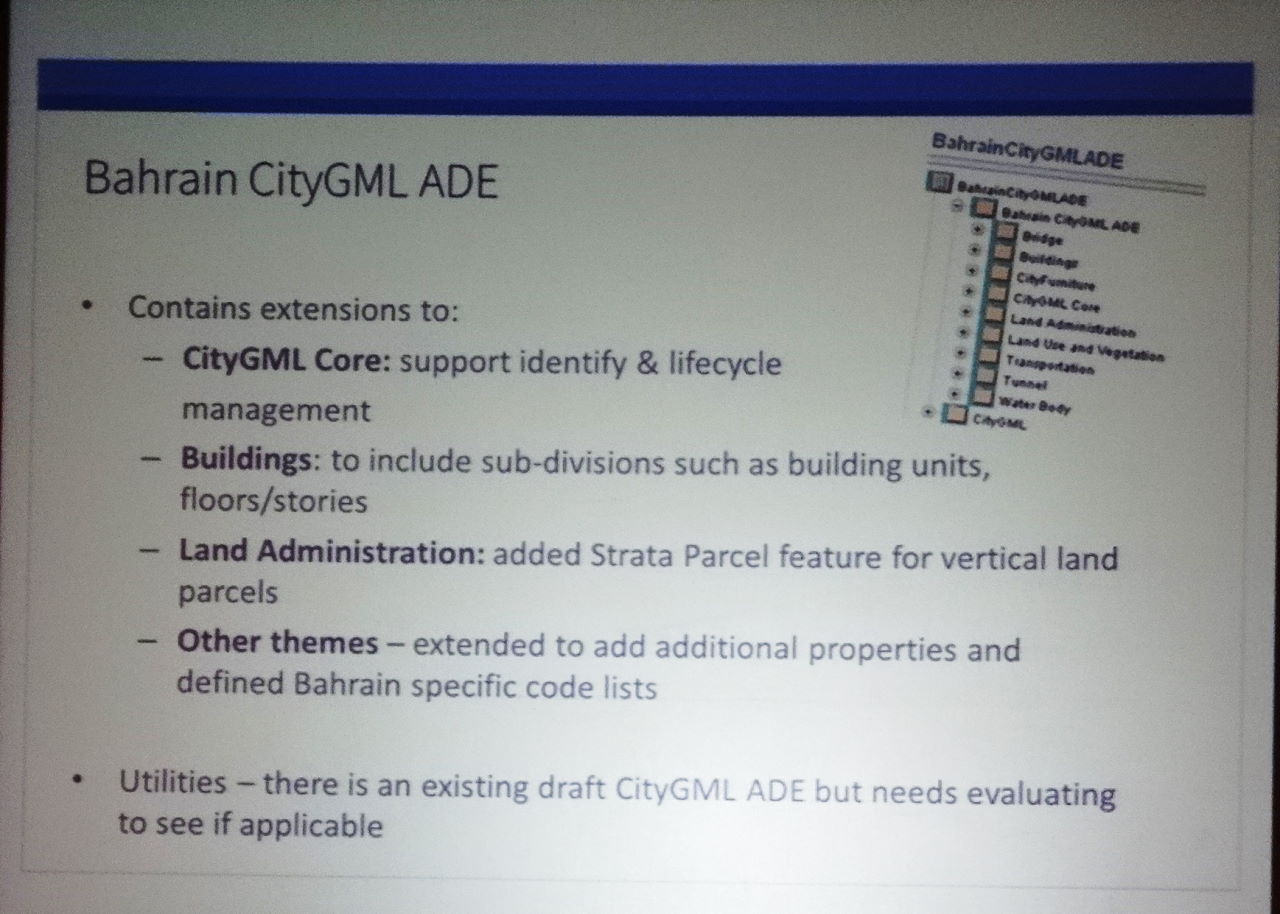 Debbie’s approach was to use existing standards (ISO, OGC, INSPIRE, industry-specific) as much as possible and to extend them only as required to meet the objectives of the SLRB. The basic model is CityGML with the CityGML utility extension ( Application Domain Extensions or ADE) for underground utilities. In addition Debbie designed a specific ADE for Bahrain’s national model called the Bahrain CityGML ADE which added floors and sub-units for high-rise buildings and some other elements for land administration. The 3D model she developed ultimately included 236 feature classes and supports Level of Detail (LoD) 3.
Currently it does not support building information models (BIM), but the SLRB is interested in extending the model to support BIM in the future.
Implementation
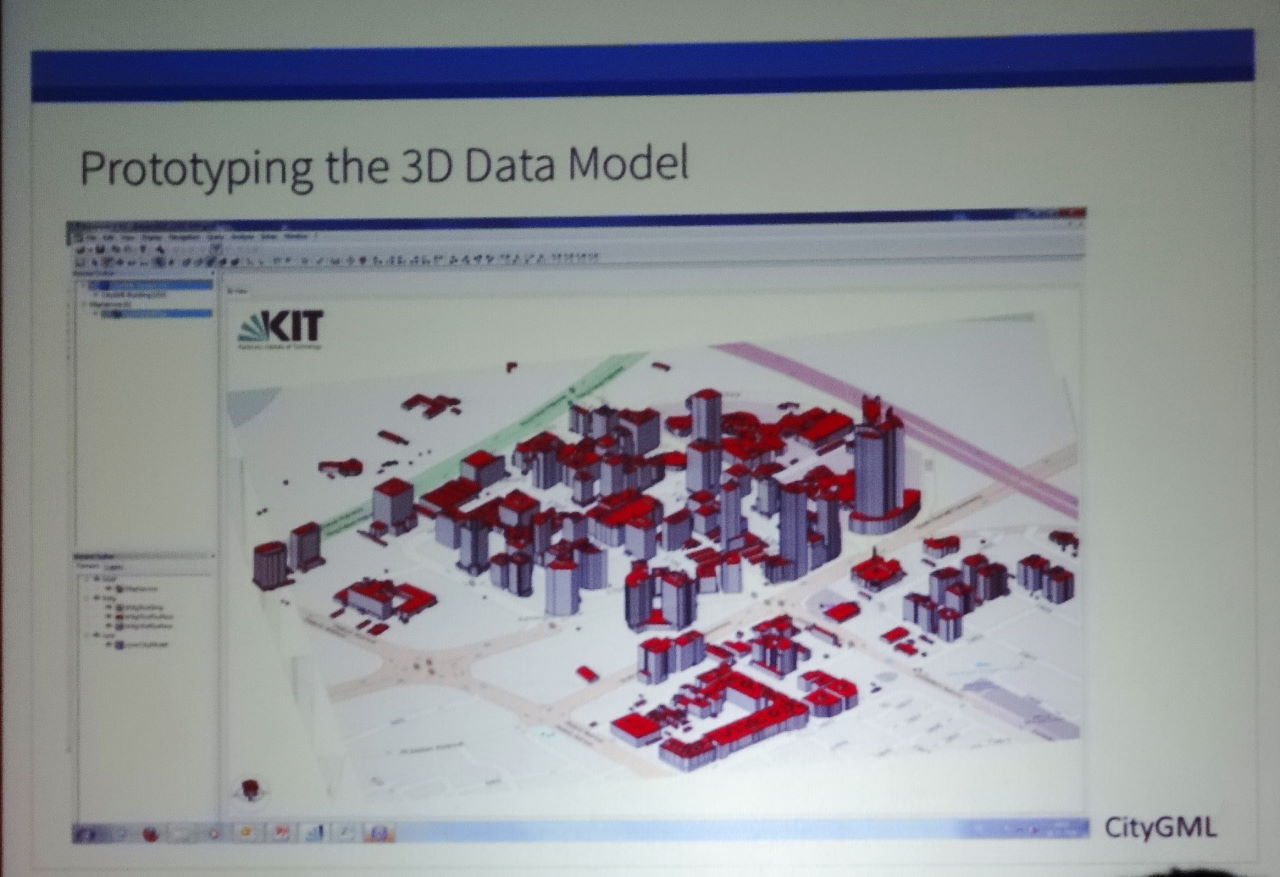 A prototype implementation of the Bahrain National Data Model was developed on Oracle Spatial. Data was imported from a variety of sources including the Ministry of Public Works, municipalities and utilities. The data model and interface to the database are intended to be vendor neutral. Demonstration applications using the data base were developed using ESRI ArcScene and CityEngine, Bentley Map and Google Maps.
Debbie credits open standards as a key factor in enabling this comprehensive national data model to be developed so rapidly, in under six months. Furthermore the implementation only required two months. The advantages that Debbie found from using open standards include
- Consistent framework enabling different domains to come together to develop a harmonized data model
- Provides a long-term foundation for data maintenance and exchange
- Platform independent allowing implementation using wide range of technologies
- Comprehensive 3D National Data Model developed in 6 months
- Prototyping team implemented model for all 236 features in Oracle database and migrated data within 2 months
- SLRB team developed series of demonstrations using key stakeholder applications withi 3 days
- SLRB and stakeholders can now start harnessing the power of their data to deliver new innovative services
Open national data model including utilities
This is an important step in developing a comprehensive data model and especially an open data model for underground utilities that I hope the smart cities community adopts and builds on. I would recommend that any organization, municipal, regional, or national that is developing or intends to develop a national data model for modeling national infrastructure take a serious look at this open model and to consider using it as a reference for their own model.
Be the first to comment