
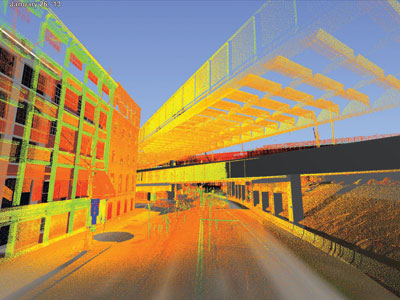
At the SPAR International conference Kevin Gilson, Director of the Design Visualization group at Parsons Brinckerhoff (PB) gave an insightful presentation on integrated 3D modeling and visualization for large transportation projects with some examples from several of the projects that PB is engaged in. The central message that I came away with is that more and more geospatial data is being incorporated in documenting and visualization large construction projects. The term reality capture has been in use for a number of years, but at SPAR I came across the term reality computing which has been applied to computing that uses spatial data captured using a variety of geospatial data techniques including LiDAR, optical/IR, oblique imagery, and satellite and aerial imagery as input. This is moving in the direction of making spatial data a foundation for BIM and other data used in the construction industry.
PB has more than 30 staff dedicated to 3D modeling and visualization and has been using innovative processes that integrate 3D, BIM, and geospatial for many years to gain efficiencies on large municipal transportation projects. Recent projects for which Kevin provided examples include the San Francisco-Oakland Bay Bridge (SFOBB) East Span, San Francisco’s Presidio Parkway, Seattle’s Alaskan Way Viaduct, and the I-95 New Haven Harbor Crossing Corridor Improvement.
Kevin pointed out that the use of intelligent computer models and processes such as Building Information Modeling (BIM) and Civil Integrated Management (CIM) is transforming the delivery of transportation programs. CIM is the term promoted by the Federal Highway Administration under the Every Day Counts initiative. Owners, designers, and contractors are using these processes to design, build, and simulate projects virtually before executing them in reality. The use of virtual modeling increases communication and coordination among project stakeholders by providing an easily accessible vision of the entire project. 3D, 4D models (x,y,z and time), and 5D (x,y,z,time, and $) reduce risks, errors, and inefficiencies that are common to more traditional forms of project management.
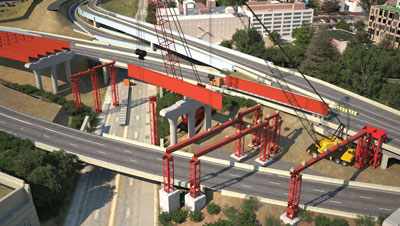 The major trends that Kevin sees are contributing to this transformation of construction are 3D integrated models that extend across the lifecycle from design through build and operate and maintain, integration of increasing amounts of geospatial data from a variety of reality capture techniques, the use of LiDAR to provide as-built data not only from scans at the end of the project, but during construction, real-time monitoring including sensors and applications that operate in near real-time, and mobile devices. In addition many cities are developing 3D models and are making them available to designers, architects and engineers so they design structures in an accurate urban context. This is important for sustainability, but is critical when certain areas and structures strictly have to be avoided. Kevin gave the examples of a cemetery very close to the projected Doyle Drive right of way, and a heritage building very close to the I-95 harbour crossing. Another example is viewports that cities like London and Vancouver have protected in by-laws.
The PB Design Visualization team uses a very eclectic suite of tools which highlights how critical standards for interoperability that cross discipline and vendor boundaries ( for example,GIS, BIM, energy performance modeling, 3D visualization, simulation, project management) are becoming.
Geospatial
ESRI, Global Mapper, Infraworks
CADD
Microstation/InRoads/GeoPak, AutoCAD/Civil3D, Revit, Solidworks
Visualization
3DS Max, Sketchup, Realtime-UDK, Unity
Collboration/4D
Navisworks, Navigator, Synchro
Using an integrated 3D model-based approach increases communication and coordination among all project stakeholders resulting in a greater level of confidence in the design, the schedule, and the overall execution of the program among the construction team and owners. The end result is reduced rework and reduced risk of cost and schedule overruns. Conflicts/issues are identified and resolved earlier in the process, visualization helps non-technical stakeholders get involved in the decision-making process and reduces the risk of surprises at project completion. Kevin also sees the new approach as producing benefits such as greater sustainability that extend over the full lifecycle – design, construction, and operate and maintain.
In summary integrated 3D modeling programs benefit design team, construction planning, stakeholder communications through
- better communication/collaboration
- conflicts resolved sooner
- more sustainable and efficient
Kevin recommends starting with a robust BIM/3D modeling plan and specification including
- real-world coordinate system
- defined roles and responsibilities including a model manager
- specified 3D model level-of-detail (level of development)
- specified model deliverables
Be the first to comment