

One the important impacts of the current economic downturn is a massive increase in infrastructure spending by all levels of governments as part of economic stimulus spending. One of the most important drivers for new infrastructure investment is the creation of a more sustainable infrastructure for energy, water, transportation, communications, and buildings, as the foundation for a new energy efficient, sustainable world economy. An essential part of this worldwide infrastructure transformation is creating a high quality digital model that will enable us to operate and manage the new sustainable infrastructure efficiently.This is a summary of a recent article published in Geospatial Today (10/2009).
State of the World’s Infrastructure
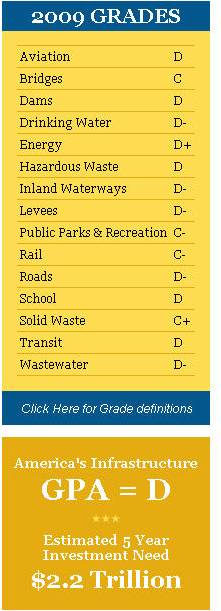 Worldwide there is a growing concern about the state of infrastructure including roads, highways, railways, water and wastewater, pipelines, power, waste, telecommunications, and other types of infrastructure. In the US the American Society of Civil Engineers (ASCE) publishes a Report Card on American Infrastructure most recently in 2009. The 2009 ASCE Report Card estimates that a total investment of $2.2 trillion over five years is required to bring US infrastructure to an acceptable condition.
Shrinking Workforce
Utilites are faced with an aging and shrinking workforce. As a result productivity in the utility industry has stagnated.
Global Climate Change
The effort to tackle global climate change is accelerating. The Copenhagen meeting on global climate change will begin to work toward an agreement to replace the Kyoto Accord next month. In preparation for the Copenhagen meeting, China’s State Council says China will reduce its carbon intensity 40 to 45 percent by the year 2020 as compared to 2005 levels. President Obama is expected to make a provisional pledge to cut carbon dioxide emissions by about 17 percent from 2005 levels by 2020. Canada’s announced goal is 20% reduction in GHG by 2020, compared to 2006 levels. And India and the United States have just agreed on a Memorandum of Understanding to increase cooperation on energy security, clean energy, and climate change.
Smart Utility Networks
Global climate change and increasing demand for electric power is motivating utilities to develop more intelligent networks. But a smart grid requires an accurate, up to date digital model of the network infrastructure, and given the state of digital network models and data at many power utilities, this represents a major challenge for power utilities.
Data Quality
One of the fundamental problems utilities are facing is the poor quality of their digital assets. Poor data quality has serious implications for the organization such as delayed and unreliable reporting to regulators which can lead to fines and other financial penalties, poor operations productivity which directly impacts the bottom line, and poor response times for outages. The most glaring symptoms of poor data quality are backlogged as-builts and poor productivity.
Model-based Design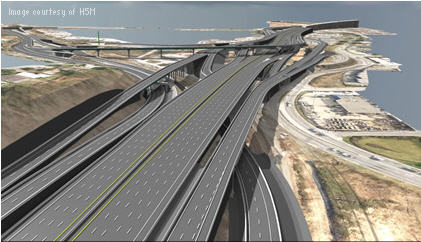
To enable engineers, owners and operators of network infrastructure to address the challenges of global climate change, aging infrastructure, aging workforce, and the demand for higher levels of reliability, new technologies are being introduced and adopted. One of the most important that engineers are increasingly adopting is model-driven approach to design, often referred to simply as BIM (building information modeling). Model-based design not only significantly reduces the cost of design and construction for new structures, but also promises to significantly reduce the downstream costs associated with operation and maintenance.
3D Visualization
Once the preserve of gamers, 3D simulation technology is now an important tool used by engineers to experience a building or other structure during the design phase, before it is built. 3D simulation relies on many of the same 3D visualization and simulation technologies underlying computer games, and allows engineers to convey their designs more effectively, reduces the risk of major modifications to built structures, and enables optimization of buildings and infrastructure for their full life-cycle including operations and maintenance.
New Design Technologies and Utilities
The implication of these initiatives targeted at more sustainable networks and greater reliability are that our electric, gas, water, telecommunications and other types of infrastructure is undergoing rehabilitation, and in some cases, complete replacement on a massive scale. New design technologies are helping to address issues, providing tools designing new sustainable technologies, for sustainable design, and for increasing design and construction productivity to enable a shrinking workf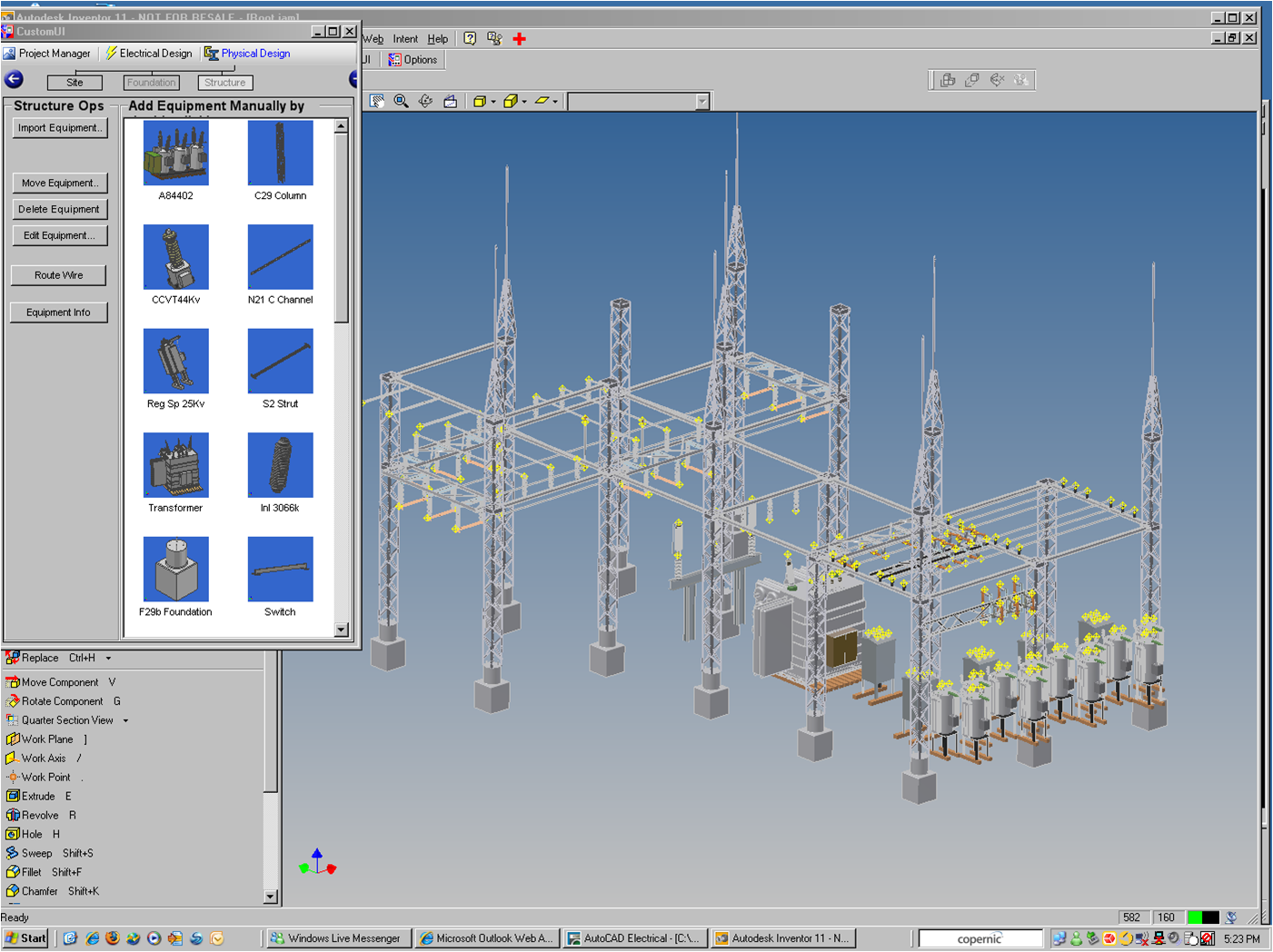 orce to become more efficient. Here’s a couple of examples.
Sub-station Rehabilitation
In North America alone there are over 13 000 sub-stations, many of which have exceeded their original design life. In 2008, it was estimated that 81% of US and Canadian power utilities have sub-station rehabilitation or replacement projects underway. By using model-based design, modern electrical design tools, and 3D visualization, Duke Energy is dramatically speeding up designing and redesigning sub-stations. Arnold Fry of Duke Energy will be talking about this at Autodesk University.
Water Treatment Plant Expansion
When DeKalb County decided to double their water treatment capacity using innovative bioreactor membrane (MBR) technology, they were faced with a large, nearly one billion dollar project involving over 50 people and 10 disciplines. Parsons, the firm selected to design the water treatment expansion, decided 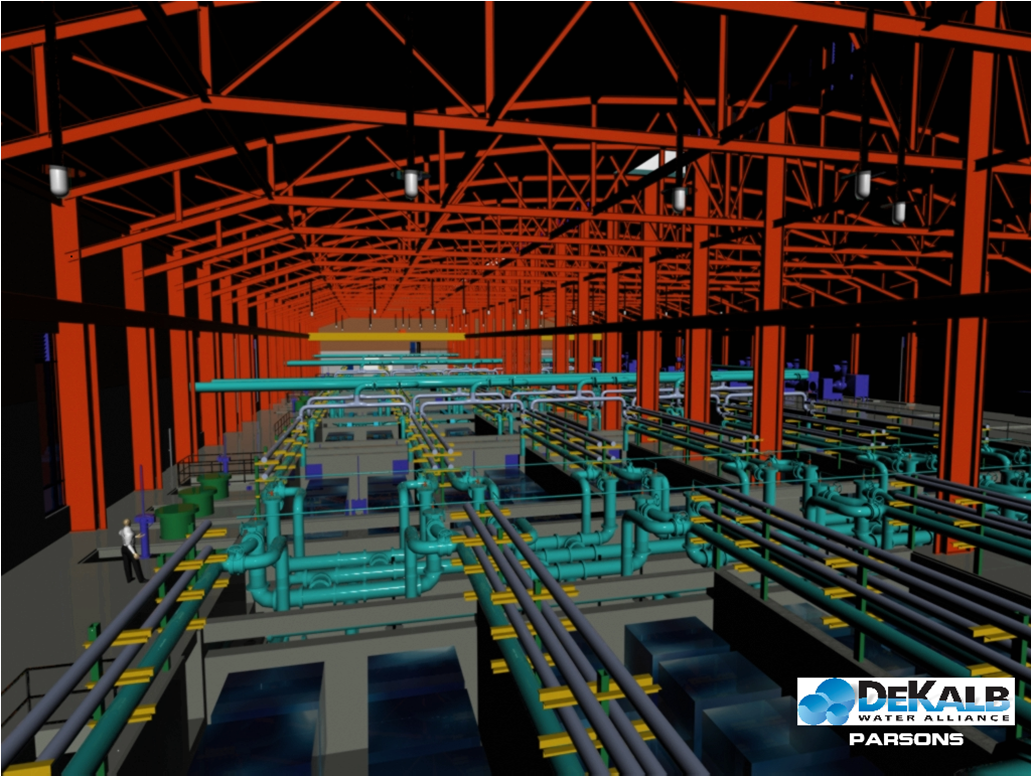 early on to take a model-based design approach to enable collaboration between the different design teams. They also employed 3D visualization tools to ensure that the stakeholders, technical and non-technical, were able to participate in critical design decisions. Asa Reese of Parsons is going to talk about this project at Autodesk University next week.
3D Design and the Millennial Generation
As the older generation of utility workers retires at an increasing rate, utility companies are faced with the challenge of attracting younger workers. The Millennial generation, brought up on Wii’s, PSP’s, and Xbox’s, is looking for challenging opportunities with leading edge technology that not only create a upwardly mobile career path, but also help preserve the environment. The younger generation of utility workers are excited by and feel much more at home with 3D applications rather than traditional 2D design applications. Utility companies are seeing the value in 3D model-based design not only for improved productivity but for attracting and retaining younger employees.
Digital Infrastructure for a Sustainable Economy
An essential part of the worldwide infrastructure transformation is creating and maintaining precise and reliable digital models that will enable us to operate and manage our new sustainable infrastructure efficiently. Integrating precision engineering data, laser scanned point clouds, and traditional GIS data makes it possible to develop a precise synthetic environment that can be used to simulate the inside (utilities, HVAC systems, furniture, elevators, walls, doors, windows, and structural details), outside (aerial utilities, full city blocks of 3D detail, road access), and under (underground water, wastewater, gas, power, and telecommunications systems) of an urban environment creates an intelligent model that can be used for visualization, analysis, and simulation. For example, urban simulation can be used to analyze the load impact of a new building on a utility network, the extent to which solar heating can be used to reduce emissions, and how much daylight will be available in interior spaces at different times of the day and of the year.
The coincidence of technical advances and government stimulus spending motivated by the economic downturn and global climate change is a unique historical opportunity is take advantage of this moment in history to create an intelligent, precision digital infrastructure for energy, water, transportation, communications, and buildings, as the foundation for a new energy efficient and low emissions world economy.

Be the first to comment