
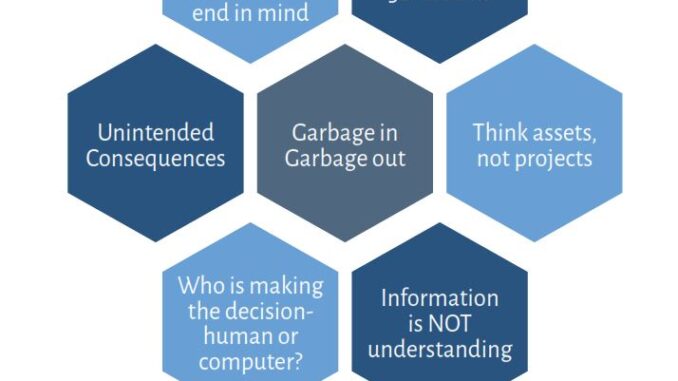
Dr Anne Kemp, Director and Fellow, Atkins, Vice-Chair of BuildingSmart, UK, Chair of ICE BIM Action Group, and Chair of BIM4Infrastructure UK, has published very thought-provoking insights into how the convergence of BIM and geospatial can contribute to the better management of information to help generate the understanding to make better decisions.
Her first assertion “So, let’s put paid to the hang-ups of what is and is not GIS and BIM, and discover what really deserves our focus” is a very good place for all of us to start if we are going to tear down the discipline boundaries that are inhibiting us from moving to a more holistic approach to problem solving in the era of smart cities.
Better outcomes, not BIM or geospatial
Her goal is not to support BIM or geospatial per se, but to use these technologies to improve outcomes. From Anne’s perspective the key outcomes we should be aiming at are
- CLARITY – Clarity of delivery
- TECHNICAL JUDGEMENT – Converging information production with sound engineering judgment and design
- ACCESS – Wider, faster access to comprehensible and integrated information
- LATERAL THINKING – Enabling reflective, adaptive thinking to incorporate whole life and integrated systems approach within the wider geographic context
- INNOVATION – Harnessing innovative technologies and harvesting intelligence from big data
- DECISIONS – Fostering instinctive, but rigorous collaboration and better decision making
Data, not documents
The construction industry is based on documents such as drawings. Documents lock data up within a discipline and prevents the wider access that can be used to build up an integrated view of an asset. In contrast digital data can be used, many times, for different purposes, by different disciplines. This requires interoperability and the ability to map semantics across different disciplines.
Assets, not projects
The full lifecycle view of a building, road or airport requires thinking of assets not projects. Anne’s perspective is that this is where the convergence of BIM with geospatial provides the biggest benefits. The UK government would agree. The short term objective of the UK Government BIM mandate is to reduce the cost of construction (design, tender, build) by 20%. The longer term objective is by 2025 to reduce the costs associated with designing, building, operating and maintaining buildings and infrastructure by a third. ‘In-use’ data from facilities management (FM) systems, building management systems, and sensors including smart phones provides information on how an asset is actually serving the needs of people, and the patterns of behaviour of people using the infrastructure. This information can be used to optimize building or infrastructure design. A geospatial perspective enables this data to be used not only with individual buildings or infrastructure, but for a whole neighbourhood, town or city.
Data ethics
Ensuring that data is not manipulated to distort decision making is critical to enabling the true data-driven organization of the future. Anne’s perspective is that the industry is becoming increasingly dependent on data management professionals. This will require standards and a code of ethics to address challenges of privacy, distortion, and manipulation so as to ensure that data is made available in a way that aids rather than confuses decision making. In the future chief data officers and other information professionals will have even much greater responsibilities – they will be responsible for specifying, collecting, and analyzing the information for decision making that will be critical to the organization’s success, even its existence.
Information is not understanding
Malcolm Gladwell in “Blink” points out that “We live in a world saturated with information. We have virtually unlimited amounts of data at our fingertips at all times, and we’re well versed in the arguments about the dangers of not knowing enough and not doing our homework. But what I have sensed is an enormous frustration with the unexpected costs of knowing too much, of being inundated with information. We have come to confuse information with understanding.”
At a recent BIM conference the term “infobesity” came up more than once. A decade ago people were concerned about not having enough data to make informed decisions. Now that we have more data being collected by sensors such as smart meters and smart phones, the problem is how do we make sense from the huge volumes of data that all these smart devices are collecting.
Anne makes the point that when managed correctly, “instant” decisions based on a small amount of data are not just as good, but can be better than those made after analyzing all available data. The “less is more” challenge is to distill the data to just the right subset to enable you can make better decisions faster with less data. Anne believes that this will require more sophisticated visualization techniques to enable insights from patterns in large amounts of data and better collaboration technology to enable a large number of individuals from different disciplines to understand each other (even when using different terms for the same piece of equipment or construction material) and to collaborate fruitfully.
This means that we will be asking our human or computer information engineers to deliver that essential subset of information to the right people at the right time, and in an intuitively understandable way. Anne suggests that our cartographic and GIS heritage of creating, analyzing and visualizing a view of the physical world as maps may provide a model for future data managers. But, as Anne points out, this will have to be transformed for a virtual environment.
Unintended consequences
Anne’s final point is often overlooked. BIM, geospatial, augmented reality and other technologies are transforming how we view “reality”. There are very real consequences for people working in a virtual world. Anne mentions the first case of internet addition disorder (IAD) involving Google Glasses on October 14, 2014 and asks how many of us are already there with our smartphones and tablets ?

Be the first to comment