

Earlier this year I was invited to give a keynote at the South Africa Surveying and Mapping Indaba. PositionIT has just published the paper Geospatial Information Technology Enables Vertical Industry Solutions based on my keynote.
 Over half of the world’s 6 billion population lives in cities and this proportion is expected to increase as we move toward 9 billion by 2050. This driving investment in new and refurbished buildings and infrastructure. The world’s construction industry including buildings, electric power, water and wastewater, roads, rail, and sea ports and airports contributes about $7 trillion annually or 10% of the world GDP. Over the next two decades these sectors will see a massive infusion of investment estimated in the range $20 to $50 trillion. In addition, as governments find they have less and less money for capital infrastructure projects, a greater proportion of the investment in infrastructure will come from the private sector, which will drive an increased focus on productivity to improve returns on investment. That in turn is driving a transformation of the construction industry that is reflected in accelerating adoption of vertical industry solutions based on integrated BIM, imagery, geospatial, 3D visualization, and geospatially-enabled data management.
 The article presents some real-world examples of the application of converged BIM, imagery, geospatial, and 3D solutions.
- In the construction world 3D modeling and model-based design which integrate BIM, GIS and survey, and laser-scanning (LiDAR) in a 3D visualization environment are increasingly being used to reduce the risk of budget and schedule overruns. Parsons-Brinckerhoff, part of the the large global construction firm Balfour Beatty, has been a leader in applying 3D modeling for design validation, clash detection, parameteric modeling, and design visualization during design and 4D modeling (time+3D), 5D (cost+time+3D) for construction scheduling during construction.
- Laser scanning (LiDAR) has become an integral part of the 3D construction process. For example, construction monitoring involves capturing construction progress as well as being able to automate the process of checking for divergence from design when contractors for a variety of reasons don’t build what is designed.
- Heathrow’s Map Live system allows everyone within the business to query, including geospatial query, retrieve and view information about the geolocation about Heathrow’s underground infrastructure.
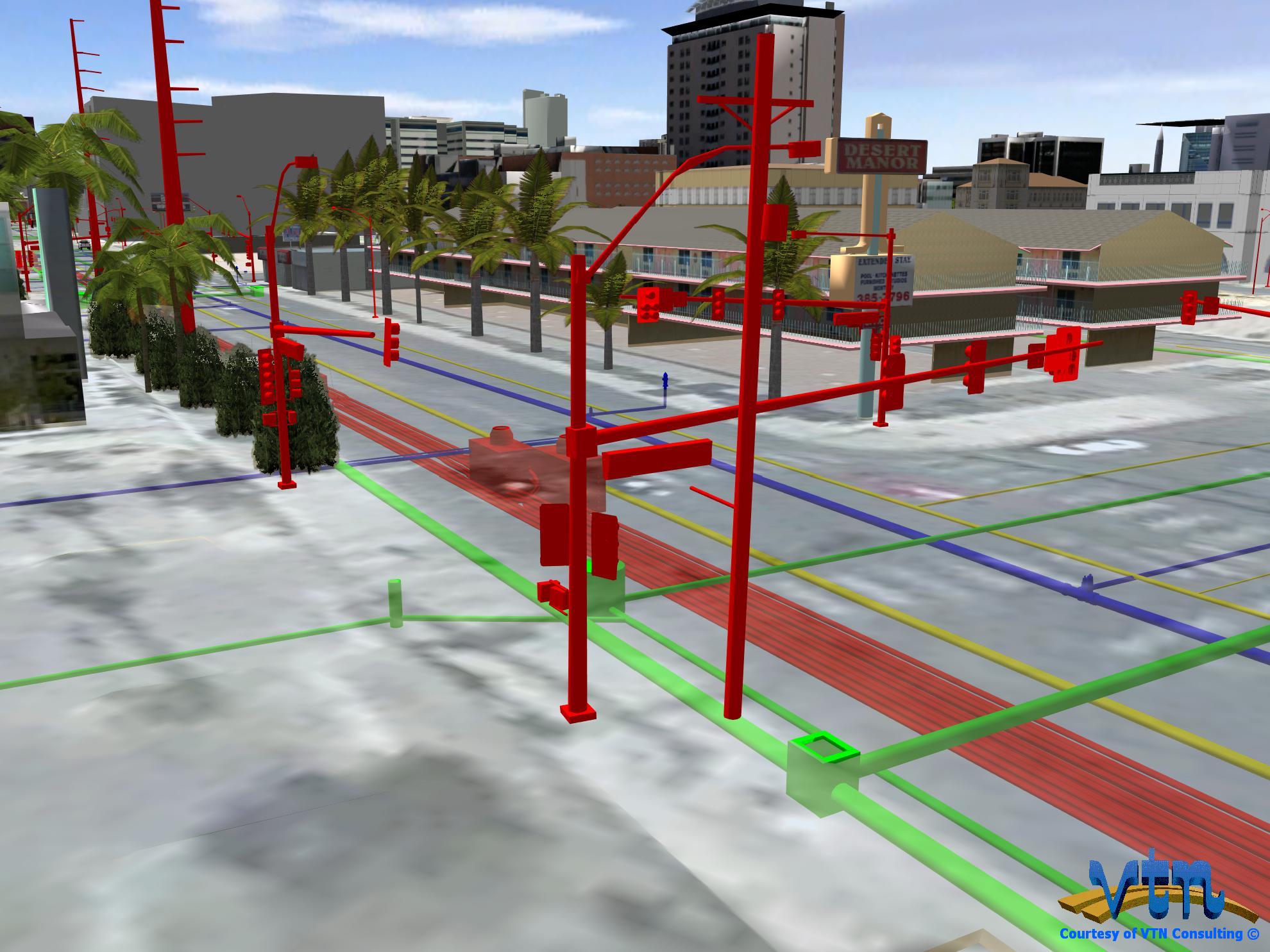
- City of Las Vegas’s intelligent 3D model of one and half miles of Main Street in the older part of Las Vegas provides access to geolocation information about Las Vegas’s below and above ground facilities including roadways, utilities and telecommunications, as well as buildings.
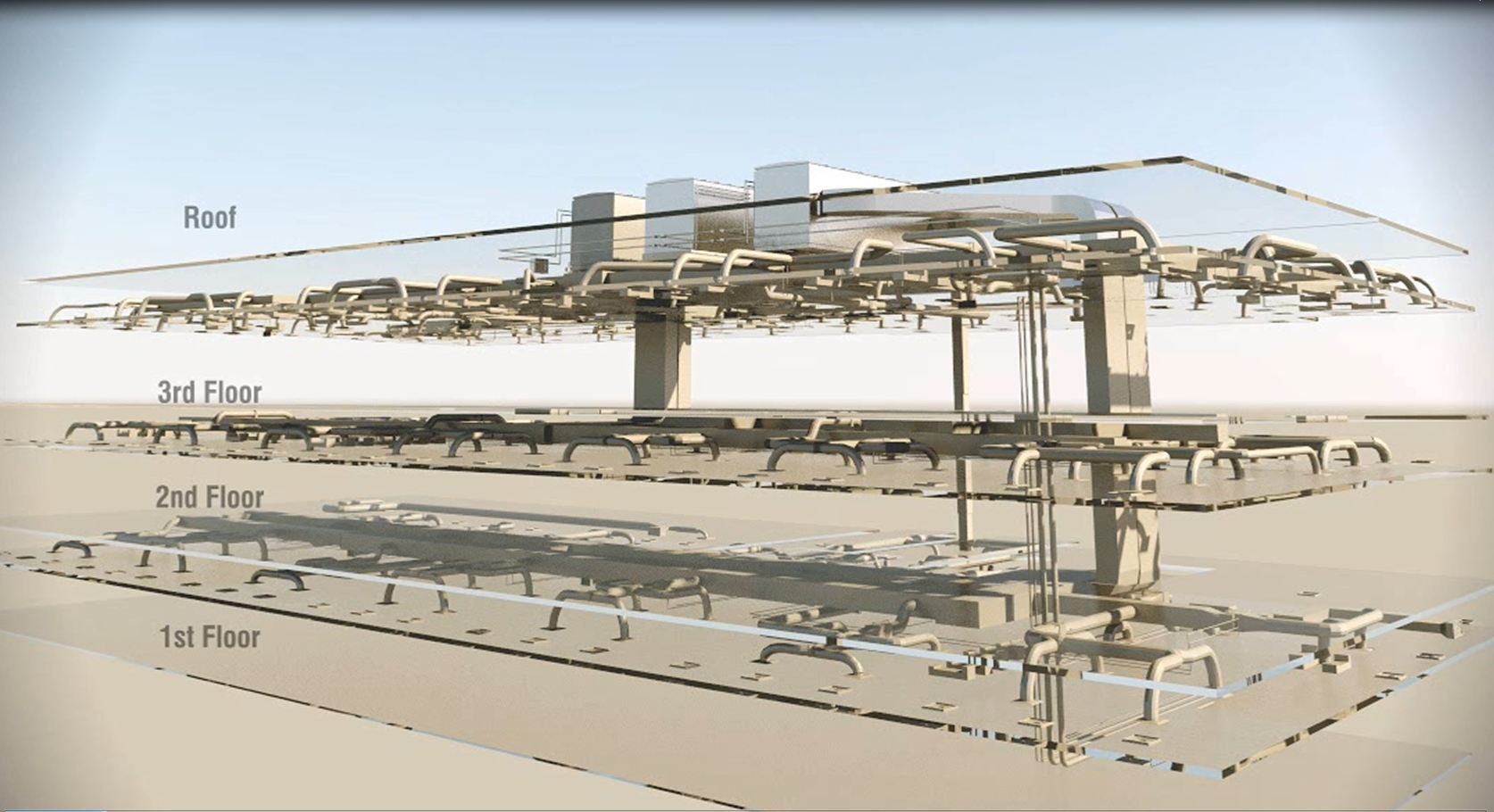
- Los Angeles Community College District’s created 3D BIM models of all the buildings including interior power, water, mechanical, and lighting systems together with 2D models of underground infrastructure on the nine LACCD campuses.
- Energy performance analysis helps architects and engineers to optimize energy usage of new buildings, often motivated by programs such as LEED certification. By integrating a 3D BIM model with the geolocation of the building and surrounding natural and man-made structures and local environmental conditions, an energy performance analysis is often able to reduce annual energy consumption and power bills by 40%.
These real-world examples show that the application of converged BIM, imagery, geospatial and 3D technology to vertical industries is not star wars, but is already feasible with existing technology.
Be the first to comment