
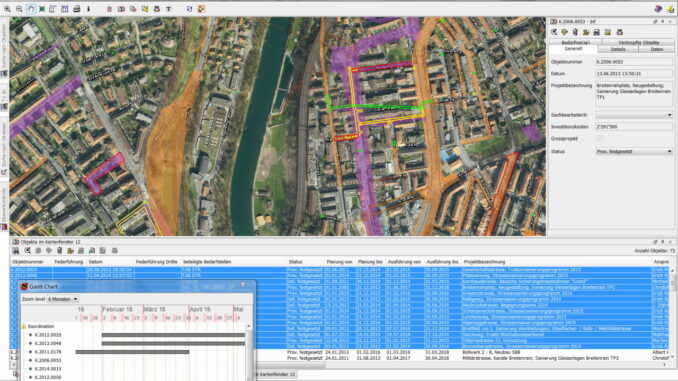
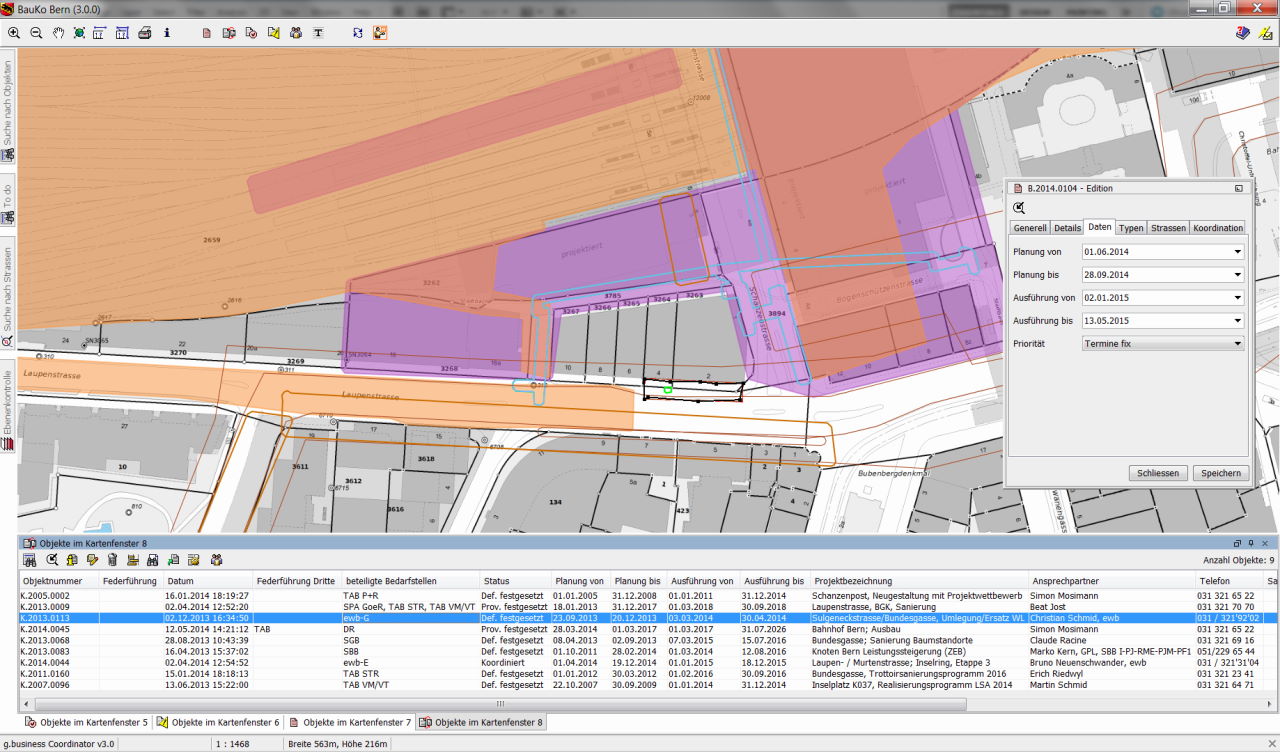
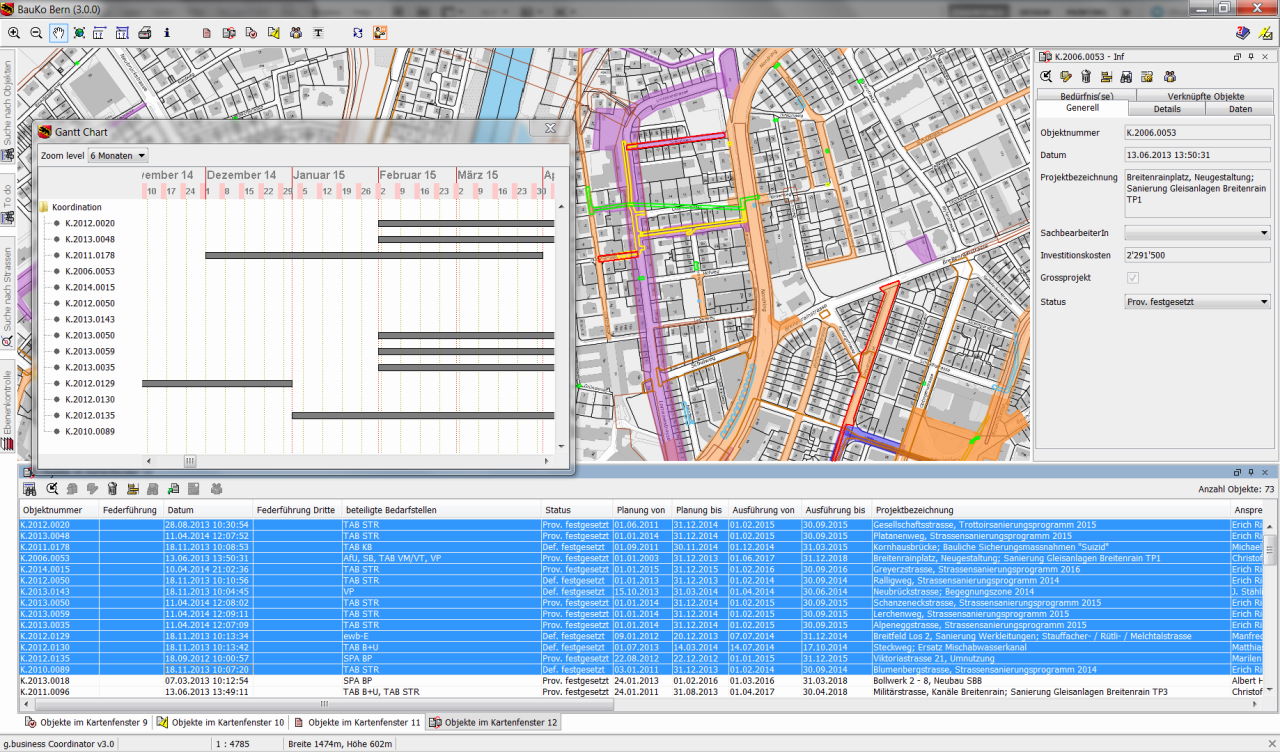
While in Switzerland for Geospatial World Forum 2014 I had the opportunity to spend some time with Dr. Martin Huber of Condesys Consulting who is responsible for the online web-based system Koordination im öffentlichen Raum (Spatial, temporal and financial co-ordination of city planning, traffic change, and construction projects on public land) of the City of Bern. This is a primarily a system for coordinating street works that achieves some of the same goals as the 2004 Traffic Management Act in the U.K. It is location aware and enables planners to avoid serial excavations of the same stretch of street or road by coodinating all construction from multiple agencies including Federal, Kantonal and city street and highway agencies, water/wastewater, gas, and electricity utiltiies, and telecommunications companies so that a section of street or road is not dug up more than once every five years.
 The City of Bern typically spends between SFR 80 and 200 million annually on construction for public infrastructure. The initial phase of the coordination system cost about SFR 150,000. In its first year of operation it was estimated that the coordination system saved SFR 7 million. In other words the project paid for itself in about a week.
 In 1999 regulations were passed by the city government requiring coordination among stakeholders involved with public infrastructure. Basically the bylaw specified that all excavation on public property within city limits required a permit. Stakeholders include the city electric and water utility (Energie Wasser Bern or EWB), Swisscom, UPC Cablecom, Colt Telecom, two railways (SBB and BLS), the Postauto bus system, billboard advertising companies, environmental agencies, archaeological agency, the agency responsible fro public monuments, the garbage collection department, fire, police and emergency agencies, Kantonal public works, and the Federal Highways Agency (Bundesamt für Strassen or ASTRA). What this means in practice is that all projects involving a certain road or stretch of highway are coordinated so that they all happen at the same time. After completion of construction there is a moratorium on any further excavations on the same stretch of street or road, except for emergencies, for five years. It also means that everyone who is affected by street work from garbage collection to billboards to city planners is aware of when and where construction will occur.
The initial implementation of the system, developed by Condesys, was deployed in 2000. In 2001 it received an award from Arthur Anderson for best egovernment application.
Geolocating underground infrastructure
In Bern the law requires that anyone planning a construction project involving excavation has to submit information about the proposed constrcution to the online coordinaton system. Providing reliable information about the location of underground infrastructure is the responsibility of the organizations operating the infrastructure.
In Switzerland each utility and telecommunications company is responsible for maintaining records that show the location of their underground infrastructure. In Bern they are required to provide the location of their underground facilities to the City Survey Office (Vermessungsamt der Stadt Bern ) who is responsible for aggregating the data from the multiple utiltiies and telecommunication companies into a single database (Leitungskadaster) and making it publicly available.
As in many parts of the world the data quality of this underground geolocation information (Leitungskadaster) is an issue. According to Martin utilities and telecoms are currently working to improve the quality of their geolocation infrmation about underground facilities. Swisscom is spending about SFR 250 million to resurvey their infrastructure and other utilties have similar projects underway. By the end of 2014 EWB and Swisscom are expected to have improved the reliability of their geolocation information about their underground infrastructure in Bern.
The city has also put in place regulations to ensure that accurate data is captured for new construction projects involving underground infrastructure. For example, there is a 24 hour rule that requires a contractor to notify the city survey department 24 hours before closing a trench. For large projects city surveyors periodically survey underground works.

Be the first to comment