
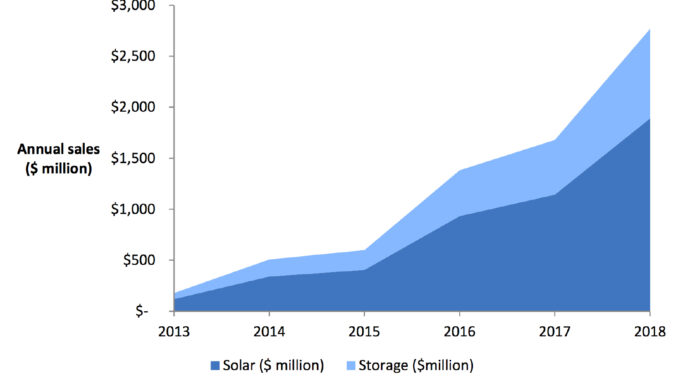
Coupled solar PV and energy storage systems projected to reach $2.8 billion by 2018

I blogged recently about SolarCity’s plan to develop a system with partners that will combine Tesla Motors’ vehicle battery system with SolarCity solar systems to create a combined photovoltaic (PV) and stationary storage product which can be installed in homes and businesses. The battery storage would collect excess PV power production so that at night or during peak periods, consumers or even utilities could pull from battery storage rather than CO2 emitting power plants.

Lux Research has released a report Batteries Included: Gauging Near-Term Prospect for Solar/Energy Storage Systems that projects that the coupled Solar and energy storage (lithium ion batteries) market will grow to $2.8 billion in 2018.  Lux projects that residential applications will be the primary driver through 2018 growing to 382 MW in 2018. It will be followed by the light commercial segment which is projected to reach 220 MW by 2018.  Most of the installations (95%) will be linked to the electric power grid.

Internationally Japan is expected to lead in coupled Solar and energy storage installations, reaching 381 MW by 2018.  Germany and the U.S. are projected to follow with 94 MW and 75 MW, respectively.

Government policies are being put in place to stimulate the energy storage market.  In 2013 Germany set aside $67 million to subsidize solar-tied energy storage and the U.S. Senate introduced a program that could fund $7.5 billion worth of new storage projects, or about 7.5 GWh of capacity.  Receblty the California Public Utilities Commission (CPUC) has mandated energy storage procurement targets for Pacific Gas and Electric Company (PG&E), Southern California Edison Company (SCE) and San Diego Gas & Electric Company (SDG&E) totalling 1.325 GW.

Geoff Zeiss

Geoff Zeiss

Geoff Zeiss has more than 20 years experience in the geospatial software industry and 15 years experience developing enterprise geospatial solutions for the utilities, communications, and public works industries. His particular interests include the convergence of BIM, CAD, geospatial, and 3D. In recognition of his efforts to evangelize geospatial in vertical industries such as utilities and construction, Geoff received the Geospatial Ambassador Award at Geospatial World Forum 2014. Currently Geoff is Principal at Between the Poles, a thought leadership consulting firm. From 2001 to 2012 Geoff was Director of Utility Industry Program at Autodesk Inc, where he was responsible for thought leadership for the utility industry program. From 1999 to 2001 he was Director of Enterprise Software Development at Autodesk. He received one of ten annual global technology awards in 2004 from Oracle Corporation for technical innovation and leadership in the use of Oracle. Prior to Autodesk Geoff was Director of Product Development at VISION* Solutions. VISION* Solutions is credited with pioneering relational spatial data management, CAD/GIS integration, and long transactions (data versioning) in the utility, communications, and public works industries. Geoff is a frequent speaker at geospatial and utility events around the world including Geospatial World Forum, Where 2.0, MundoGeo Connect (Brazil), Middle East Spatial Geospatial Forum, India Geospatial Forum, Location Intelligence, Asia Geospatial Forum, and GITA events in US, Japan and Australia. Geoff received Speaker Excellence Awards at GITA 2007-2009.

View article by Geoff Zeiss

Be the first to comment

Leave a Reply

Your email address will not be published.


*