
The UK Government as part of its building information modeling (BIM) initiative has said repeatedly that it expects the big payoff of a digital model, estimated at more than 40% savings, will be during operations and maintenance, typically representing 80% of the total cost of a facility. Companies such as BAM who do Design, Build, Finance and Maintain (DBFM) projects report significant benefits from full lifecycle BIM + geospatial. But there is little if any quantitative evidence supporting this conjecture. I have asked people from Finland familiar with the very early BIM developments in that country if there were studies of the benefits of BIM for operations and maintenance, but apparently the BIM focus there has been entirely on design and build.
Crossrail with a budget of £14.8 billion is the biggest engineering project in Europe. It involves 42 km of tunnels beneath one of the most densely populated parts of Europe. It has wider tunnels and its 40 stations have longer station platforms than the Tube has. Crossrail trains are expected to start running next year and the full network should be open by 2019.
But the most interesting aspect of the Crossrail project is a 3D digital model with associated asset data that has not only been used during design and construction, but is intended to be used for operations and maintenance. Crossrail appears to be the first major project that may be able to provide support for the conjecture that the biggest benefits of BIM are for operations and maintenance.
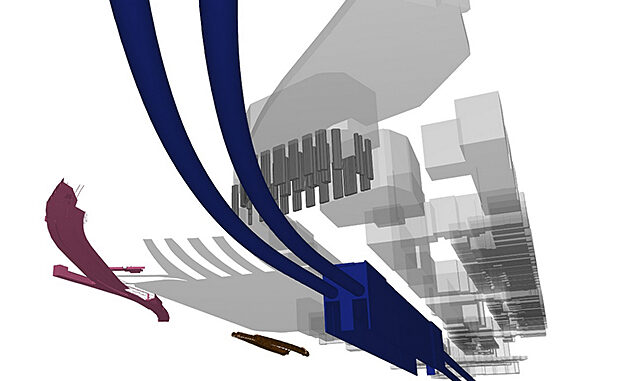
The Crossrail model is comprised of spatial and non-spatial data with links between the two. The spatial data is made up of more than 250,000 3D BIM models as well as as-builts, together comprising a few terabytes. As construction of each facility is completed as-builts are collected by point-cloud survey using laser scanners. The point clouds captured in the survey are compared to the design and divergences that need resolving are recorded for fixing. The detailed asset data and documentation add an additional 5 terabytes. This represents one of the World’s largest BIM model. A critical aspect of the spatial database is that all assets are geolocated so that workers can query a particular location of London on a map and then navigate to the Crossrail assets there.
The model is intended to become a crucial tool for monitoring, operating and maintaining Crossrail’s systems once the railway is running. Sensors monitor various aspects of the railway’s operation and remote-controlled devices can change operating parameters from a central control room or from a handheld device. Managers can view this information within the 3D model and can zoom in on an area which needs attention. Crossrail is testing low-power wireless smart sensors called Utterberries that can monitor strain, temperature, humidity, acceleration, and other aspects of a facility. Utterberries weigh 15 grams and are smart – they have an ARM processor on-board and can operate for more than a year on one charge. One of the coolest capabilities of the digital infrastrucure is an augmented-reality interface which allows workers to hold an iPad up to a wall or floor and see a view of the infrastructure (electricity, water, and communications) under the floor or behind the wall.

Be the first to comment