
I spent a fascinating day at the CanBIM Regional Session & Technology Exhibition in Toronto. I was very impressed by how much things relating to BIM have progressed in Canada, which has generally lagged the countries spearheading BIM development, partly because of government inaction.
One of the most interesting presentations today was by Erin Morrow of Arup who talked about two pedestrian simulation products he has been responsible for developing, MassMotion and Flow. These are 3D agent-based models. They are based on real spaces with continuously connected 3D geometry and crowd interactions. Agents have size and acceleration, personalities that prefer things like avoiding going up stairs. They can dynamically assesses their environment and make routing decisions. Social forces determine how agents respond to their environment, other people, and goals. They try very hard not to hit obstacles or bump other agents. Agents are able to make autonomous decisions based on this continuous space. For example, MassMotion can simulate how agents will be behave when faced with a choice between a crowded elevator or empty stairs.
There are also tools for assessing the result of a simulation including 3D dynamic visualization and various quantitative metrics such as density in various parts of the model, how long it takes people to get from one point to another, what route do most people take, flow rates through doors and up escalators, and and others.
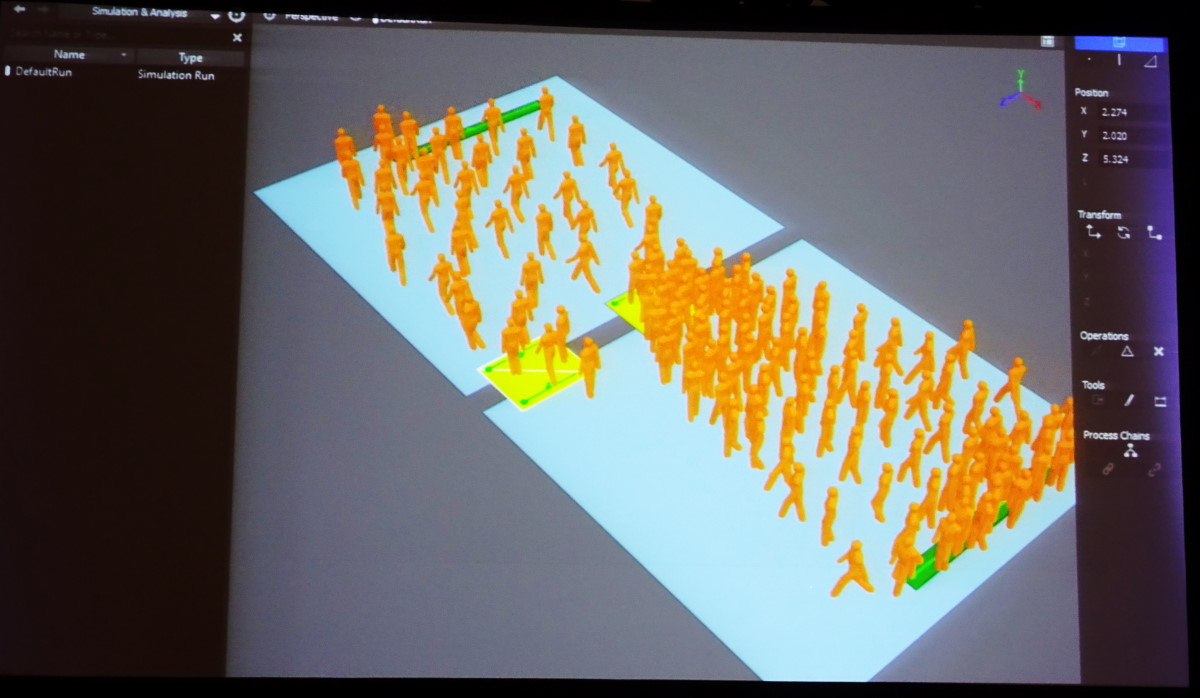 The simulation tool defines portals, where people can enter or leave from, spaces where agents can go anywhere, connectors that connect rooms and other features. Erin demonstrated live how to create a simple model with two rooms, connected by a door, with a portal where people entered and an exit portal. He created a simulation where 100 people enter the first room every minute and visualized the crowd flow in 3D. It was fascinating to watch how people bunched in front of one of the connecting doors and then the other.
The simulation geometry can be developed from scratch in MassMotion. But for complex structures it is much simpler to import a BIM model (MassMotion imports IFC models from a variety of software including AutoCAD, Microstation, SketchUp, Rhino, and Revit. ) to create spaces and connectors including stairs and escalators. 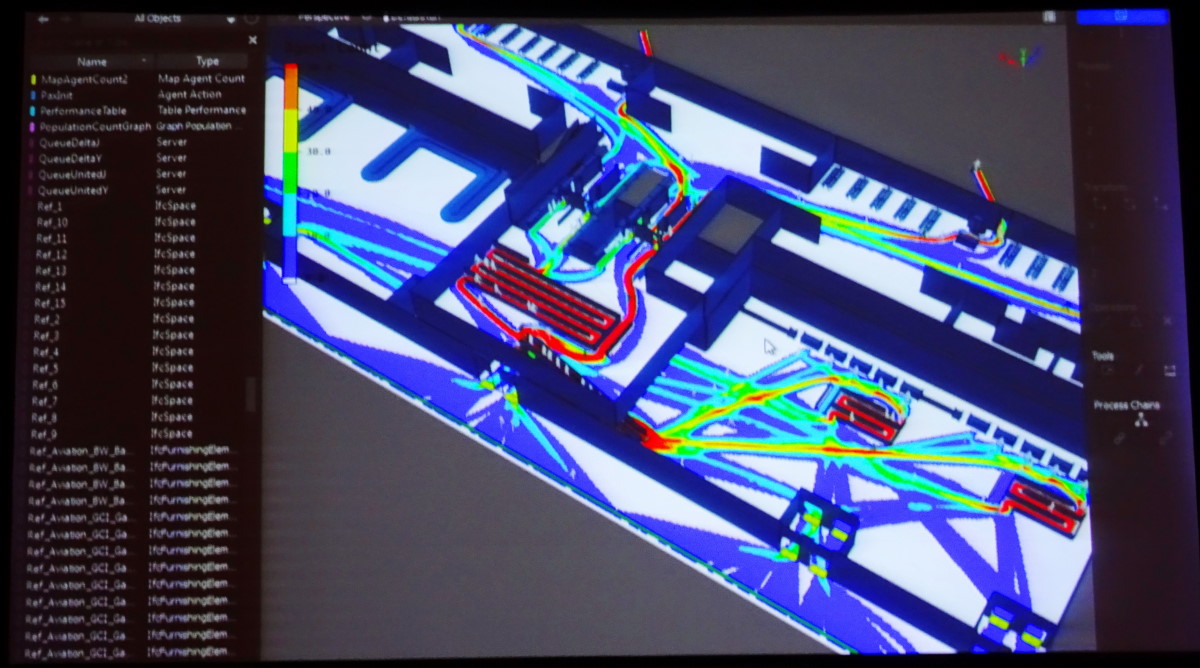 Erin demonstrated doing this with a BIM model of an airport. MassMotion was able to correctly identify 90% of the elements it recognizes such as rooms, doors, stairs and escalators. In the demonstration some editing was required to make sure there was a continuous geometry. For example, an escalator needed editing to logically connect to the upstairs floor. Then the user adds other information such as portals, sources where people come from, sinks where people go and rates of flow through the portals people enter from. People may come from outdoors or train cars and they may be going to gates to catch planes.
The software has roles to play during design, during construction, and as a management tool throughout the lifespan of a building and surrounding areas. It can be used operationally during construction to design alternate routes during construction. The software was used to simulate passenger movements during a full day at the new Jetblue T5 terminal at JFK airport in New York with the objective of ensuring passenger comfort and fluidity of motion in the terminal.
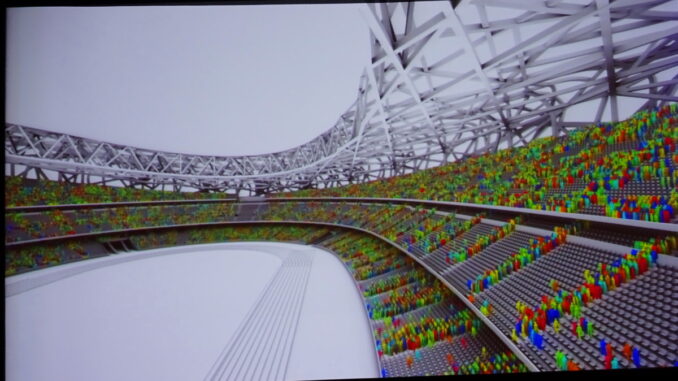
There are many other applications used by engineers and planners including evacuation analysis. One of the interesting results that Erin mentioned was that the Roman Coliseum built in 70 CE could be evacuated in 15 minutes, the same time it is estimated it takes to evacuate the recently built Olympic stadium (the Bird’s Nest) in Beijing.

Be the first to comment