

Since Google Earth’s release in June 2005, national mapping agencies (NMCAs) and other government organizations involved with geospatial data and technology have been reassessing their role. At the Geospatial World Forum (GWF) in Amsterdam two years ago, Paul Cheung of the United Nations Initiative on Global Geospatial Information Management (GGIM) voiced the concern about their role that many national mapping agencies and other government organizations with responsibility for geospatial information have had since the advent of Google Earth, private data companies like Digital Globe, crowd-sourced geospatial data like OpenStreetMap, and open data policies adopted by many governments around the world.
The challenge for NMCAs is that in parts of the world, Google. Bing, OpenStreetMaps, or a local crowd-sourced alternative like Malsingmaps provides more comprehensive, accurate, current and accessible data with less restrictive licensing and at a lower cost than the NMCA. A report from the GGIM argues that “governments have a key role to play in bringing all actors together to ensure that our future society is a sustainable, location-enabled one, underpinned by the sustainable provision and effective management of reliable and trusted geospatial information.” In other words governments and NMCAs have a unique critical role in developing and maintaining authoritative national databases. To improve the quality and timeliness of these authoritative databases many have argued that NMCAs need to find ways to incorporate volunteered or crowdsourced geospatial data in these databases.
In the United States the National Map is a significant contribution to the National Spatial Data Infrastructure (NSDI). It is a collaborative effort among the US Geological Survey (USGS) and other Federal, State, and local partners to deliver topographic information for purposes that range from recreation to scientific analysis to emergency response. The geographic information available from The National Map includes orthoimagery, elevation, geographic names, hydrography, boundaries, transportation, structures, and land cover.
In addition to being an important contribution to the NSDI, the National Map is a foundation for the Department of the Interior (DOI) Geospatial Modernization Blueprint and its mission to protect America’s treasures for future generations, provide access to America’s natural and cultural heritage, offer recreation opportunities, honor trust responsibilities, conduct scientific research, provide wise stewardship of energy and mineral resources, foster sound use of land and water resources, and conserve and protect fish and wildlife.
 The USGS’s National Map Corps (TNMCorps) was initated a year ago as a nationwide program with the goal of using volunteered or crowdsourced data for the National Map. TNMCorps’ Volunteered Geographic Information (VGI) project engages citizen scientists to collect manmade structures data including: schools, hospitals, post offices, police stations and other important public buildings. In the past year, civilian volunteers in
 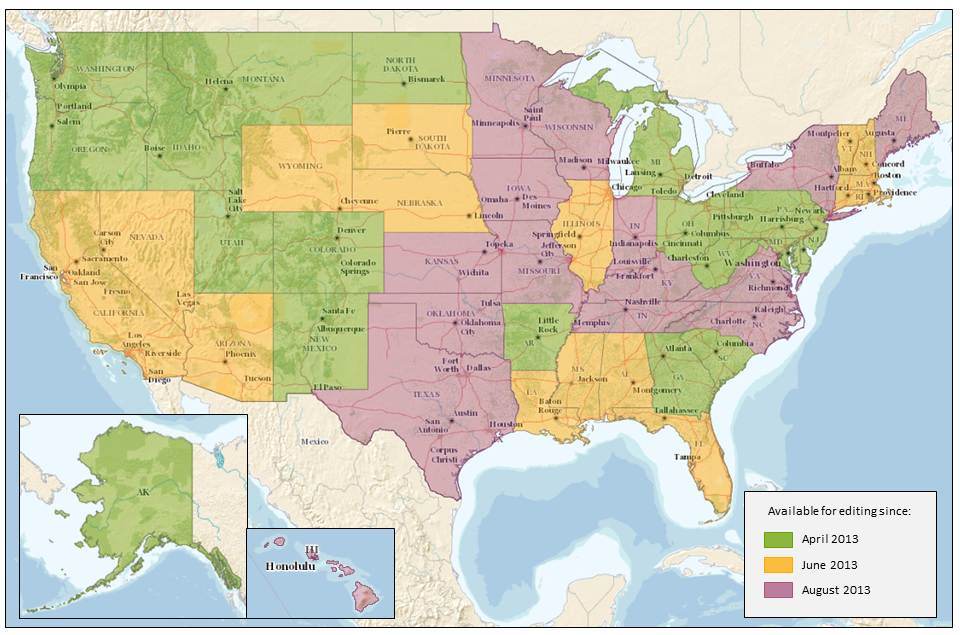 50 U.S. states have begun providing accurate geospatial data to the The National Map,
- 1,422 – volunteers
- 50,696 – total number of edits
- 50 – U.S. states
According to the Director of the National Geospatial Technical Operations Center in the U.S.”This project has proven that we can count on volunteers to provide quality information to be included in authoritative government databases“.
If you are interested in becoming a volunteer for TNMCorps, go to the National Map Corps project site to sign up.
Thanks to Dave Smith for pointing me to this.

Be the first to comment