
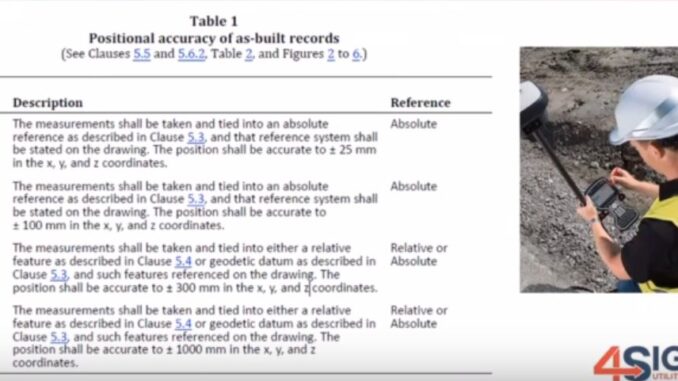
In Canada the goal of the Canadian Standards Association (CSA) S250 Standard, first published in 2011 and revised in 2020, is to specify mapping requirements for the recording and depiction of newly installed underground utility infrastructure and related structures. It is intended to promote communication and data sharing throughout the construction lifecycle of projects and asset life. Specifically it is intended to improve the reliability and accuracy of underground utility infrastructure mapping records and supporting data. Accurate records provide greater safety to the public and construction workers by decreasing utility infrastructure line hits and strikes and by augmenting and enhancing damage prevention programs, such as state and provincial one call programs and initiatives by contractors, utility owners/operators and state and provincial transportation agencies. CSA S-250 has been adopted by agencies such as the Ministry of Transportation of Ontario and the Ontario transit authority Metrolinx and utility owners such as Enbridge. The best practices guide developed by the Transportation Association of Canada (TAC) recommends that “as-builts” submitted for newly installed and relocated infrastructure be compliant with CSA S-250.
The CSA S-250 standard is a precursor to and has much in common with the new U.S. “as-installed” standard ASCE 75-22 developed by the Utility Engineering and Survey Institute (UESI) and already in use in Colorado and Montana. In particular the horizontal and vertical positional accuracy levels adopted by ASCE 75 are shared with S-250 and while not identical are very close.
CSA S-250
The CSA S-250 standard specifies 3D mapping requirements for the recording and depiction of underground utility infrastructure and related attributes at or below grade. Unlike the ASCE 75 standard it does not apply to above grade infrastructure such as poles and overhead wires. It was one of the first standard to specify levels of positional accuracy – for both horizontal and vertical dimensions. Throughout the standard “shall”, “should”, and “may” are used consistently to distinguish mandatory, recommended, and optional requirements.
What’s new in CSA S250:20 ?
New field locating and mapping technologies are being developed and existing technologies evolving. The latest version of the standard has expanded the recognized technologies to include LiDAR, total station survey (TSS) and video recording for supplemental records. The requirements for mapping records has been expanded to include all stages of operational status; proposed, existing, abandoned in place, retired, or reserved for future use. The challenge of digital base mapping is explicitly discussed, because in North America in general every utility has adopted a different base map. Clarification is provided on how information is to be collected and used to depict the location and attributes of utility infrastructure so users can be confident of its level of reliability and accuracy. The owners’ responsibility for measuring and recording the location of underground utility infrastructure has been revised. The requirements for absolute spatial positioning (i.e., horizontal and vertical datums) have also been revised. The importance of open data standards, for example the Open Geospatial Consortium’s MUDDI standard, that enable data sharing between industry partners has been explicitly recognized.
The revised standard specifies that field records and data “shall” be collected contemporaneously during construction. The owner “shall” define the type and format of the field records collected. Field records “should” be the primary source of mapping information. Furthermore, anyone who discovers what appears to be a significant discrepancy during construction, excavation, SUE activities, and locating “should” report the discrepancy to the owner and/or source of the record in a timely manner.
Example of petroleum/gas distribution system
As a concrete example of the level of detail that is provided by the standard, for a liquid petroleum or gas pipe distribution system, the standard specifies a minimum set of properties that “shall” be captured and others that “should” be captured.
Mandatory
horizontal and vertical position and accuracy levels
cross-sectional size of pipe
material type of pipe
material of casings
pipeline coating
cathodic protection
Recommended
Valves, tees, fittings and plugs
Compressor stations, pressure reducing stations
Pipeline maximum operating pressure
Symbolization
A solid line “should” be used to depict existing infrastructure, an “x” though the solid line “should” be used to depict abandoned facilities, hatching “may” be used to depict proposed infrastructure.
This post is based on Lawrence Arcand’s talk at the Canadian Underground Forum (CUF). You can listen to all the talks at CUF on the GeoIgnite CUF Youtube channel.

Be the first to comment