
At the Global Geospatial Conference 2012 in Québec City, Ed Parsons of Google argued in favour of web access to micro data including geospatial.
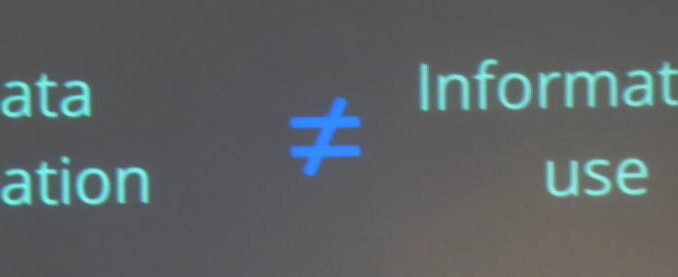
Google’s goal is to organize the world’s information, of which geospatial is just one type and not really so special, as Jack Pellicci then of Oracle, has been advancing for many years. Ed emphasized the the importance of access to data by paraphrasing the well-known movie adage, if you build it, they will not necessarily come. In the case of spatial data infrastructure (SDI), a lot of this data has been available for a long time, but without access it has sat on shelves gathering dust. Data creation is not information use and the focus on data creation has obscured the importance of analysis and visualization, and above all access. Fortunately, the global information infrastructure already exists to enable this to happen in the form of the Web, which Google used to fundamentally change the way the world accesses spatial data.
Web access to micro data
 He then gave an example of being able to access information about one if his favourite pubs in London by a single click, and said that we should be able to access information about individual items of infrastructure, whether a utility pole, power transformer, or water valve in the same way. Fundamentally this is the internet of things where everything has an internet address or URI. He gave another example, accessing information about a particular property parcel in Nanaimo, BC with a single click, which is also a good example of how the web allows you to visualize the same data in different ways.
He also made the case for adding more structure to the web, as a way of making the information you retrieve on the web more meaningful. Many sites are generated from structured data, typically stored in databases. When this data is formatted into HTML, it becomes very difficult to recover the original structured data, but many applications, especially search engines, can benefit greatly from direct access to this structured data. One way to do this is to use a standard set of html tags, defining schemas, that you can use to markup web pages in ways recognized by major search providers.

Be the first to comment