
One of the highlights of this this year’s RICS BIM Conference in London was the keynote presentation Delivery of Level 2 BIM by Terry Stocks, Deputy Head of Estates Department, Ministry of Justice and Delivery Director for Level 2 BIM, UK BIM Task Force.
As people in the construction industry are aware, next year all central government construction projects (which represents about half of the construction industry in the UK) will require building information modeling (BIM) Level 2. The short term objective is to reduce the cost of construction (design, tender, build) by 20%. The longer term objective is by 2025 to reduce the costs associated with designing, building, operating and maintaining buildings and infrastructure by a third.
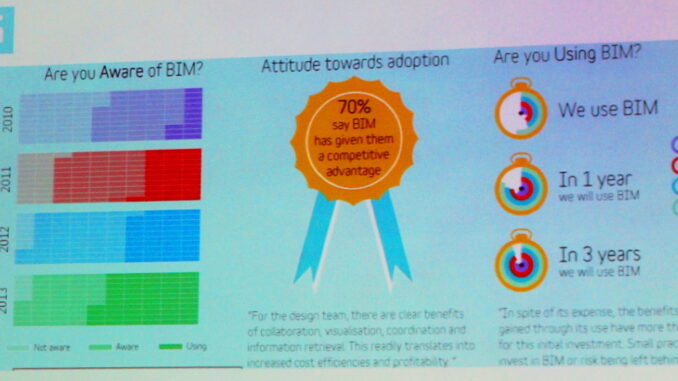
An industry survey in the UK last year reported that 54% of respondents in 2013 said that they were using BIM on projects. Most of those not yet using BIM said that they would be within one to two years. 70 % of the respondents reporting using BIM said that BIM has given them a competitive advantage. Terry’s perspective is that BIM is fast becoming the standard way of working for designers and contractors on most construction projects – public and private.
Goal: Avoiding waste
Terry pointed to a recent Economist article which included statistics that explain the primary driving force – avoiding waste – behind BIM adoption around the world. According to the Economist 30% of the construction process is rework, 50% of the labour effort is wasted, and there is a furthe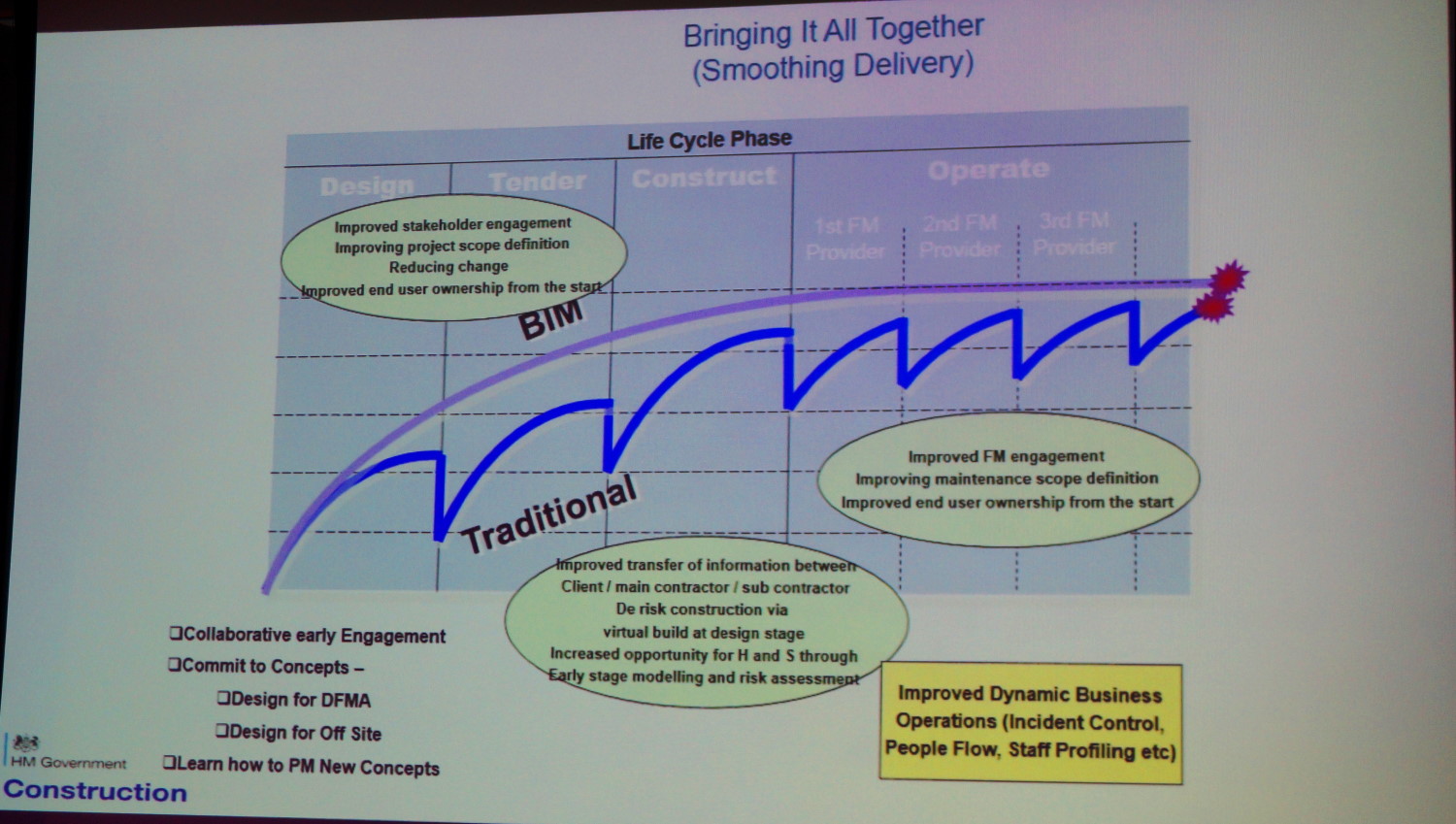 r 10% loss due to wasted materials. Even more critically for the operations and maintenance phase of the lifecyle, 3-5% of the construction turnover is lost at the discipline interface (design, tender, construct, and operate). The discipline interface data loss resembles a sawtooth diagram with the result that the construction information required to maintain and operate the building is often inaccurate and incomplete.
An important objective of the full lifecycle BIM initiative is to smooth delivery and avoid data loss at the discipline interfaces. Some of the key ways to enable this to happen are collaborative early engagement including clients (owners), designers, contractors, and facilities managers (FM) from the beginning and improving inter-discipline interoperability to improve the transfer of information between the client, designers, the main contractor, sub contractors, and facilities managers. For example, all handover data will be provided in a structured format “COBie UK 2012”.
One of the challenges relating to data that several speakers mentioned is “infobesity” – attempting to collect and maintain too much data. The simple guideline suggested to avoid this problem is to only collect data that you have the resources to maintain (keep up-to-date) and that contributes significantly to operational efficiency. This requires close collaboration between the owner, facilities managers, designers and contractors from the beginning of a project.
Delivery of BIM Level 2
BIM Level 2 is a set of discipline-specific models (architectural, structural, HVAC, services, etc) with a single environment to store shared data and information. The delivery of BIM Level 2 in the UK is the responsibility of the UK BIM Task Force supported by key government departments. It involves building knowledge and capability in government departments, building capability in the supply chain, and encouraging BIM capacity development in the private sector through initiatives such as BIM4SME and other BIM4 community development efforts. One of the most important initiatives is the development and publication of seven key documents which collectively represent an impressive repository of BIM best practices. Just about every speaker at the RICS BIM conference referenced these documents.
- PAS 1192:2 – Specification for information management for the capital/delivery phase of construction projects using BIM
- PAS 1192:3 – Framework for an asset owning or operating organization to identify its information requirements and to create an asset information model with a governance method.
- BS 1192-4 – Collaborative production of information: Fulfilling employers information exchange requirements using COBie. All handover data will be provided in a structured format “COBie UK 2012”.
- CIC BIM Protocol – The BIM Protocol is a supplementary legal agreement that is incorporated into professional services appointments and construction contracts by means of a simple amendment. The Protocol creates additional obligations and rights for the employer and the contracted party.
- Classification – A series of tables which classify all aspects of the life cycle of a project to structure data in order to support the BIM process and facilitate collaboration. Expected to be based on CPIC Uniclass 2. (Under development)
- Digital Plan of Works / Levels of Detail (LoD) – Documents the concepts and detail of the management of built asset data derived from the process of building and managing building information models including how this data is defined, tested and effectively used by both the supply chain and the public client. Level of Detail specifies the level of geometric information a model should exhibit. (Under development)
- Government Soft Landings – “Design for operation” to encourage better outcomes using BIM for built assets during the design and construction stages to ensure value is achieved in the operational lifecycle of an asset. For example, early engagement of the end user (owner) during design and construction through to operational handover using BIM to provide a fully populated asset data set into the end user’s facilities management system.
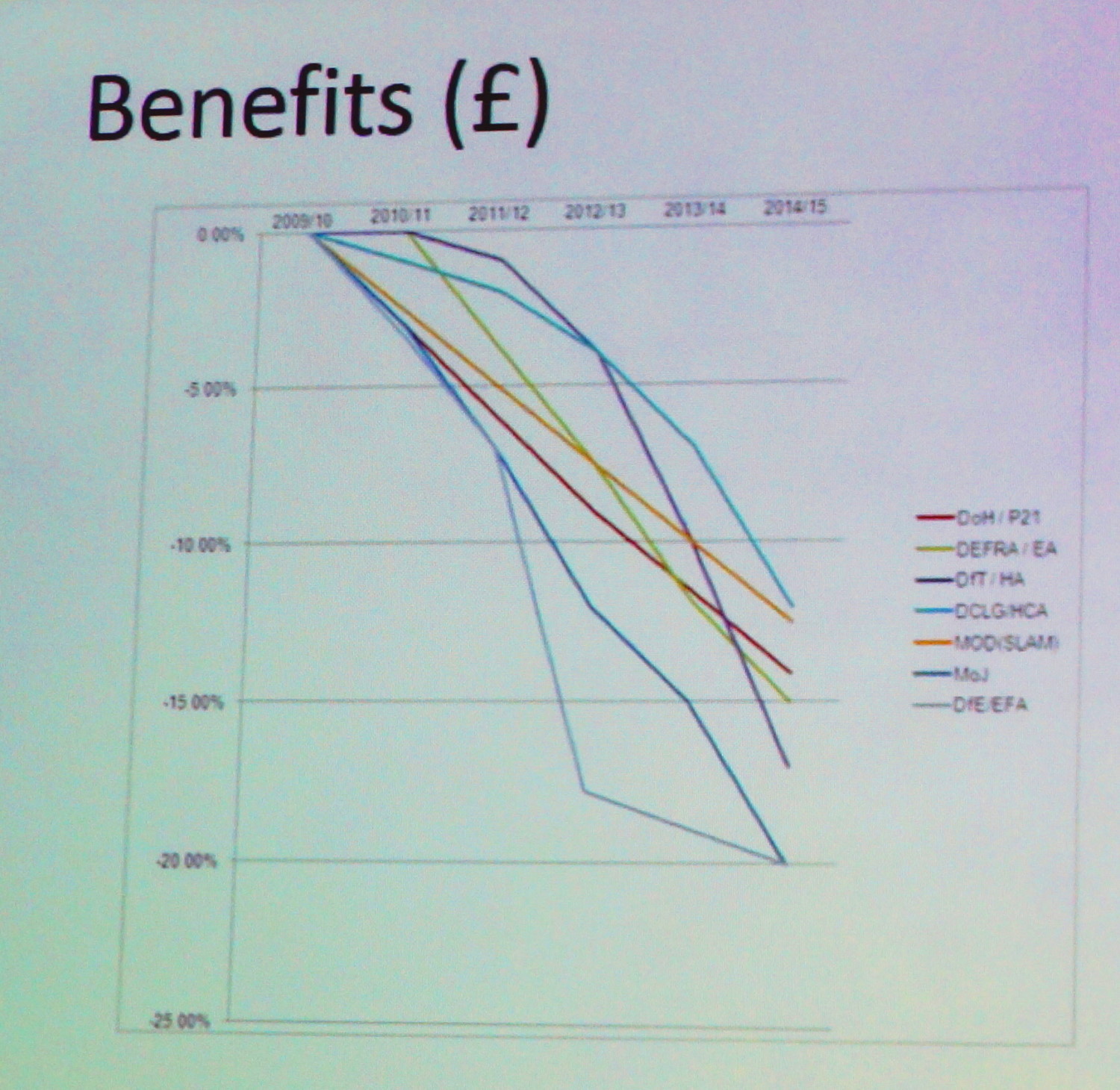 Savings attributed to BIM
Seven major government projects worth about £ 10 billion which are currently using BIM maintain records of the savings they have seen from using BIM. The measured benefits of BIM and factors associated with BIM range between15-20%, and are primarily realized during design, pre-construction, and construction. The government estimates that it has achieved savings of £ 1.4 billion through BIM and related improvements in the 2013/2014 fiscal year.
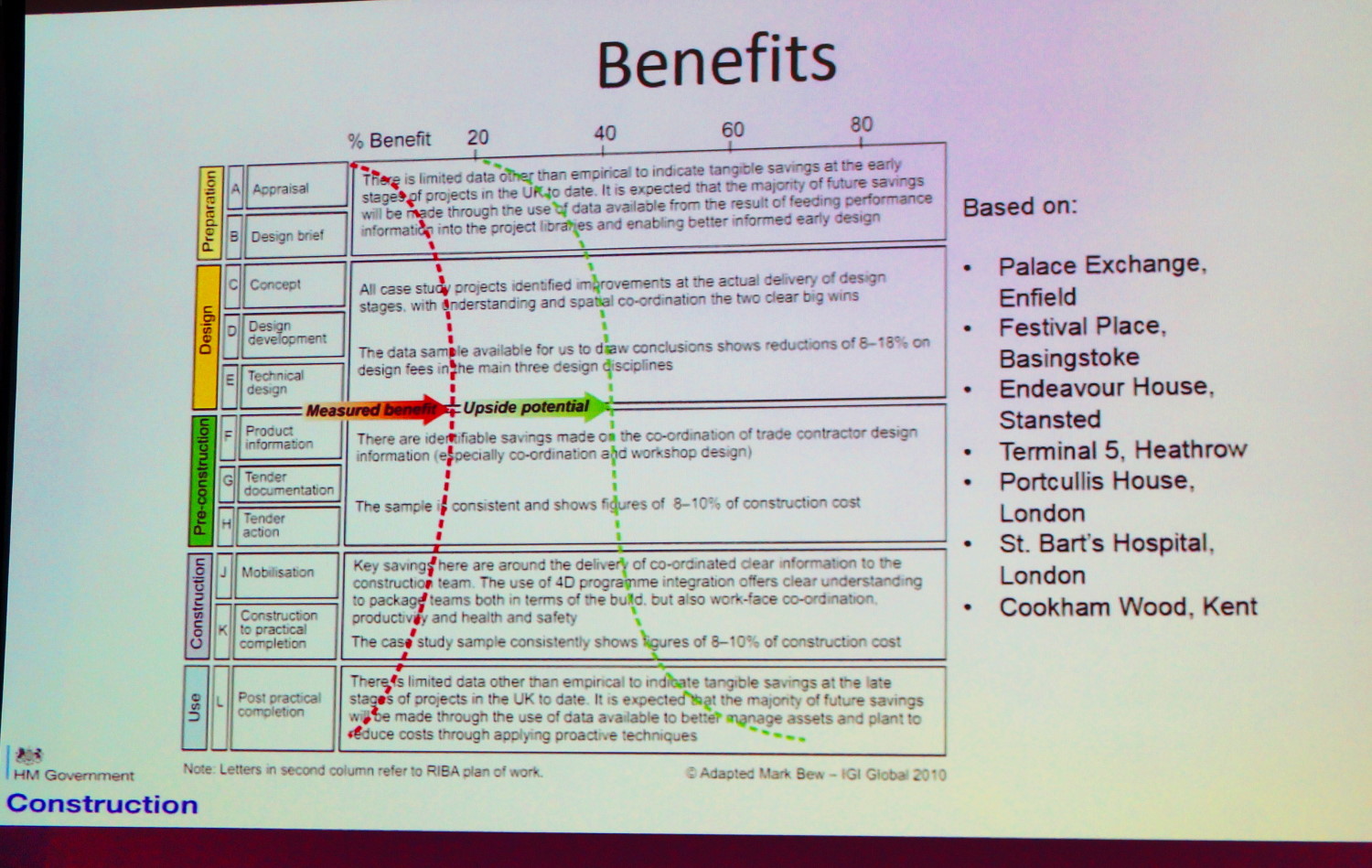 Full lifecyle cost savings
With full lifecyle BIM, the government sees an upside potential of 40%+ with the biggest benefits being realized in the operations phase of the building lifecycle.

Be the first to comment