
In 2007 I listened to an exceptional presentation
at a Spatial Sciences Institute Biennial International Conference in
Hobart, Tasmania given by Tim Barker and Neale Hooper, of the Queensland
Treasury, part of the government of the State of Queensland. The
effort within the Queensland government was motivated by the finding of
an internal review that within the government licensing is non standard,
there are inter-jurisdictional problems, and in many cases it is easier
to get geospatial data by buying it from the private sector than to
work through the licensing issues to get it from another government
agency. What Tim Barker and Neale Hooper were recommending to the Government of Queensland that all government
spatial data would be available under Creative Commons (CC) licenses.
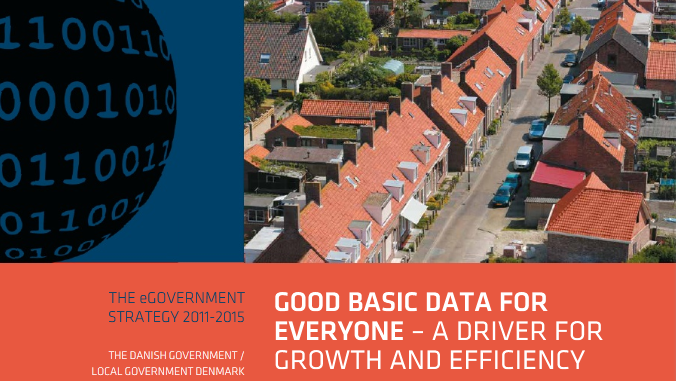
In Denmark there is a similar problem. Both governments and businesses spend large amounts every year on buying and administrating basic data.
The Finance Minister of Denmark has just announced that from January 1, 2013,
individuals, public authorities and private businesses will have free
access to retrieve and use what in Denmark is callled basic data. Basic data is fundamental information that is used by government for day to day adminstration. It included data about people,
companies, addresses, land/properties and administrative geographic data, such as administrative and electoral boundaries. (Personal data that is included in basic data is protected by the Act on Processing of Personal Data).
Basic data falls into nine databases called registers; business registers, the Danish cadastre, the
Danish Building and Dwelling Register, Danish administrative and
geographical boundaries, a Danish elevation model as well the Danish place name register. Givernments use basic data for collecting land tax, paying social benefits, planning climate change adaptation, emergency services, and other day to day administration.
Reducing government administration costs
It is estimated that by making basic data open and freely accessible, government administration will be improved. In particular the cost of buying data from other government organizations will be reduced. It is estimated that this could save Danish governments DKK 260 million ($45 milllion) per year from 2020.
Contributing to the economy
It is also expected to benefit the private sector, by reducing red tape, reducing the cost of acquiring data from governments, improving publice services, and creating opportunities for wealth creation from new digital products and services. By eliminating redundant information (often the same information has to be submitted by businesses to the public sector several times over) and making data freely available to businesses could save Danish businesses up to DKK 0.5 billion ($87 million). It is expected that real estate, insurance, finance, and tele-communications and geospatial companies in particular will directly from open basic data.
Who pays for capturing and maintaining basic data ?
Financing basic data acquisiton and maintenance will be reorganised so that governments
contribute to basic data acquisition and maintenance through their ministries’ appropriations, or block
grants in the case of municiplities.
The process of managing basic data is being centralized to make it more efficient,
- Basic data in all nine registers will be harmonised and converted to interoperable formats.
- More information will be added to the basic data registers to better support public administration processes.
- A common IT infrastructure will created. Basic data will be distributed by a single entity, called the Data Distributor.

Be the first to comment