
At last year’s Royal Institution of Chartered Surveyors (RICS) BIM National Conference 2014, RICS sponsored a BIM Vendor Showcase in which a BIM model derived from s canning the RICS headquarters building in Parliament Sq in London was provided to vendors who were asked to estimate quantities including gross internal floor space. For comparison RICS staff also measured the building internal spaces with tape measures.
The results were surprising. For example, the gross internal floor space was measured by tape measure to be 4,736 sq-m. The vendors’ estimates derived from the BIM model ranged widely from 3,474 to 4,781 sq-m. The variances in other measurements derived from the BIM model among the vendors were also quite wide.
At this year’s RICS BIM Conference, a similar experiment was tried, but the question was not focused just on measuring dimensions of interior spaced but also on estimating maintenance costs based on the BIM model. The vendors were asked to consider just one floor. In addition to the 3D BIM model derived from scanning the building, the following information was provided to all the vendors
- BIM model and coloured plan of the floor
- A condition survey/schedule
- BCIS typical component life expectancies
- BCIS building maintenance price book
Scenario
Eight vendors were invited to participate in this year’s exercise. Four vendors took up the challenge. The vendors were asked to respond to the following scenario:
A company has a floor in a building (the RICS HQ building) and wants to understand the expected life cycle costs over the next 10, 20, and 30 years.
Floor space measurement
On the basic measurement of floor space the different vendors were in much better agreement with the tape measure result than last year. In fact one vendor came up with exactly the result that RICS measured. (The others didn’t include some cupboard space in the floor space calculation.)
Lifecycle cost estimates
All the vendors used different software packages to estimate maintenance costs 10, 20, and 30 years into the future. Each vendor had a different focus, for example, feasibilty, detailed estimating, or facilities management, and the results reflected the different objectives.
At the RICS BIM event three of the vendors described the workflow they followed to estimate the lifecycle costs. One example of a workflow was
- Import BIM data in IFC format into a BIM 3D model viewer
- Select elements and export data as COBie Excel file
- Create survey template with full element and room list using NRM1/3 (see below) elemental structure
- Import BCIS component life expectancies and building maintenance prices (see below)
- Import BIM data
- Perform condition survey of RICS HQ
- Upload data to cloud to run 10, 20, and 30 year lifecycle plan
- Report results as net present values
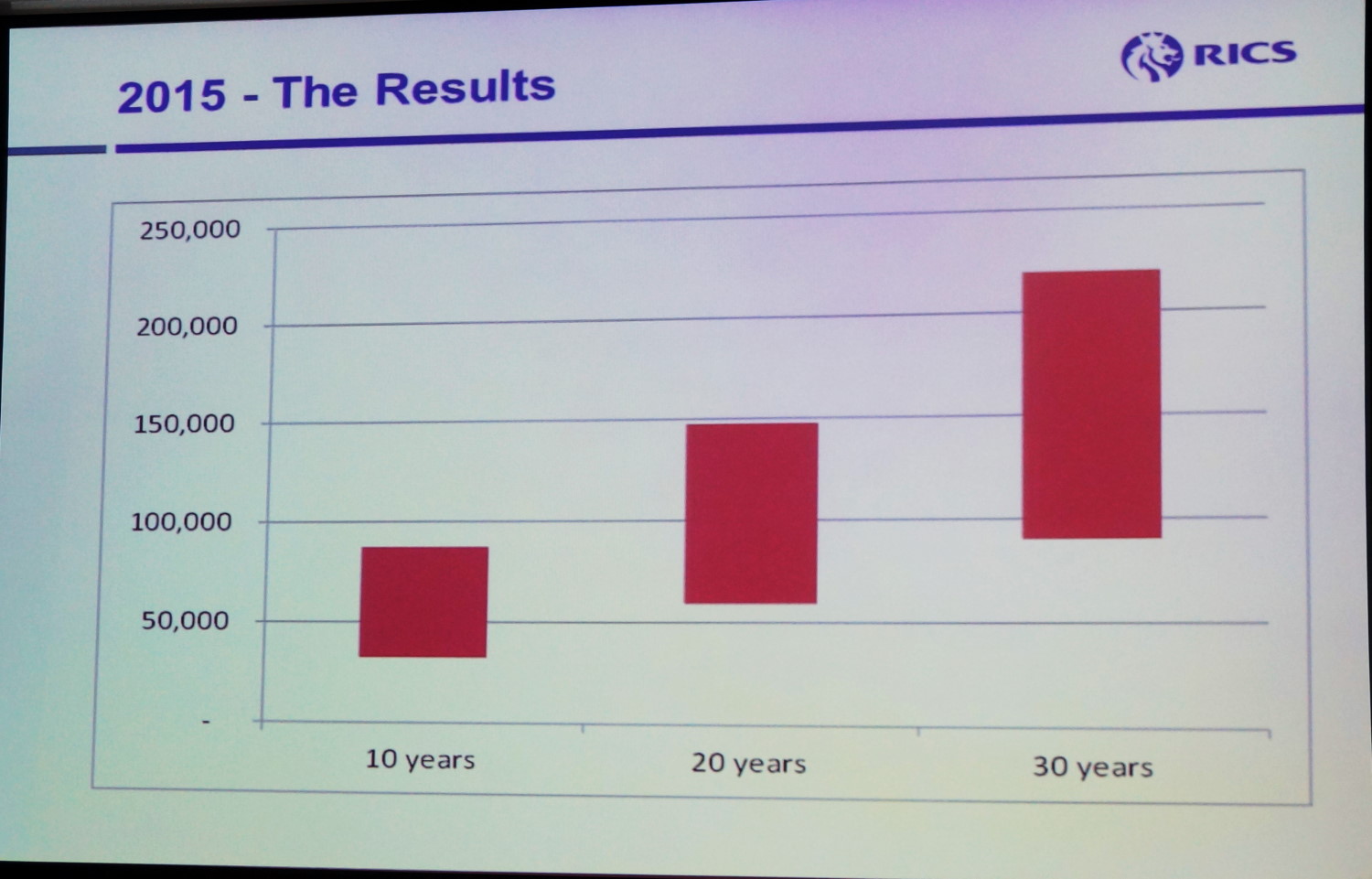 The lifecycle costs estimated by the different vendors varied widely, for example, from £ 90,000 to £ 220,000 for the 30 year lifecycle cost. The variance reflects the different assumptions that were made by each vendor about the condition of the assets (remaining life), the condition they needed to be in to operate efficiently, how much they could be stretched before failing, which maintenance activities to be included/excluded in the life cycle costing, the cost of maintenance activities, and different discount rates and other financial parameters.
Conclusion
RICS’ conclusions are that the software vendors are accelerating rapidly in this field. They were pleased that RICS standards such as NRM are being embedded in the software. From a data perspective, BIM quality is key and a content plan defining what information is required is essential. Most importantly, it was emphasized that you can’t plan on simply loading the data and pushing the big red button. It is necessary to carefully check everything and this requires an experienced professional.
Glossary
BCIS (Building Cost Information Service) provides benchmarking data covering cleaning, energy consumption and administrative costs. It is used for early life cycle cost estimating and the development of life cycle cost plans by facilities managers and surveyors who specialize in facilities management, maintenance and operating costs.
NRM (New Rules of Measurement) are published by the Royal Institute of Chartered Surveyors (RICS). They provide a standard set of measurement rules for estimating, cost planning, procurement and whole-life costing for construction projects. They are the “bible” for what is in the UK called quantity surveying (QS). It is comprised of three volumes NRM1: Order of cost estimating and cost planning for capital building works, NRM2: Detailed measurement for building works, and NRM 3: Order of cost estimating and cost planning for building maintenance works. Together this suite provides a cradle-to-grave guide for cost estimating, works procurement and post-construction procurement.

Be the first to comment