
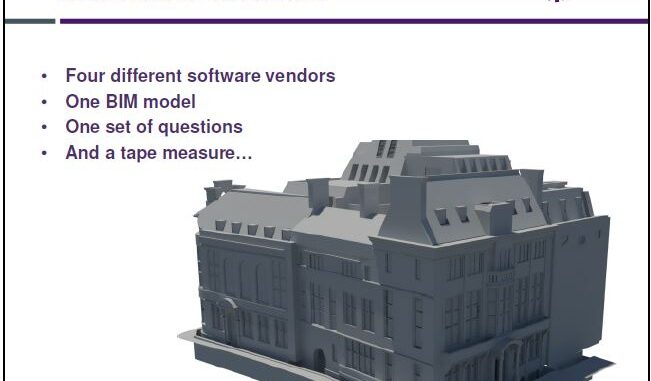
At this year’s Royal Institution of Chartered Surveyors (RICS) BIM National Conference 2014, Nick Bleukarn, of the Severn Partnership, described a “scan to BIM” project sponsored by RICS to create a BIM model for the RICS headquarters building in Parliament Sq in London. The vision for the project was to scan the building and create a classified (Uniclass2) BIM model that will be kept and maintained rather than thrown away. Severn and RICS collaborated on the specification for the project. RICS wanted to achieve a pretty good level of detail. The deliverable was point clouds and a BIM model classified according to the Uniclass2 standard.
Severn employed total stations and laser scanners. Laser scanners were particularly essential for this project because this is an older building and none of the rooms are “square”.
 One of the lessons learned is that creating a model from point clouds is very difficult. It is a manual, visual process and is more an art than a science. For the RICS building it required six weeks of modelling to create the BIM model. For older buildings this process has to be “bespoke” modeling, because every project has its unique challenges. It requires an ongoing dialogue and a frequent comparison of the point cloud with the derived BIM model between the client and surveyor.
Deriving measuements from the BIM model
As an experiment RICS then provided the model to four vendors and asked them to calculate some standard dimensions from the model such as gross internal floor space (GIFA). The exercise was not intended to be competitive, so each vendor’s result were reported anonymously. The dimensions were measured manually by tape measure for comparison.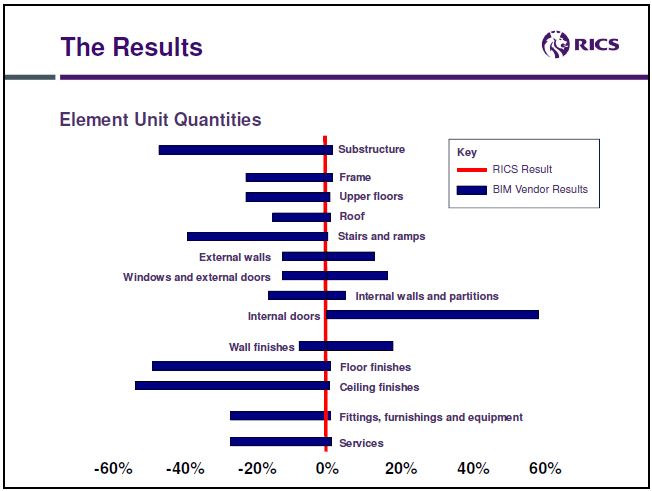 Three of the vendors visually inspected the model as well as using other techniques in coming up with the estimates. The fourth vendor relied on a completely automated process.
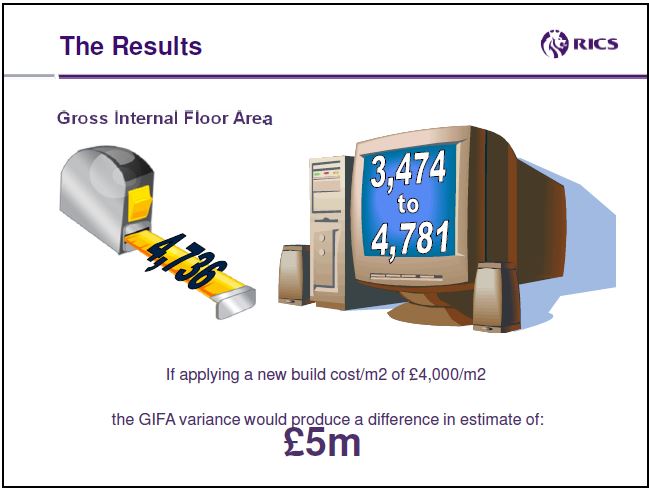
The results were surprising. For example, the gross internal floor space (GIFA) was measured by tape measure to be 4,736 sq-m. The vendors estimates derived from the BIM model ranged from 3,474 to 4,781 sq-m. RICS estimated that assuming a new build cost per sq-m of £4,000/sq-m the GIFA variance would produce a difference in the construction estimate of: £5 million. The variance in other measurements derived from the BIM model were also generally quite wide.

Be the first to comment