
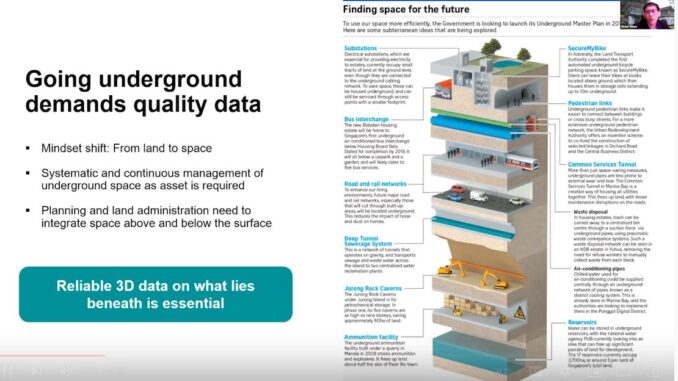
Singapore has severely limited land, but unlimited space and has started to build many types of activities underground to save the land above ground for the better living of citizens. Many of the traditional utilities such as electric power, water, wastewater and others, as well new type of utilities, such as the Pneumatic Waste Conveyance System are almost one hundred percent underground. Parts of the transportation network, such as the metro, are also underground. In addition some storage, waste disposal and national defence facilities are underground.
Data quality
As underground development expands in Singapore reliable data about the location of underground infrastructure becomes increasingly essential. Data quality is a huge issue. Virtually all stakeholders are aware that much of the available information is unreliable and that this has repeatedly led to losses of time, money and opportunities. 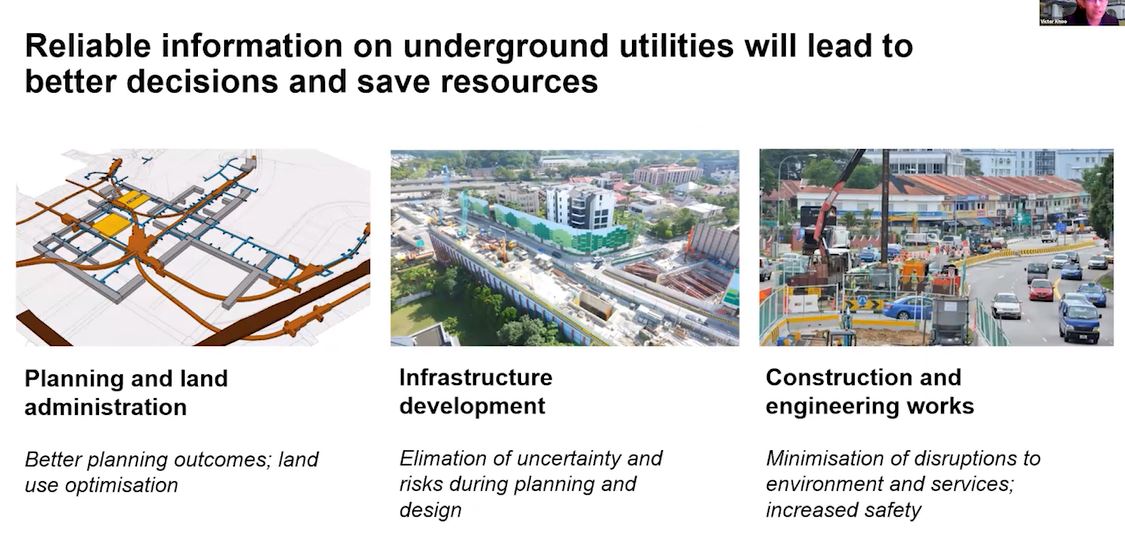 From the perspective of planning and land administration, infrastructure development, and planning and design there are important benefits in the form of reduced uncertainty and risks to be derived from reliable underground data. These include reduced costs, avoiding unnecessary rework, minimizing destruction to the environment, avoiding disruption of consumer services, and greater safety for people working in the environment as well as the general public in general.
To address this issue the Digital Underground (DU) initiative was started in 2017. The objective of DU is to develop a reliable map of Singapore’s subsurface infrastructure for planning and land administration. The DU has four phases. The objective of Phase 1 was to identify the problem and create a road map. The second phase involved looking into what was required to create a utility mapping ecosystem. The current phase involves looking at the underground utility workflow which has many components that will contribute towards reliable data. The final phase is the operational phase when we implement a new utility mapping ecosystem.
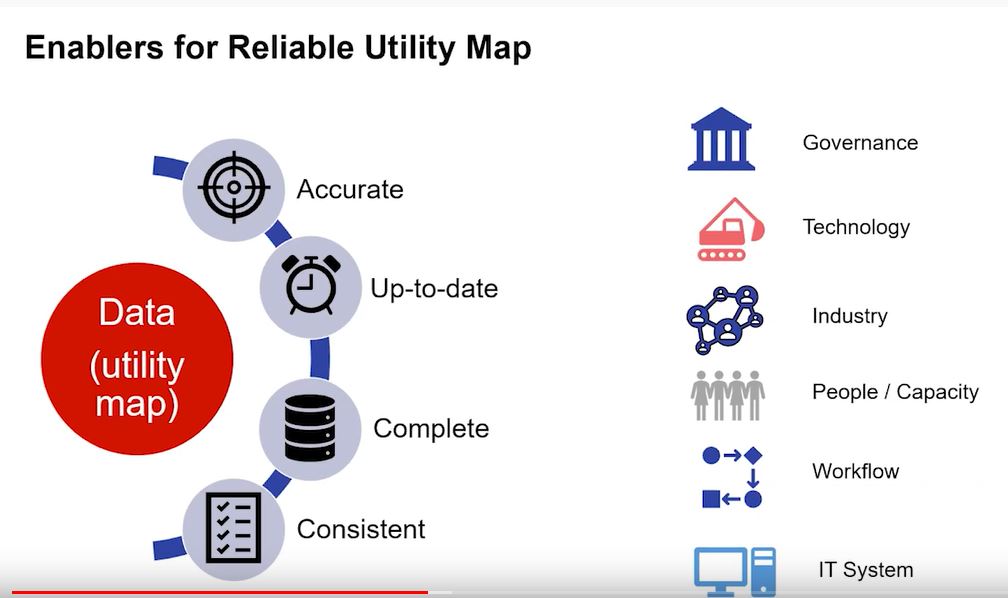 In Phase 1 an assessment was made of the reliability (locational accuracy, completeness, and currency) of the existing data. It was concluded that the data quality of the data is seriously deficient. In terms of location, it is inaccurate, much of it is out of date, and it is also incomplete. It was also found that the quality level of the data is undefined, in other words, no quality level has been assigned to each facility for example based on a quality standard like ASCE 38 or PAS 128. We do not know which piece of data is of higher quality or which piece of data is sufficiently reliable to be relied on for planning and land administration.
Road map for improving data quality
Addressing data quality involves fundamental survey, locating and mapping issues. In addition to assessing data quality an objective of Phase 1 was to develop a road map for addressing the data quality issue. First we wanted to ensure that going forward data for all newly installed utilities would be reliable. In 2017 we implemented a strategy requiring certified survey quality as-builts. Secondly, we started to look for opportunities to improve the data quality of existing below ground infrastructure. We are looking at several new technologies, such as ground penetrating radar and gyro mapping for detecting underground utilities and LiDAR and 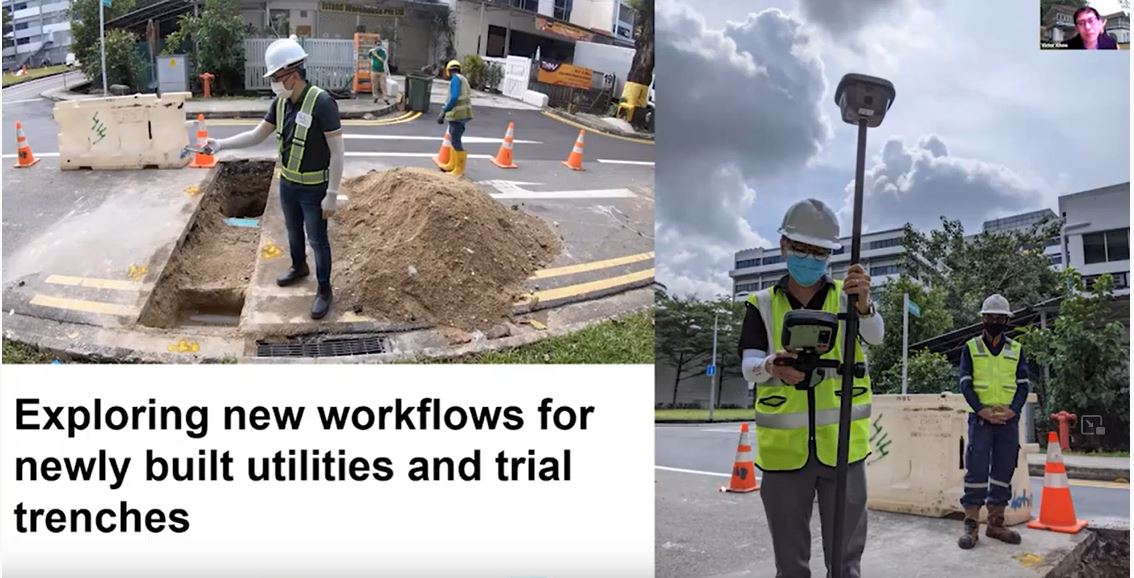 photogrammetric capture with a smart phone of trial trenches. We are also exploring ways of capturing not just vector data, but integrating 3D point cloud data of an open trial trench in our GIS so the next person interested in this section of road doesn’t have to open up the trench to see what’s there.
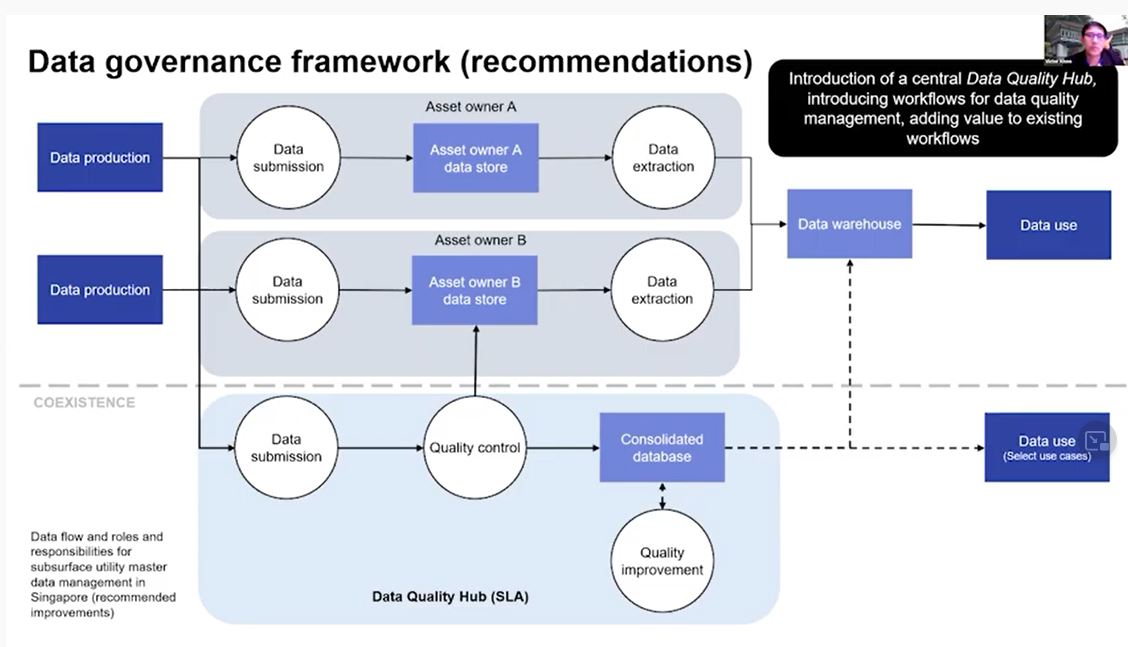 A key part of the road map is governance, especially accountability and transparency; assigning responsibilities for data capture, data quality improvement, and data quality management. We want to introduce a new framework so that we can ensure high quality utility data ongoing in the future. We are suggesting a process that would not interrupt or change the current utility workflow, but add a new data quality workflow on top of the current workflow. Asset owners will be able to continue to do their work the way they have in the past, but will be required to submit their data to a Data Quality Hub for quality control to ensure that data quality standards are complied with. We intend to implement quality control on the front end when data is submitted to the database, not at the tail end of the information supply chain. Eventually this process is intended to ensure that we are getting reliable and high quality data that can be shared back again to the end user, the planners and land administrators.
 Community of practice
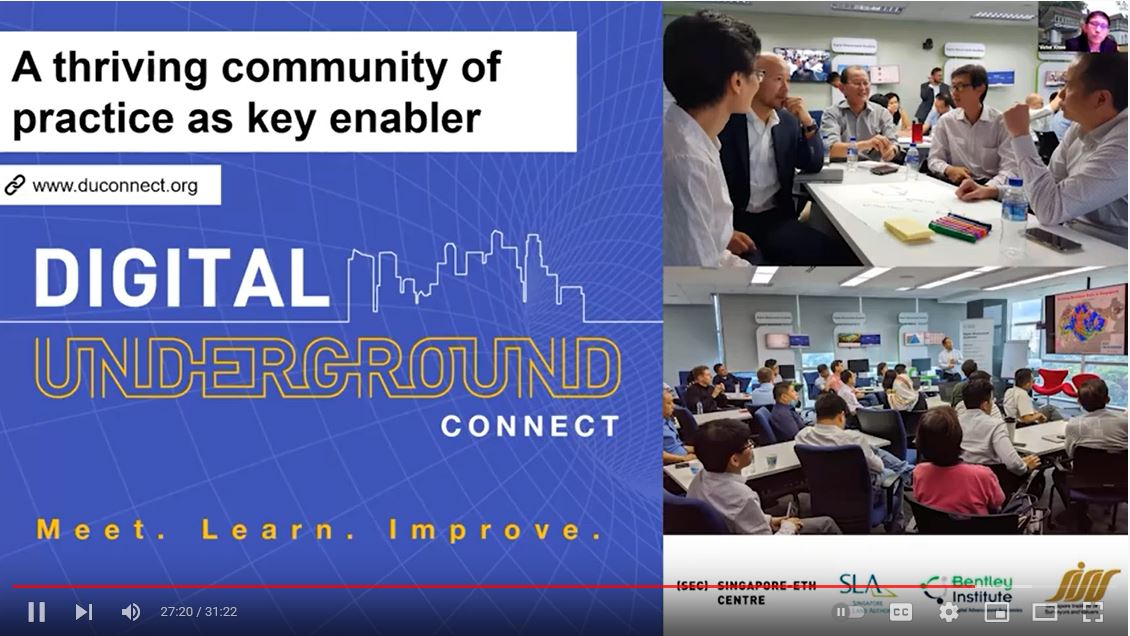
Creating a utility mapping ecosystem requires buy in from network owners, transportation agencies, excavators, and others. The Digital Underground Connect is a platform where we provide people to meet, to learn and to improve.
This post is based on Victor Khoo’s talk on the Singapore Digital Underground Project at the Subsurface Utility Mapping Strategy Forum (SUMSF).
Be the first to comment