
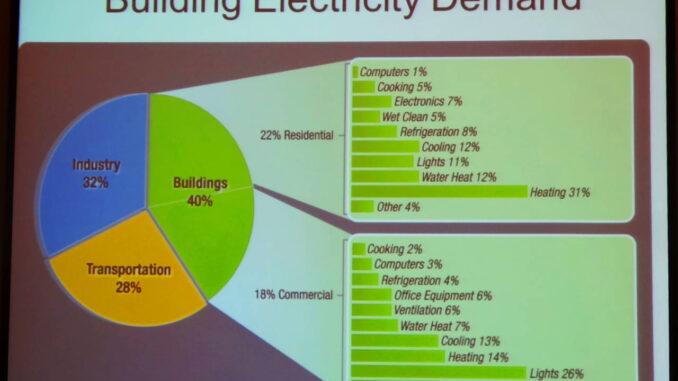
In the U.S. buildings are responsible for 72% of U.S. electricity demand, 55% of U.S. natural gas demand, and 40 % of U.S. CO2 emissions. 36% per cent of the buildings electricity load is due to commercial buildings.
California has some of the most aggressive mandated emissions reduction targets in the country. They include
- 33% renewable energy by 2020
- Reduction of GHG emissions to 1990 levels by 2020
- The California Public Utilities Commission’s Long Term Energy Efficiency Strategic Plan calls for 60% to 80%
statewide reduction in electrical lighting consumption by 2020. (lighting accounts for nearly 30% of California’s electricity use. - New residential construction to be net-zero by 2020.
- New commercial construction is to be net-zero by 2030.
- Governor Brown’s Executive Order B-18-12 calls for a 20% reduction in state energy purchases by 2018.
LEED
The US Green Building Council is responsible for the enormously
successful LEED program. Currently 10.3 billion square feet have been
registered, of which 2.7 billion square feet has been certified under
the LEED program. According to the USGBC, currently 1.7 million square
feet are LEED certified every day.
Last year at Distributech the US GBC and its partners
Environment Defense Fund, Lawrence Berkeley Lab, and Skipping Stone
launched a LEED-DR pilot program (DRPP) designed to encourage the
adoption of demand response among owners of commercial buildings who
have generally lagged in adopting DR.
Southern California Edison (SCE) is a major sponsor of the LEED-DR
initiative.
Demand response at Southern California Edison
This year Mark Martinez of SCE gave an overview of SCE’s DR program. In the U.S., commercial buildings represent 36% of the electricity load, but the majority of commercial building owners have shied away from DR programs. A number of reasons are given for this.
- Limited number of energy focussed facility managers
- Lack of familiarity with utility DR programs
- Perception that DR is disruptive
- Concerns over loss of control
- Lack of specific knowledge around costs/benefits
- Concerns over ongoing operation changes
In the past utilities have paid major users, typically large industrial customers, not to use electric power at times of peak load. The process has typically been manual, managed by telephone.
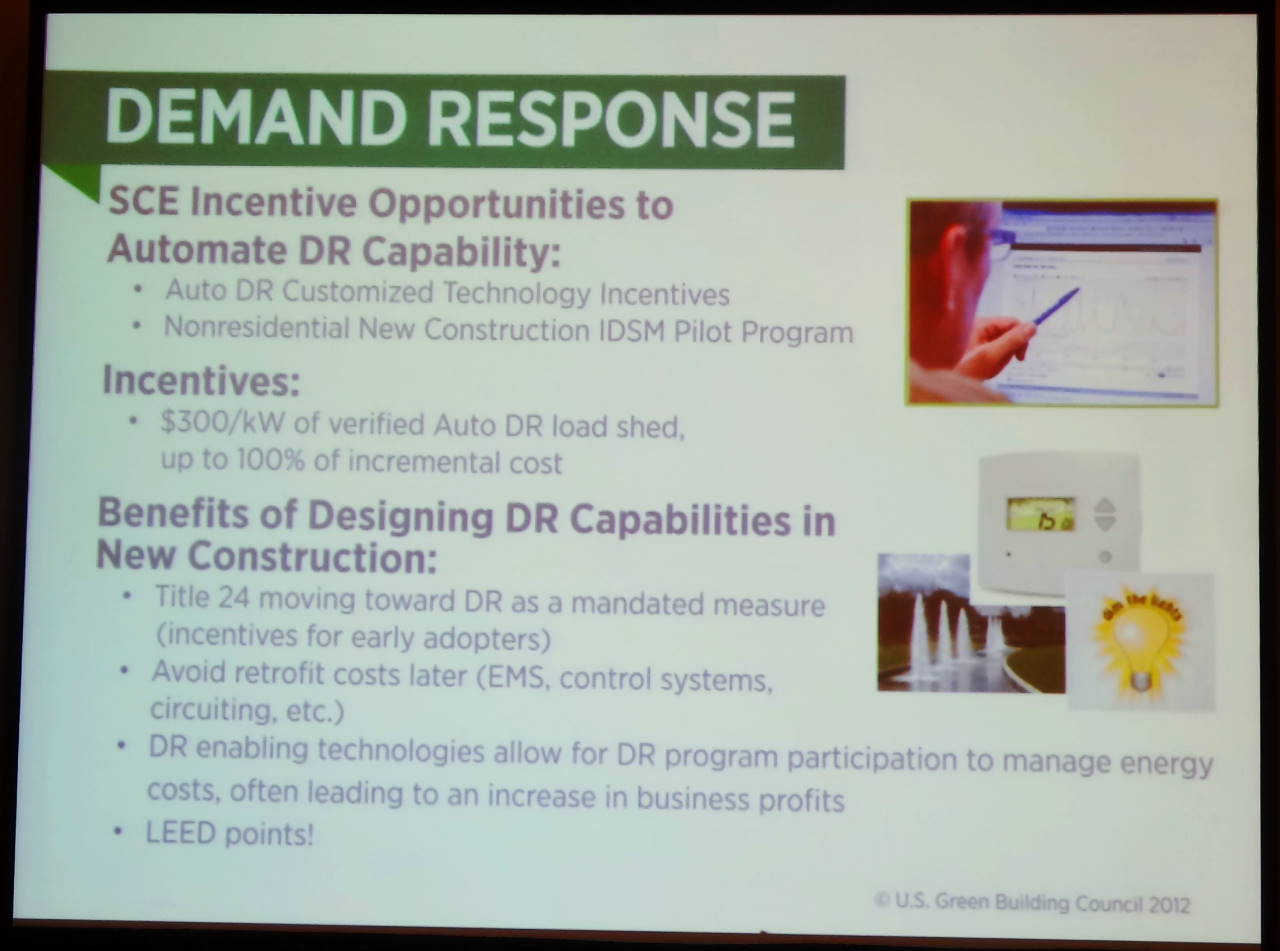 But now SCE is reaching out to a much broader group of consumers necessitating automated demand response (ADR). Its approach for motivating commercial customers to adopt ADR is both a carrot and a stick.
The carrot
For nonresidential new construction SCE offers financial incentives, $300 per kW of verified automated load shedding and up 100% of the incremental cost of DR enabling equipment.
The stick
Given the state’s aggresive emissions reduction program many building owners can see the writing on the wall as the state moves in the direction of mandating DR through the state building code.
The California Energy Code, part 6 of the California Building Standards Code which is Title 24 of the California Code of Regulations, were created by the California Building Standards Commission in 1978 in response to a legislative mandate to reduce California’s energy consumption. The standards are updated periodically by the California Energy Commission to allow incorporation of new energy efficiency technologies and methods.
For example, smart lighting is now mandatory in California. The California Energy Commission recently updated its Title 24 Energy Efficiency Standards, improving what “up to code” means by 25 percent for residential buildings and 30 percent for commercial buildings. The new standards, which take effect January 1, 2014, introduce requirements for photosensors, occupancy sensors and multi-level lighting controls. In the not too distant future, many expect that DR will also be mandated through the building code.
The benefits to commercial building owners from participating in SCE’s DR program are
- Incentives for early adopters that won’t be available when DR is mandated.
- Avoid retrofit costs later.
- Claim LEED points
From SCE’s perspective the LEED-DR program helps get people to start thinking about DR when they design buildings.
DR and peak load management
Many utilties are finding that DR is the least cost and best fit for
peak load management. It is much cheaper than building additional
gas-fired ‘peakers”. Automated DR will enable SCE to shed load much more rapidly than is currently possible. The California ISO, which is responsible for operating most of the grid in California, currently does not count DR as a dispatchable resource because it is not as fast and reliable as the ISO would like. As DR becomes more automated, it should move in the direction of becoming a dispatchable resource.
 LEED DR credits
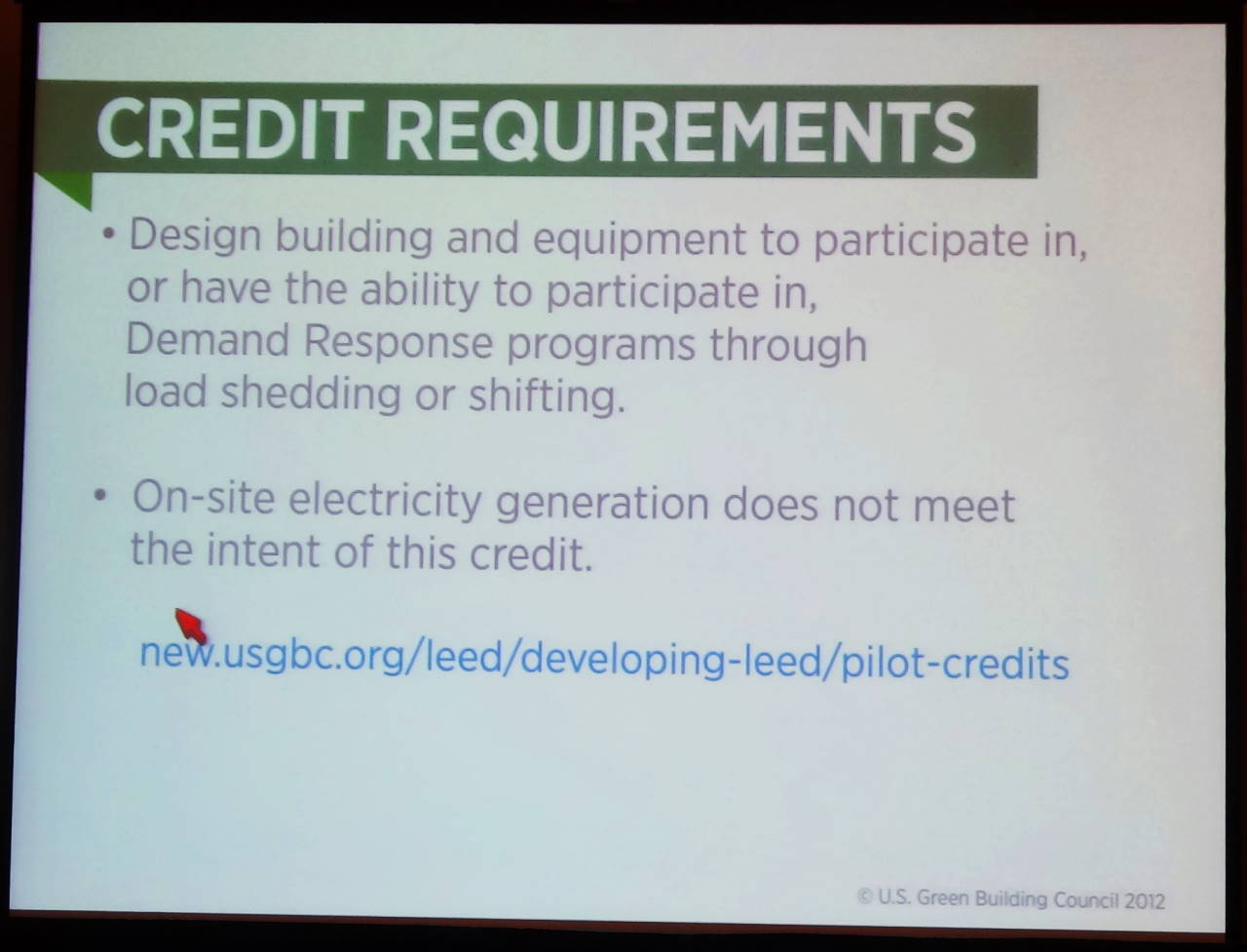
The basic requirement for LEED-DR credits are that the building must be capable of shedding 20kW or 10% of load whichever is greater. They can sell this to an aggregator or to the utility.
To earn LEED DR credits the owner needs to demonstrate curtailment. This often means that tenants and others participating in the program will require training.
In June after a mandatory ballot, LEED V4 including LEED DR will come into force. At that time developers who satisfy the requirements for LEED DR will get full LEED credits.
Be the first to comment