
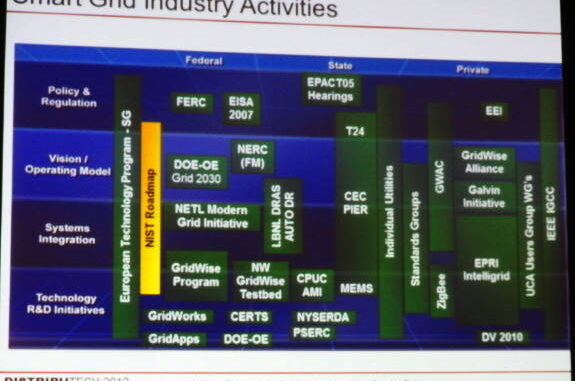
Yesterday at the Distributech Utility University, Erich Gunther, Ron Farquharson, Sandy Bacik, and Christian Perreault gave a very well researched, in-depth overview of the state of smart grid in North America. Starting from the premise that “the power system will change more in the next 10 years than it has in the past 100 years”, Erich Gunther discussed the major drivers for the smart grid,
- increasing population and increasing power demand
- aging infrastructure – transformers, insulating, switch gear are reaching the end of life
- retiring personnel – losing experienced people who know why we did things in the past the way we did
 The term “smart grid” is a marketing term that has become overused and covers a wide variety of elements. The Department of Energy includes seven elements in its definition of what comprises a smart grid
- consumer participation
- distributed generation
- an integrated market including a consumer market
- power quality including fast resolution of outages
- operational efficiency, utilizing assets to full capacity, and real-time situational awareness
- self-healing
- resilient to malicious attack and natural disasters
He mentioned Southern California Edison’s vision of the smart grud as enabling it to intelligently connect the utility to its customers, which focusses on the benefit to consumers.
The major inhibitors that Erich sees are slowing down the adoption and deployment if the next generation of the power grid are
- utility culture – utilities are traditionally focussed on safety and reliability, not on innovation
- lack of integration tools – most utilities are characterized by siloed applications, usually proprietary with severely limited interoperability
- lack of standards – product suppliers are not supplying products that are standards compliant
- lack of understanding of what’s possible – technology is moving very rapidly and it is hard for utilities to keep the power on and stay on top of the latest technology
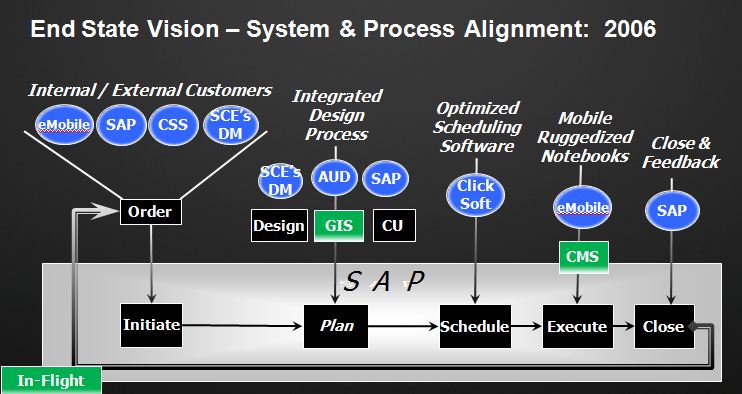 One of the major benefits of the focus on smart grid is that it is motivating companies to understand their business processes. I blogged previously about how Southern California Edison has looked at its distribution design process and found ways to standardize and impriove the efficiency of this process by integrating their ERP application into the design process. Edison’s use cases developed for its SmartConnect program are available here.
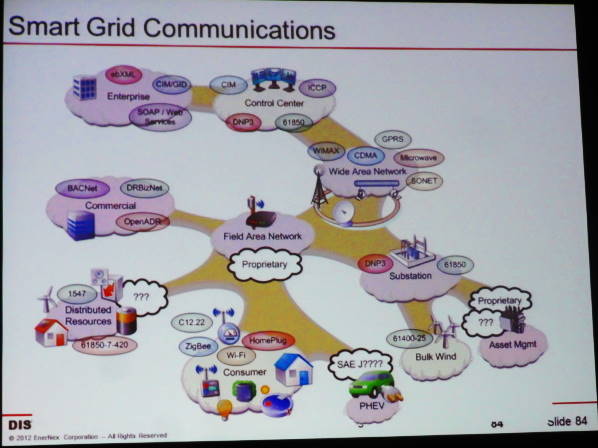 Erich spent a lot of time discussing the NIST/SGIP smart grid standards process with which he is intimately involved. He mentioned NIST’s three phase plan, the NIST Smart Grid Framework 2.0, and the fairly recent SGIP Catalog of Standards which has been released to FERC. He mentioned that in some areas standards are very well developed and in others there has not been as much progress. He showed a slide showing the state of standards for communications in a smart grid environment. In some areas such as wide-area networks, control centers and substations, standards are well developed. In others such as field area networks (FANs) and asset management there are no standards,
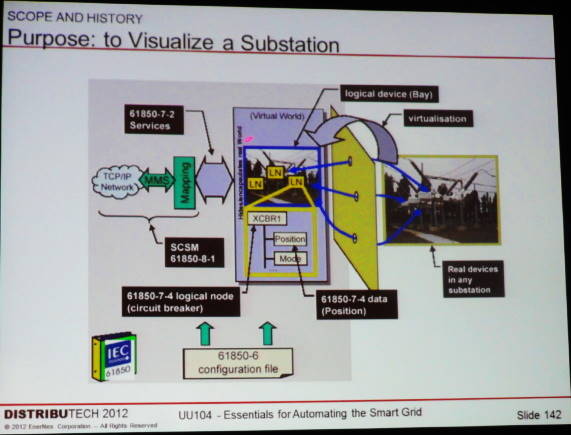 The standards adopted into the SGIP Catalog of Standards include
- IEC 61970/61968 – Common Information Model (CIM) for distribution and transmission
- IEC 61850 – common data model and format for substations
- IEC 60870-6 – standard for the exchange of information between controls centers
- IEC 62351 – cyber security standard for the above standards
Erich said that many substation equipment manufacturers especially European based ones like Siemens and Alstom have been manufacturing their equipment to be compliant with 61850 for years. He also says that work is underway to enable compatibility of 61850, DNP3 and CIM.

Be the first to comment