
Geospatial technology – spatial data management and analytics – is being used in many industries outside of the traditional GIS sector. Analysts and IT folks in these industries may be surprised to find that the spatial analytics and data management they require is already available from their database management system whether it is Oracle, SQL Server, PostgreSQL, or SQLite
At the GIS in the Rockies conference in Denver Dave Murray from the City of Westminster reminded us how powerful the spatial analytics in modern relational database systems are.
In the late 1980s the first implementations supporting spatial data in a relational database were Vision* on Oracle RDBMS developed by Geovision and GFIS on Db2 by IBM. Subsequently the Open Geospatial Consortium defined a simple feature specification for spatial SQL. First Oracle and then Microsoft and the open source community have added spatial SQL based on the OGC standard to relational databases. Oracle Spatial, PostGIS+PostgreSQL, Microsoft SQL Server, and Spatialite+SQLite all support spatial SQL.
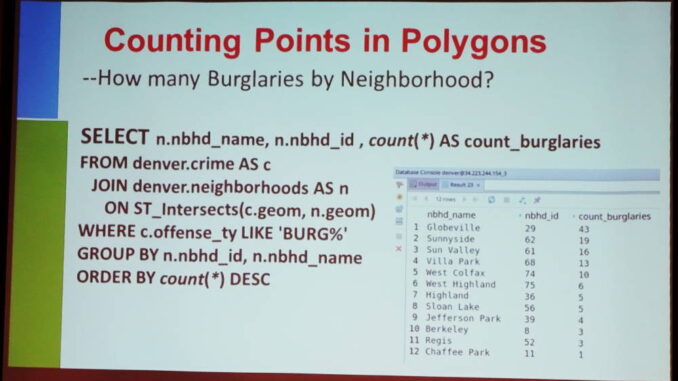
Folks wishing to employ geospatial techniques may find that they don’t need a traditional GIS product and all the complexity involved in integrating a GIS with their database management system. They very likely will find that they can do all the geospatial processing they require using spatial extensions to standard SQL on their existing database. Finding the number of automobile accidents along a stretch of road, the census tracts a road passes through, or the burglaries in a neighbourhood are straightforward spatial SQL queries. The results can be visualized using Oracle’s own visualization tools or open source applications like QGIS sitting on top of Oracle, SQL Server or PostGIS+PostgreSQL. Dave mentioned spatial SQL courses on Udemy for those interested in learning more about spatial SQL. Gordon Luckett’s web site has a wealth of information about spatial queries, especially for integration with AutoCAD and Esri ArcMap. Gordon also has developed courses on Lynda such as Using SQL Server with AutoCAD and Learning QGIS.

Be the first to comment