
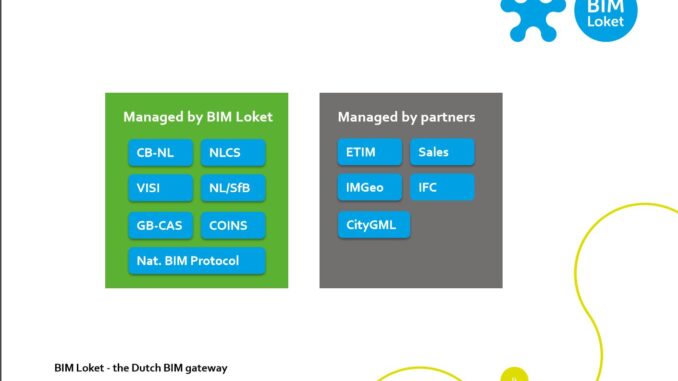
The Netherlands has created a new BIM Loket (BIM Gateway). It is intended to be a national portal for information about and and management of open BIM standards in the Netherlands. It is to both provide a central information centre for open BIM standards including related geospatial standards and to stimulate their use.
The most important reason for building a BIM Gateway for all stakeholders is to reduce maintenance costs by bringing together the open BIM standards into one coherent system. This will ensure that the standards can be used more effectively and with greater efficiency as well as promoting their widespread use.
The Dutch Building Information Council (BIR) has been encouraging BIM for a long time. I have blogged about it previously. It will continue to focus improving the quality and competitiveness of the Dutch construction industry through initiatives such as BIM. The BIM Loket’s focus will be on open standards for BIM. One of my takeways from the recent RICS BIM conference in London was that there is a desperate need for standards, especially to classify the huge amount of date in addition to the 3D model that accumulates during a construction project. Much of this would be useful to the FM folks who are responsible for operating and maintaining the building after construction.
At a Geospatial World Forum in Amsterdam several years ago, Jantien Stoter of the Delft Univeristy of Technology and an advisor to Geonovum, described work on the Dutch 3D standard which aimed at integrating CityGML and the Dutch IMGeo standard. This inclcuded an attempt GeoBIM which was to be a CityGML Application Domain Extension (ADE) intended to extend CityGML to include detailed, semantic information about the inside of buildings (IFC). Finding some way of integrating of BuildingSmart’s IFC BIM standard and geospatial standards like CityGML remains a major challenge for the international construction industry.
As a practical example, I blogged previously about a firm Royal BAM Group nv / BAM Infraconsult that relies on integrated BIM and GIS because many of its projects require full life-cycle BIM. At the first GeoBIM conference in Amsterdam, Jothijs van Gaalen gave some real world examples of Design, Build, Finance and Maintain (DBFM) highway construction that included GIS+BIM integration. BAM’s motivation for investing in BIM+GIS are market developments especially more complex construction assignments and an increasing demand from customers for service provision throughout the entire life cycle of a project. The other major drivers are internal business needs especially being able to control safety, quality, costs, planning, and sustainability through the lifetime of a project.
As another example, ARCADIS Netherlands has been involved in projects that integrate geospatial into the design process. On the HOV Nijmegen project it was found that integrating geospatial and engineering design in a single database resulted in a single copy of each data element which supported multiple use. It simplified communication and increased the quality of the final design. It also enabled automated analysis of the consequences of design choices with the result that the planning cycle was shorter. Based on their experience with these projects, Bram Mommers and his colleagues concluded that there are several barriers to the integration of civll engineering and geospatial; Semantics, different terms used for the me things by geospatial analysts and civil engineers and designers, different topology, geospatial uses point, lines, and polygons, CAD/BIM uses splines, nurbs, and other parametric curves and treats polygons in a different way from geospatial topology, and features which are fundamental objects in geospatial vs engineering objects with location as an attribute, and data formats, geospatial data is stored in shape files, GML, and CityCML; CAD/BIM uses DWG, DGN, RVT, and IFC.
As the UK AGI has pointed out in a recent Foresight Report integrated BIM and geospatial technology will be fundamental for BIM Level 3.
The BIM Loket is intended to be a one stop shop for BIM-related standards including geospatial, whether maintained in Holland or internationally. It is intended to involve all the stakeholders, industry, academia, and government organizations. It is considered urgent because standards are essential for the digitization of the Dutch building industry and it is essential if Dutch construction firms like Royal BAM and Arcadis Netherlands are going to remain internationally competitive. The BIM Loket plans to compile a knowledge platform based on a coherent palette of Dutch open BIM standards for industry-standard BIM products.
Thanks to Rob van de Velde for pointing me to this.

Be the first to comment