
Increasing urbanization throughout the world challenges the sustainable development and resilience of cities. To address this challenge cities, regions and nations are developing digital twins of their infrastructure. However, the importance of the ground beneath cities is often overlooked.
Every day information about the underground is captured during excavation and drilling, but this data is rarely shared and is often recaptured over and over again. In the Netherlands one source of subsurface data is derived from borehole logs, cone penetration tests, and groundwater measuring points. It has been estimated that over the past 120 years the Netherlands has spent € 20 billion collecting this type of data about the subsurface.
Recently the Netherlands has embarked on a national program supported by legislation and standards to expand the collection and sharing of data about the subsurface. In 2015 a new law was passed by the States General in the Netherlands which created the Basisregistratie Ondergrond (BRO) or Key Registry for the Subsurface which is open and accessible to all citizens of the Netherlands. The law mandates that if you excavate or drill you have to share your data with the BRO registry. In addition if when using the data in the registry you find something is incorrect you have to report it.
To fund this effort Rijkswaterstaat, which is the Dutch highway authority and is roughly equivalent to Highways England or the Federal Highway Administration (FHWA) in the U.S., has allocated an € 80 million.
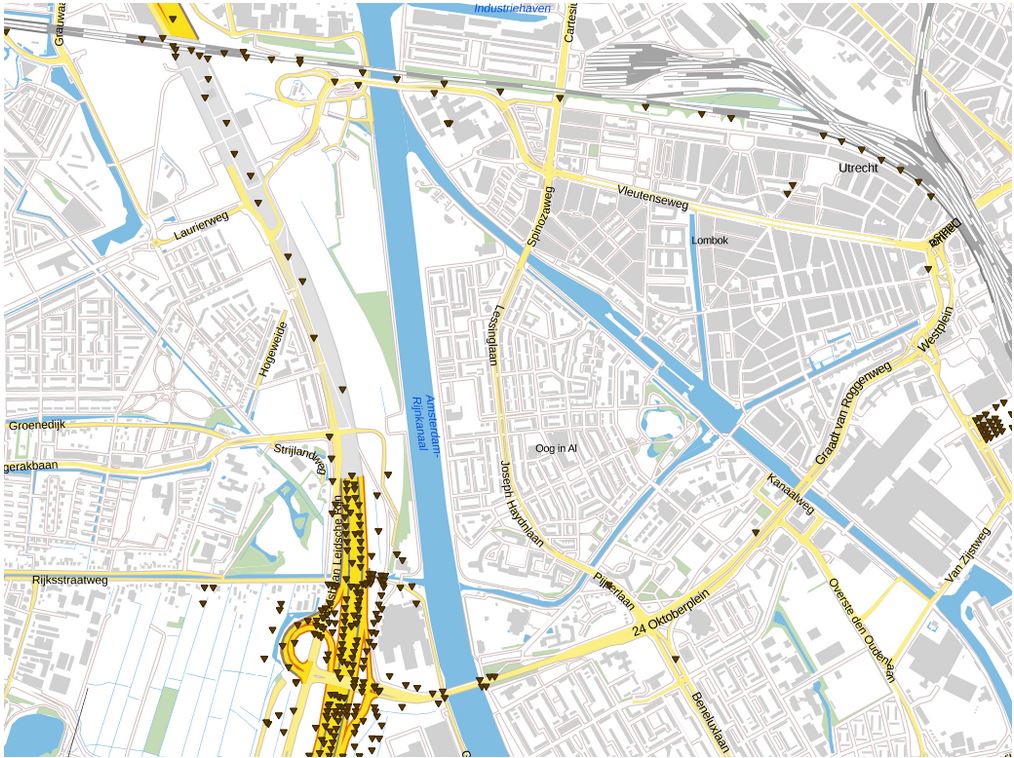 The Key Registry for the Subsurface (BRO) came into force in January, 2018. The BRO registry forms part of the System of Basic Registrations of the Netherlands which includes location and other data on addresses, buildings, topography and cadastral data. The BRO registry consists of 26 data types, which will become mandatory in installments over five years and all of which include location. On 1 January 2018,it become mandatory to report the first three data types, geotechnical surveys (CPT), groundwater monitoring wells and soil drilling sample profiles. On 26 June 2018, this data became publicly available via the Dutch open data portal PDOK. Work is underway to implement data models for the remaining data types including geotechnics, soils, and groundwater. Manmade underground infrastructure, apart from mining, is not part of the BRO. All 26 will become mandatory by 2022.
Manmade infrastructure is a separate program steered by national regulation on minimizing excavation damage. There is a separate portal where constructors put in their planned excavation area and are reported with a joined set of harmonized utility data from all utility companies. Harmonization is done by aligning with the INSPIRE utility specifications. The information model cables and pipes (IMKL) is a Dutch standard data model for the exchange of data about underground infrastructure and is founded on the INSPIRE model for cables and pipes, in which location is specified in the Open Geospatial Consortium (OGC) GML format.
Be the first to comment