
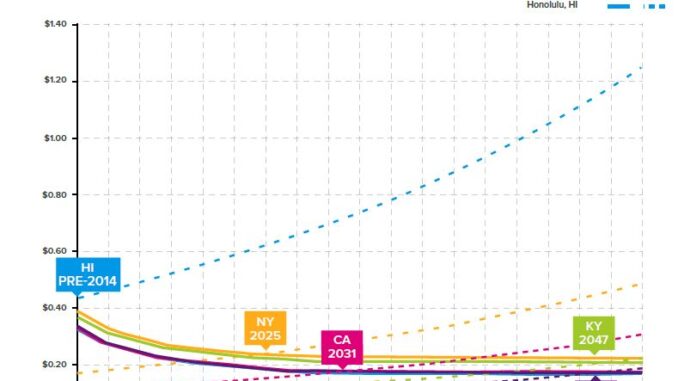
The Rocky Mountain Institute (RMI) has published a fascinating analysis of the economics of leaving the grid. The central thesis is that solar PV and electricity storage enables consumers to leave the grid completely.
Solar PV has already reached grid parity in about 10% of the U.S. and declining PV prices suggest that this trend will continue. However, without the ability to store electric power, consumers with rooftop PV still require the grid for nights and cloudy days.
The development of combined solar PV and batteries from Tesla and others promises to make solar + storage accessible for increasing numbers of consumers. These consumers could form their own microgrid, either by themselves or with their neighbours and disconnect from the grid. Increasingly they could find that it is be economically advantageous to do so. This has serious implications for local utilities because if this trend develops it could seriously erode the traditional utility revenue base. Generally this would lead to increased rates for the remaining customers still on the grid, which would tend to encourage more customers to leave the grid.
The RMI analysis attempts to show when and where U.S. customers could choose
to bypass their utility without incurring higher costs or decreased reliability. It focuses on five U.S. regions New York (Northeast) , Kentucky (Midwest) , Texas (South), California (West), and Hawaii which has some of the highest power rates in the U.S.
RMI modeled four scenarios:
- Base case—Uses an average of generally accepted cost forecasts for solar and battery systems that can meet 100% of a building’s load, in combination with occasional use of a diesel generator
- Accelerated technology improvement—Assumes that solar PV and battery technologies experience aggressive price declines
- Demand-side improvement—Includes investments in energy efficiency and user-controlled load management
- Combined improvement—Considers the combined effect of 1 and 2
RMI compares its estimates of costs per hWh for combined solar PV and storage with projected retail electricity price forecasts from the U.S. Energy Information Administration (EIA).
RMI arrives at some interesting conclusions.
Solar-plus-battery grid parity has already happened or is coming soon for a rapidly growing minority of utility customers. For many customer segments in Hawaii, grid parity is already here. It will likely be here before 2030 and even as early as 2020 for tens of millions of commercial and residential customers in other geographies including New York and California.
Motivating factors such as more control over their power (Jon Wellinghof, outgoing chairman of FERC has emphasized the importance of this.) and the desire for low-carbon electricity generation will attract early adopters even before grid parity is reached.
Because grid parity could arrive within 30 years or even sooner for some parts of the U.S., the traditional utility business model based on cost recovery through kWh sales is rapidly becoming obsolete.
As I have blogged before some utilities have foreseen this scenario and have been actively looking at alternative business models.

Be the first to comment