
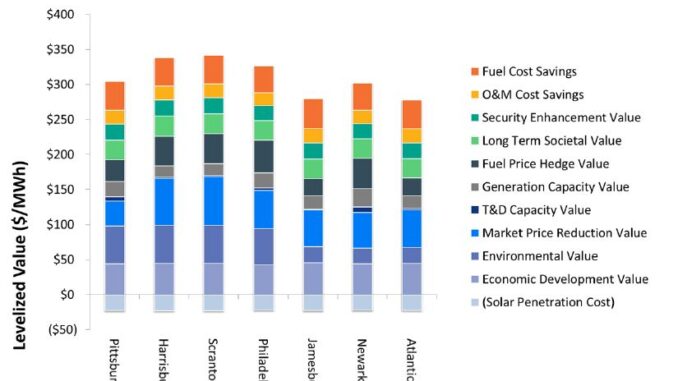
The Mid-Atantic Solar Energy Industries Association (MSEIA) and the Pennsylvania Solar Energy Industries Association (PASEIA) recently commissioned Clean Power Research to do a study released as The Value of Distributed Solar Electric Generation to New Jersey and Pennsylvania to estimate the economic value of photovoltaic (PV) solar power to utilities and elelctric power consumers.
The study involved six utilities in Pennsylvania and New Jersey, which had a combined peak load of 47 GW in 2011. New Jersey is the second largest solar market in the U.S. with 900 MW of solar capacity. New Jersey is also the first state to generate more than 1% of its annual electricity (currently about 1.5%) from solar energy.. Pennsylvania is in eighth place in the U.S. in installed solar PV capacity.
The study assumes a moderate assumption of penetration. PV is assumed to provide 15% of peak electric load, or about 8 GW of solar PV capacity. Load data and market pricing was taken from PJM for the six zones.
The study broke down the economic value of PV into several categories.
Fuel Cost Savings
Each kWh generated by PV results in one less unit of energy that the utility needs to purchase.
O&M Cost Savings
The utility saves O&M costs due to decreased use of the conventional thermal power generation plant.
Security Enhancement Value
Distributed PV energy improves overall system reliability by reducing the risk of power outages and rolling blackouts.
Long Term Societal Value
The study period is taken as 30 years. If the assumed life were 40 years instead of 30, the increase in total value is the long term societal value.
Fuel Price Hedge Value
PV generation provides a hedge against fossil fuel price fluctuation.
Generation Capacity Value
PV displaces the need for additional thermal power generation capacity.
T&D Capacity Value
PV potentially provides utilities with capital cost savings on transmission and distribution (T&D) infrastructure. PV is assumed to defer the need for additional T&D infrastructure.
Market Price Reduction
PV generation reduces demand reducing the cost of wholesale energy to all consumers.
Environmental Value
Environmental benefits include future savings for mitigating environmental damage (sulfur dioxide emissions, water contamination, soil erosion, etc.).
Economic Development Value
Distributed PV provides local jobs (e.g., installers) at higher rates than conventional generation.
Solar Penetration Cost
In addition to the value provided by PV, infrastructural and operational costs will be incurred to manage the flow of non‐dispatchable PV resources.
Economic value of solar power
In New Jersey and Pennsylvania utilities pay a premium for solar power in the form of Solar Renewable Energy Certificates (SRECs) which is passed on to ratepayers. SRECs in New Jersey currently cost about $60/MWh (6 cents per KWh),
and in Pennsylvania they cost about $20/MWh (2 cents per KWH).
The study found that solar power delivers a total levelized value ranging from $256 to $318 per MWh (25.6 cents to 31.8 cents per kWh) depending on location. This is $150 to $200 per MWh (15 cents to 20 cents per kWh), above the value of the solar electricity generated. The study concludes that electric ratepayers are getting more than a two to one return on their investment in solar energy.
The study concludes that distributed solar power delivers measurable benefits including
- Lower electricity market prices because of reduced peak demand
- Deferred costs of new transmission and distribution infrastructure because of distributed solar generation
- Reduced neeed for new natural gas generating plants
- Fewer outages outages because of a more distributed electric power system
- Reduced environmental costs
- Local job creation with better paying jobs than conventional power generation

Be the first to comment