
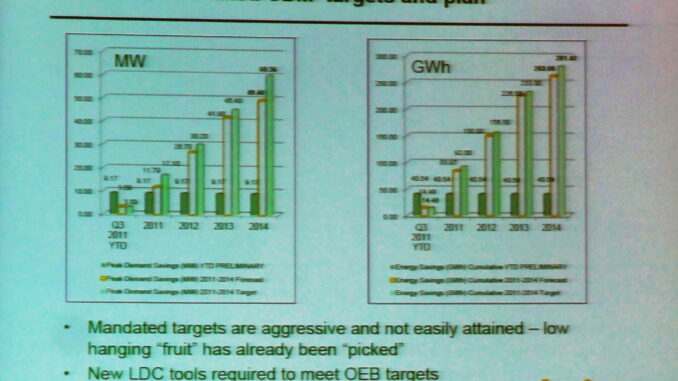
At EDIST Neil Freeman, Horizon Utilities Corporation, gave a very interesting presentation on using energy density mapping to help take the guesswork out of identifying customers on whom to target conservation and demand management (CDM) programs. Horizon is required to meet CDM objectives mandated by the Ontario Energy Board (OEB).
The OEB has establised hard targets for 2011-2014 for peak demand and energy consumption for each electricity distribution compnay (LDC) in Ontario. In the case of Horizon their objectives are to reduce peak demand by 5.6% and consumption by 4.9%. The mandated targets are aggressive and Horizon has found that it needs to look at new ways to identify customers with high energy footprints,
Horizon saw overlap between smart grid initiatives like CDM and the provincially mandated smart growth policy with which since 2001 all municipal development plans in the Province of Ontario must comply. Smart growth is designed to prevent sprawl, make cities more livable, reduce energy usage and get more value out of existing infrastructure. It typically involves downtown densification and greenbelts.
Energy density mapping
The part of the smart growth initiative that Horizon saw as relevant was energy usage reduction. In Calgary, the city where the smart growth approach was initiated, energy density was mapped using data provided by the gas and electric utilities. The data was aggregated at a relatively course level of granularity and expressed in terms of of gigajoules/hectare. In Ontario the Ontario Power Authority supported several municipal pilots that that took a similar approach and mapped energy usage at a fairly course level of aggregation.
Horizon decided that to identify the high energy usage customers on which to target their CDM programs they needed higher granularity, speicfically at the building and property level, expressed in units of kWh/m2.
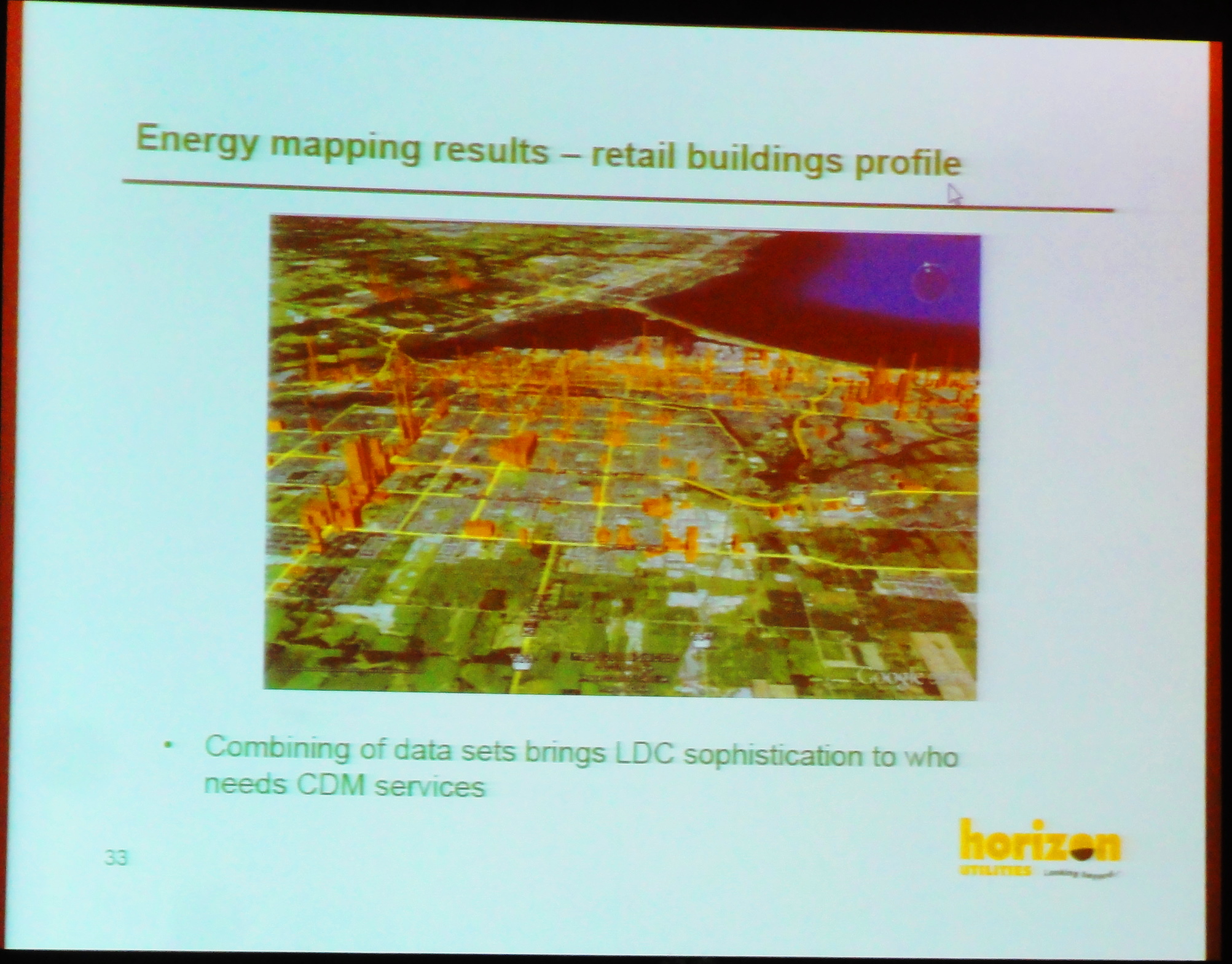 Horizon has partnered with public organizations including Municipal Property Assessment Corporation (MPAC), Teranet, and others. This provided them with detailed building and property information such as building age, sun exposure, heating type, air conditioning, and parcel data. They also partnered with NRCan/CanmetENERGY for standard metrics for different building types, with Environics for Prizm lifestyle profiles and data, and with Canadian Urban Institute. Horizon says they are aware that there are privacy issues and a part of the project is specifically to protect customer privacy.
They have found that energy density mapping at the building level has enabled them to succesfully target their CDM marketing as well as contribute to the broader objective of contributing to the sustainability of the municipalities with which they are working.

Be the first to comment