
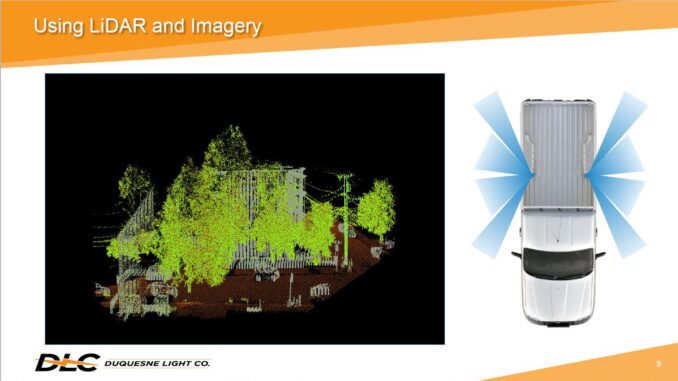
Duquesne Light is typical of many of North American small to medium electric power utilities. It does not have an outage management system or an electrical data model which means it is difficult to connect customers to transformers and to determine upstream devices when customers report power problems. It has become clear to Duquesne Light that an electric data model is essential for moving forward on modernizing their grid. At Distributech 2018 Jim Karcher, Manager, Operation Technology Projects at Duquesne Light Co. (DLC), gave an overview of a remarkable project that compared different approaches including reality capture and a traditional foot survey for developing an electric grid data model.
Duquesne Light still uses paper tickets for tracking outages and other problems. Currently Duquesne Light’s circuit maps are AutoCAD drawings. These drawings are designed to be used by electrical engineers and are not spatially correct. The reliance on AutoCAD drawings means that tracing from transformers to customers or from customers to controlling devices is a manual process. However, Duquesne Light is moving to modernize its grid. It has implemented distribution SCADA (DSCADA) and has over 1100 DSCADA controlled field sectionalizers, about 400 DSCADA controlled field capacitors and is implementing an AMI deployment which will be completed in 2019. And it plans to deploy and Advanced Distribution Management Systems (ADMS) including outage management (OMS), DMS and DSCADA. But the ADMS will require developing a complete distribution electrical data model.
A quarter of a century ago there were two ways to do this. Either walk the entire network and plot it on a USGS map or attempt to conflate the AutoCAD drawings onto a USGS basemap. Today’s technology advances have created new alternatives. One of these is to use modern reality capture, typically LiDAR and photo and infrared cameras with a GPS which can be mounted on a truck.
To compare alternative ways to create a grid data model Duquesne Light decided to run a pilot on about four of its circuits comprising a 100 miles of its distribution grid. Quantitative criteria were defined to allow comparison of cost, schedule, and electric data model accuracy of different approaches. Electric data model accuracy included location accuracy, phasing, ability to trace customers to transformers, asset inventory and attribution. The data model had to be captured in a form that was compatible with Duquesne Light’s GIS.
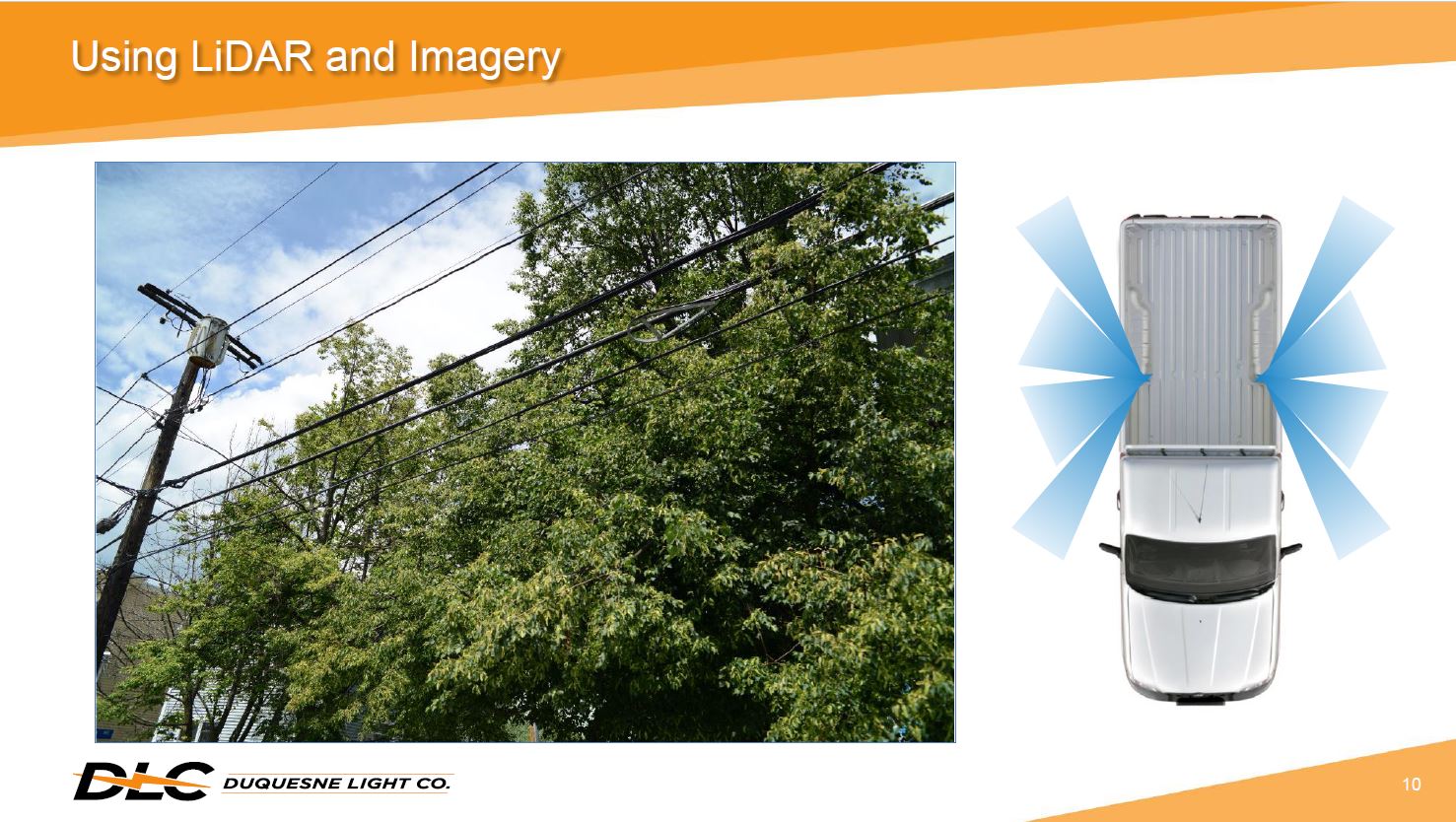 Reality capture was done with a pickup truck with side mounted photo and IR cameras and LiDAR laser scanners. Pictures were taken very second which enabled a 270 degree picture of each pole. Location accuracy was about a meter. To drive the entire 100m miles of distribution network required about a week.
When the model captured by reality capture was compare to the result of a traditional survey (on foot with a GPS), only one discrepancy was found that could be attributed to the reality capture approach. Comparison with other approaches revealed that the reality capture data provided the most geospatially accurate asset location data. The reality capture survey only required two Duquesne Light employees in the field for a week and at no time during the survey did they have to leave the truck – meaning that the survey was completed rapidly and safely. Actual development of the data model was completed in the office without the necessity of going to the field for quality checks because the imagery provided all the data that was required to create and verify the data model.
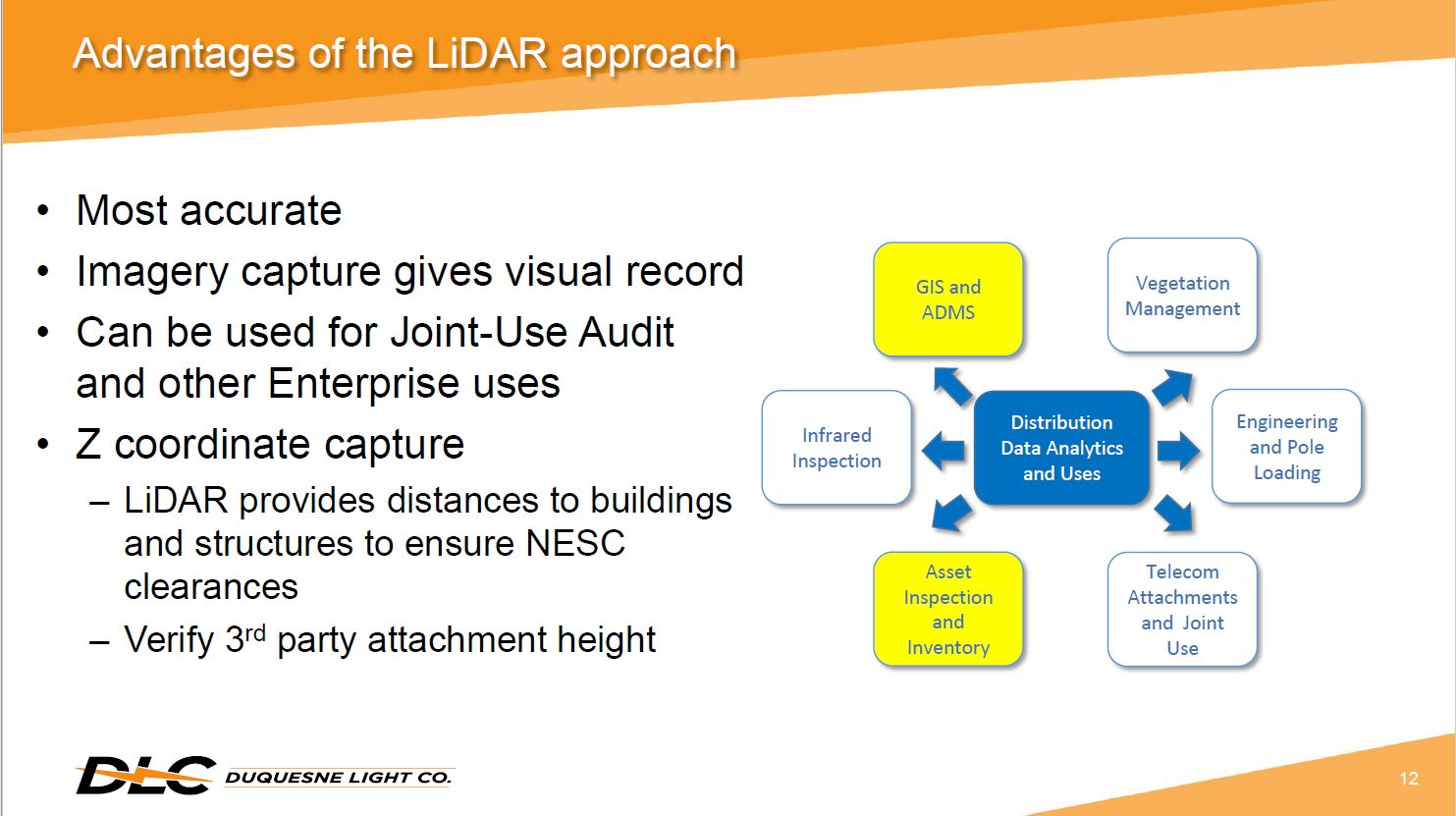 Duquesne Light found several significant advantages of the reality capture approach. The first was asset accuracy – both location and asset attributes. Reality capture provided a visual record that could be checked in the office obviating the need to go to the field. The captured imagery could be used for other purposes. It could be used for a joint-use audit. The LiDAR data allowed distances between poles and cables to buildings and structures to be accurately measured to ensure regulatory clearances and to verify third party attachment heights. The infrared imagery could be used to detect hot spots.
This is critically important because it shows that reality capture is a feasible alternative to a traditional foot survey. Duquesne Light has shown, based on a quantitative comparison of alternatives for developing a data model including a traditional foot survey, that reality capture provides a cost-effective and safe way to rapidly develop an accurate electric data model. It also concluded that reality capture also provides significant additional benefits.

Be the first to comment