
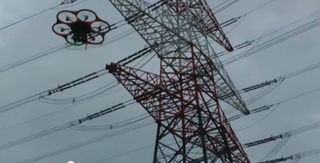
Over the past couple of years I have followed the regulation of the commercial use of UAVs in the U.S. In the back of my mind, I have always thought that the application where there would be a tremendous cost benefit from UAVs is monitoring transmission lines for vegetation management. Recently a utility in Southern California has begun flying UAVs to test the concept.
In general the operation of unmanned aerial vehicles (UAV) for commercial purposes is illegal in the U.S., but there are ways to gain FAA authorization to fly UAVs commercially:
- Section 333 Exemption – grants of exemption for UAVs to perform commercial operations in low-risk, controlled areas
- Special Airworthiness Certificate (SAC) – the design and construction of the proposed UAV must be described in detail as well as how and where it is intended to be flown.
The Federal Aviation Administration (FAA) has issued Section 333 grants of exemption for commercial UAVs for general aerial surveys (Trimble, Woolpert), construction monitoring, agriculture, on and offshore oil and gas inspections, and real estate.
In February of this year the FAA proposed to amend its regulations to adopt rules for the commercial operation of UAVs in the National Airspace System (NAS). The FAA has suggested some types of operations the proposed new rules would allow. These include “power-line/pipeline inspection in hilly or mountainous terrain.”
The FAA’s proposed rule would limit commercial UAV flights to daylight-only, visual-line-of-sight (VLOS) operations. The unmanned aircraft must remain close enough to the operator for the operator to be capable of seeing the aircraft with unaided vision. The UAV is not permitted to operate over any people not directly involved in its operation. Its maximum airspeed must be100 mph or less (87 knots). It cannot fly higher than 500 feet above ground level or above 18,000 feet of altitude. Minimum weather visibility is 3 miles from the control station. The UAV cannot be operated from a moving vehicle or aircraft. The UAV must weigh less than 55 pounds (25 kg). However, there does not appear to be any restriction on total flight time.
An operator of a UAV would be required to be at least 17 years old, pass an initial aeronautical knowledge test at an FAA-approved knowledge testing center, be vetted by the Transportation Security Administration, obtain an unmanned aircraft operator certificate with a small UAS (small unmanned aircraft systems) rating, and pass a recurrent aeronautical knowledge test every 24 months.
The FAA’s proposed rules would exclude long range UAVs such as the Silent Falcon, which is claimed to be the first UAV capable of meeting long endurance mission profiles typical of many commercial, civil, public safety, and other operations. Its daytime endurance is estimated to be 5 to 12 hours depending on wing configuration, weather, and flight profile.
According to a report in Greentech Media, in July of this year San Diego Gas & Electric (SDG&E) became the first utility in the country to begin a pilot program under a FAA Special Airworthiness Certificate. SDG&E plans to fly a pair of UAVs along a half-mile-wide, 2.5-mile-long stretch of transmission line right-of-way in remote eastern San Diego County. The objective is to demonstrate that UAVs are safe and effective and could replace helicopter flights for transmission line monitoring including vegetation management. Replacing helicopter flights, which are typically thousands of dollars per hour, with a UAV would dramatically reduce the cost of vegetation management for transmission lines.
SDG&E appears to be operating its UAVs within the rules proposed by the FAA in February. According to Greentech Media, SDG&E is operating its UAVs with the line-of-sight rule. Each UAV is always in sight of the pilot flying it and the pilot is not in a moving vehicle. The current transmission line being used for the test is in a remote, unpopulated area where there is little risk of the UAV flying over people not involved in operating it.

Be the first to comment